布製ランプシェード:種類、素材、正しい選び方

目次

A fabric lampshade is a textile-covered wire frame that diffuses bulb light into warm, even illumination, softer than glass and far more customizable in colour, pattern, and texture.

Stand in any lighting aisle long enough and the options start to blur: drum shades in a dozen neutrals, empire shades trimmed with fringe, pleated silk cones that look like they belong in a 1920s hotel suite. The problem isn’t a shortage of fabric lampshades. It’s that nobody explains what actually separates a good one from a frustrating one. Wrong opacity and you’re reading in shadows. Wrong size and the shade dwarfs your lamp base. Wrong fabric and you’re replacing it in eighteen months because it’s faded, saggy, or singed at the liner.

This guide covers it, fabric by fabric and shape by shape.


What are fabric lampshades?

Fabric lampshades use a stretched textile outer skin (and usually an inner liner) to diffuse and warm the light from a bulb, turning a bare point source into a broad, even glow. Unlike glass, which transmits light with relatively little scattering, fabric absorbs some wavelengths and scatters others. The result is softer, more directional output that makes a room feel inhabited rather than interrogated.

How fabric diffuses light compared to glass or paper

The physics is simple, but the effect is real. A glass shade with even a light frost scatters light across roughly a 120° arc; a tightly woven linen shade does similar work, but the textile structure creates micro-shadows and warm tones that change the character of the light entirely. Translucent fabrics like silk and fine cotton let 60–80% of the light pass through the shade body, making the shade itself glow. Opaque fabrics (velvet, thick burlap) block most side-emission and push light out the top and bottom openings, creating uplighting and a pool of task light beneath.

That distinction matters more than most buyers realise. Want ambient, all-round warmth? You need semi-translucent fabric. Want drama and directionality? Go denser. The 照明工学協会 classifies luminaires partly by this distribution pattern, and fabric lampshades fall across nearly every category depending on material weight.

Anatomy of a fabric lampshade

Every fabric lampshade has three working parts: the frame (steel wire or coated aluminium ring sets), the fitter (the spider, clip, or uno fitter that connects shade to lamp or bulb socket), and the covering (outer fabric plus, usually, an inner liner). The liner, typically white or cream PVC, polycotton, or styrene, has two jobs: reflecting light outward and stopping the outer fabric from showing hot spots or wire shadows through a thin weave. On cheaper shades, the liner is skipped. You’ll notice.

Understanding the same construction vocabulary behind ガラスランプシェード helps here: both categories share the same fitter and frame language, just different surface materials.

生地ガラスPaperMetal
光の拡散Warm, scattered, softNeutral to cool, harder-edgedWarm, moderate scatterMinimal (mostly directional)
耐熱性Depends on fabric (see Section 5)高い低い非常に高い
耐久性5–15 years with care10–20+ years2~5年20+ years
CustomizationVery high (fabric, trim, colour)限定中程度低い
Typical price range£15–£400+£20–£300+£5–£80£20–£250

Fabric lampshade shapes explained

Shape determines how light distributes through a room, and whether the shade actually fits your lamp base proportionally. Get the shape wrong and even an expensive fabric shade looks awkward. It also determines which fabric choices make sense: pleated fabric only works on tapered silhouettes, and certain open-weave textiles need the right geometry to avoid looking shapeless.

Drum and cylinder shades: clean and contemporary

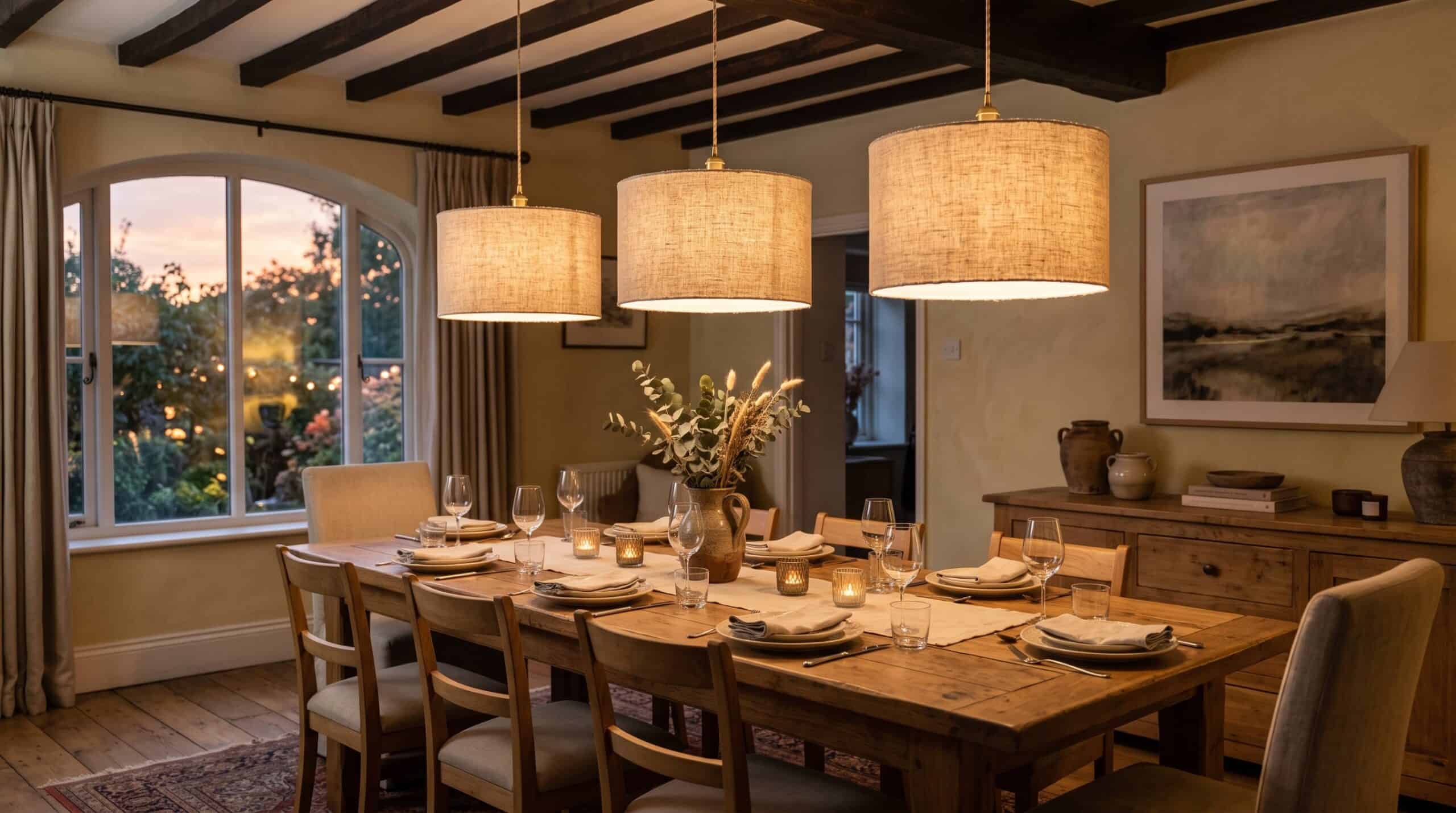
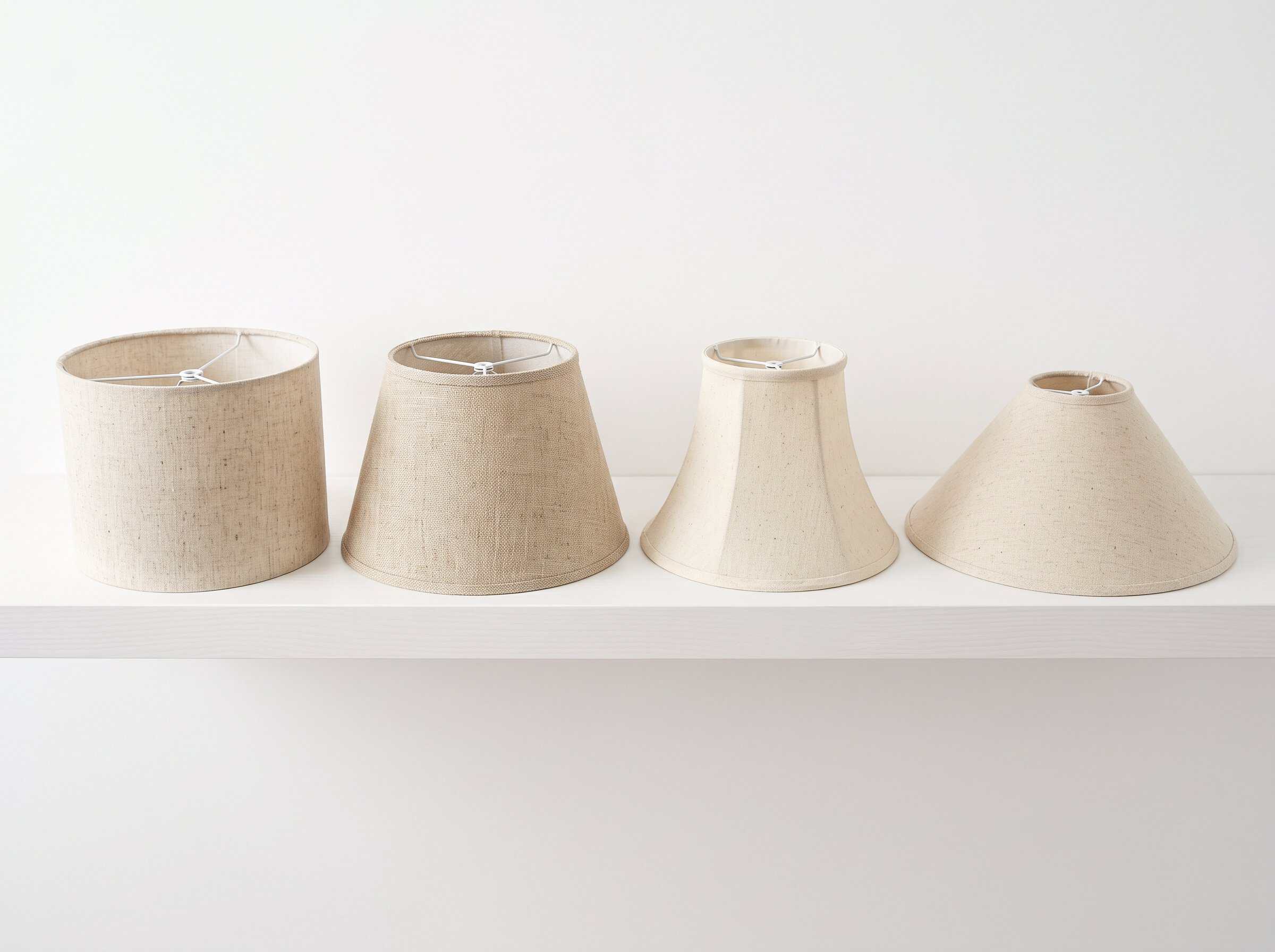
The drum shade is the default choice for contemporary interiors: equal-diameter top and bottom rings, straight vertical sides. Light exits evenly from top and bottom openings, and the cylindrical body glows if you choose a semi-translucent fabric. Drums suit floor lamps with long vertical bases, pendant installations with statement canopies, and table lamps with geometric ceramic or metal bases.

One sizing note that trips people up: for a table lamp, the drum shade’s height should typically be about two-thirds of the lamp base height above the table surface. A 45 cm base takes a 30 cm tall drum shade. Going taller looks top-heavy; going shorter looks like a hat.

Empire and bell shades: tapered and traditional

The empire shade tapers from a narrow top ring to a wider bottom ring, the classic lampshade silhouette that most people picture when they close their eyes. It pushes more light downward than a drum, which makes it better for task areas and traditional, formal rooms. Bell shades are a variant with a gently curved taper that flares slightly at the bottom; coolie shades take the taper to its extreme, with a very wide base and a tiny top ring, sometimes only 5 cm across.

For fabric, empire shades are where pleated construction earns its keep. Tight vertical pleats running top to bottom create a refined texture that catches light differently across each pleat face. Pleated fabric empire shades are standard in hotel room bedside lamps for exactly this reason: they look deliberate and refined without being fussy.

Coolie, pleated, and specialty silhouettes

Coolie shades have a very wide bottom (sometimes 50–60 cm) and that tiny top ring. The extreme taper focuses light into a broad, low wash: good for atmospheric accent lighting, almost useless as task light. Oval shades work on oval or rectangular bases and look intentional rather than mismatched. Scallop-edge and fringe-trimmed shades are vintage or maximalist statements. At that point, the fabric choice matters less than the proportions and trim finish.


形状Best fixtureRoom styleBottom diameter rule
ドラム型Floor lamp, pendant, table lampContemporary, Scandinavian, industrialapprox. lamp base height x 1.0–1.2
エンパイア型Table lamp, floor lampTraditional, transitional, classicapprox. lamp base height x 1.5–2.0
ベルTable lamp, buffet lampCountry, vintage, French provincialapprox. lamp base height x 1.4–1.8
クーリーAccent table lampBohemian, maximalist, retroapprox. lamp base height x 2.0–2.5
OvalOval or rectangular base lampsModern, architecturalMatch base width ratio
プリーツ加工Bedside, hotel lampsFormal, hospitalityapprox. lamp base height x 1.5–1.8

Best fabrics for lampshades: a material comparison

This section compares materials used on finished shades. For weave, backing, light diffusion, frame compatibility, quantity calculations, and supplier specifications, use the lampshade fabric material guide.

Most buying guides list fabric names without explaining what each one actually does to the light or how long it will last in real use. Here is the breakdown that actually helps.

Linen and cotton: the reliable all-rounders

Linen is the workhorse of fabric lampshades. It’s naturally semi-opaque, so light passes through without showing a harsh bulb silhouette. It handles heat well: linen ignites at around 200°C, well above what a correctly-wattaged LED or CFL bulb will produce at the shade surface. It holds colour without fading badly under artificial light over time. A linen drum shade over a 9W LED looks fresh for a decade. That’s not marketing; that’s what we see from well-made shades in everyday residential use.

Cotton behaves similarly but tends toward slightly more translucency when woven loosely. Muslin-weight cotton glows beautifully. It also runs cheaper. Cotton/polyester blends are common in mid-range shades: more resistant to wrinkling, slightly less breathable, which matters marginally for heat dissipation. The catch with both linen and cotton: they show dust and staining more readily than synthetic fabrics. Since most shade fabric is glued to its liner, dry-clean-only in construction, spot-cleaning is your only realistic maintenance option.

Silk and faux-silk: warm glow, formal feel

Real silk is the premium choice for traditional and formal interiors. Light through natural silk takes on a distinctive amber warmth. The fibre’s protein structure absorbs blue wavelengths slightly, warming the output in a way that bulb temperature selection alone can’t fully replicate. Pleated silk empire shades in hotel lobbies are doing exactly this: compensating for the slightly cooler colour temperature of modern LED arrays by letting the fabric warm the transmission. According to Wikipedia’s overview of lampshade history, silk and fine cotton have been the fabric of choice for formal interior lighting since the early 20th century, a preference that still holds in luxury settings today.

The downsides of real silk are real. It degrades faster at sustained temperatures above 120°C. It fades under prolonged UV exposure, so keep fabric shades away from south-facing windows. And it’s expensive: quality silk shades run £80–£300+. Faux-silk (polyester satin) solves the cost problem but introduces another. Synthetic fabrics have lower ignition points and can melt rather than char when overheated. With LED bulbs below 10W this is rarely a practical risk, since LED surface temperatures are far lower than incandescent, but verify your wattage rating on the label before fitting.

Velvet, burlap, and printed designer fabrics

Velvet fabric lampshades are having a moment in 2026, driven partly by maximalist interior trends and partly because velvet on a drum shade photographs exceptionally well. The pile creates directional light-play: a velvet shade lit from inside looks completely different at different viewing angles. Practically, velvet is opaque enough that almost no light escapes through the shade body. All output exits top and bottom. Poor choice for ambient fill; excellent choice for a statement accent.

Burlap and jute are the rustic counterpart. Woven loosely enough to allow significant light pass-through, they create a warm dappled effect. Forgiving, cheap, and sustainable when naturally sourced, but they fray at cut edges and liners are almost essential to prevent a ragged interior appearance.

Printed and designer fabrics, including wallpaper-lined shades and block-printed cottons, are increasingly available from specialist suppliers. The trade-off: bold patterns can fade unevenly, and liner adhesive may react differently to ink and dye treatments. Always ask suppliers specifically about UV and heat stability when sourcing printed fabric lampshades for commercial projects.

生地OpacityMax safe wattage (incandescent equiv.)お手入れApprox. cost per yard最適な用途
リネンSemi-opaque60W (LED: 9W)部分的に拭き取る£8–£25Everyday residential, commercial
Cotton / blendSemi-translucent60W (LED: 9W)部分的に拭き取る£5–£18Budget residential, DIY
Real silkTranslucent to semi-opaque40W (LED: 6W)Dry clean only£30–£120Formal, luxury, hotel
Faux-silk (polyester)Translucent40W (LED: 6W)部分的に拭き取る£6–£20Mid-range residential
ベルベット不透明25W (LED: 4W)Spot clean carefully£15–£50Accent, decorative
Burlap / juteOpen-weave / translucent60W (LED: 9W)部分的に拭き取る£4–£15Rustic, farmhouse
Printed designer fabric様々様々Dry clean only£20–£150+Statement, bespoke

Where fabric lampshades work best: industry applications

Fabric lampshades run the full range from a £12 cotton drum at a flat-pack furniture retailer to hand-pleated silk shades that take a skilled maker six hours each. The application usually determines where you land on that spectrum, and understanding the commercial use cases helps residential buyers understand what “quality” actually means in this category.

Hospitality: hotel and restaurant lamp shades at scale

Hotels are the single highest-volume buyer of fabric lampshades at the mid-to-premium tier. The standard hotel bedside lamp uses a pleated empire or drum shade in cream or ivory fabric, chosen for three practical reasons: fabric diffuses light softly enough for an intimate, warm atmosphere; pleating is durable (the fabric surface flexes slightly rather than cracking the way painted rigid shades can); and fabric shades are straightforward to specify with consistent Pantone-matched dye lots when ordering 500–1,000 units for a single refurbishment.

私たちの hotel lamp shades guide covers the full procurement picture, but for fabric specifically: linen and cotton blends are the hospitality standard. They’re surface-cleanable enough for 5–7 year replacement cycles, available in B2B minimum order quantities as low as 50 units, and they wear consistently across the unit count. Restaurants often push further into statement fabrics: velvet jewel tones in a cocktail bar, open-weave burlap in a farm-to-table dining room. The restaurant lampshade guide covers atmosphere and lumen output by zone in more depth.

Home interiors: table lamps, floor lamps, pendants

Residential fabric lampshade buying has shifted noticeably. Where 2022–2023 saw a glut of plain white linen drum shades driven by Scandinavian-minimal aesthetics, 2026 buyers are more willing to commit to colour: printed block patterns, textured boucle, ribbed pleated cotton. The shade itself is now often a deliberate statement rather than a neutral background.

For table lamps, the most-purchased fabric shade is still a 30–40 cm empire or drum in cream linen or cotton. It reads as a tasteful neutral in almost any interior. For floor lamps, drum shades in the 45–55 cm range dominate. Pendant fabric shades over dining tables are where you see the most experimentation. This is where people take risks with colour that they won’t take with a lamp base they’ve owned for years.

B2B and trade sourcing: MOQs, lead times, custom options

If you’re sourcing fabric lampshades for a design project or a retail range, the key numbers: most specialist manufacturers in China offer minimum order quantities of 50–200 units per SKU at the stock-fabric level. Custom fabric, your specified material and colour, typically requires 200+ units to be cost-effective. Custom frame geometry usually adds 8–12 weeks to lead time. Factories that offer both stock frames and stock fabric combinations can turn B2B orders in 3–5 weeks.

How to choose a fabric lampshade: size, opacity & safety

Get the size right, choose opacity for the mood you want, and verify the heat rating before fitting. Those three things cover the vast majority of buying mistakes.

Sizing: the base-to-shade ratio that actually works

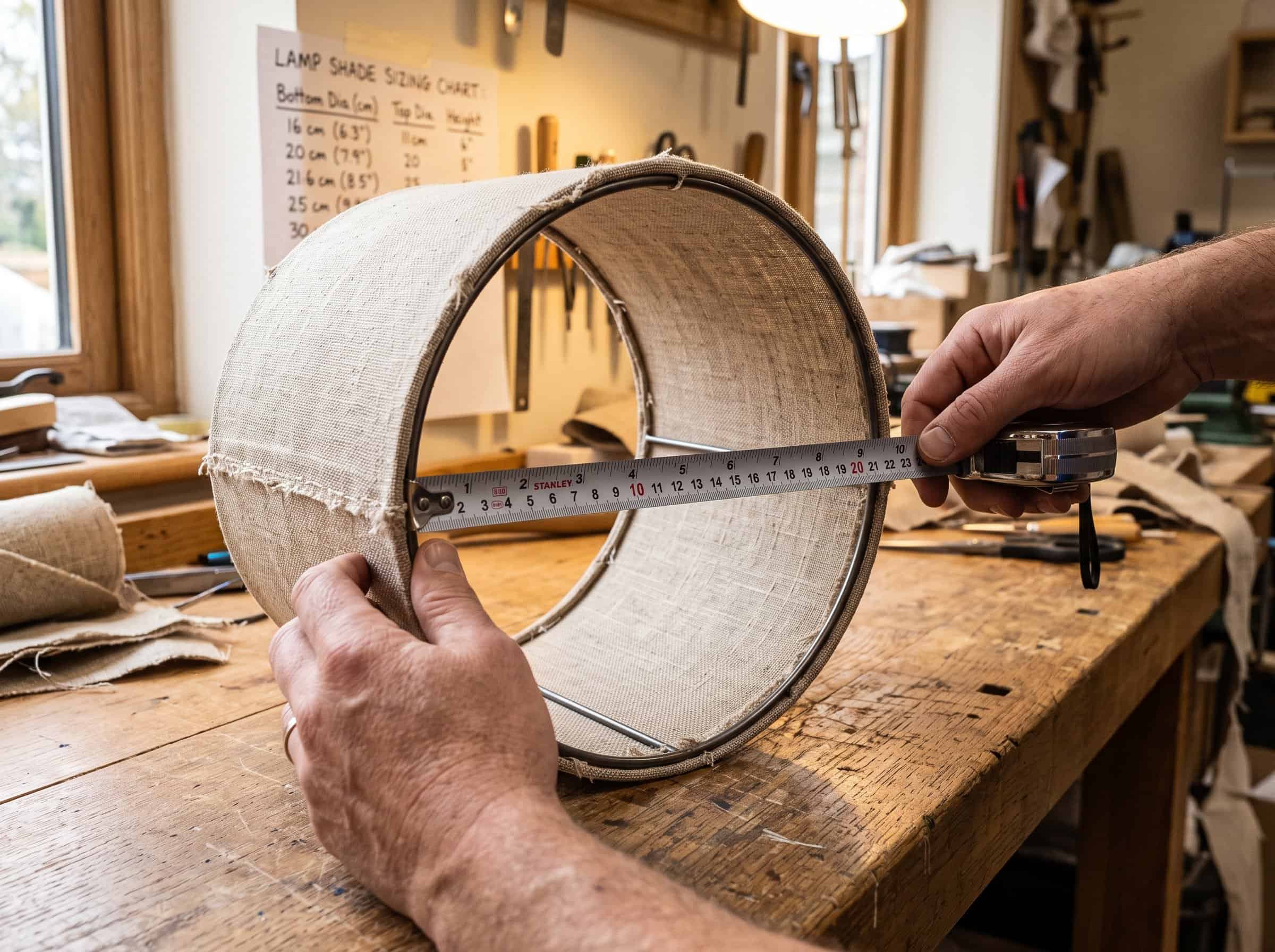
Most lampshade regret comes from buying too small. The rule that works reliably: the bottom diameter of the shade should approximately equal the height of the lamp base, measured from table surface to the light socket, not to the top of the finial.

A base 30 cm tall takes a bottom shade diameter of 28–32 cm. A 45 cm base takes 42–48 cm at the bottom. For empire shades, the slant measurement (the diagonal from top ring to bottom ring edge) should also roughly equal the base height. For a full breakdown of top diameter, bottom diameter, slant, and spider-to-top clearance across every shade type, the ランプシェードのサイズガイド has the complete chart.

Shade height matters too: ideally the bottom of the shade sits at or slightly above eye level for a seated person, to avoid direct glare into the bulb opening. For a lamp on a side table beside a sofa, that typically means the shade bottom is 90–100 cm from the floor.

Fabric opacity and colour: what the light actually looks like

Fabric opacity determines whether the shade body glows or whether light only exits from the top and bottom openings. This is the distinction that disappears in most product descriptions.

Semi-translucent fabrics (thin cotton, fine linen, gauze) make the shade body glow warmly, giving you a soft lantern effect and even ambient light throughout the room. Semi-opaque weight (medium linen, regular cotton) gives slight body glow with stronger light from the openings; this is the most commonly sold weight and the most versatile. Opaque fabrics (velvet, thick cotton, double-lined shades) produce no glow from the body at all: just defined pools of up- and downlight. More dramatic, less ambient.

Fabric colour has an underrated secondary effect. A cream or ivory liner warms the outgoing light considerably, which is the classic hotel amber warmth. A white liner keeps it neutral. A coloured liner tints the light that passes through: a blush pink lining casts a warm rose wash across the room. Subtle, but buyers who’ve lived with it will either love or regret it.

Heat safety: fire ratings, wattage limits, LED vs incandescent

This is the one area where most buyers don’t ask enough questions, and where it genuinely matters.

In the UK, domestic fabric lampshades sold as household furnishings fall under the Furniture and Furnishings (Fire Safety) Regulations, which set minimum flammability performance standards for covered items. Quality UK-sold fabric shades should meet these requirements, worth checking before purchasing from unverified import sources.

What this means practically:

  • Always match bulb wattage to the shade’s rated maximum. A “max 60W” label means 60W incandescent. The LED equivalent is 8–9W and runs far cooler. If your shade is rated max 40W incandescent and you fit a 6W LED, you’re operating well within thermal limits.
  • Never exceed the stated wattage with incandescent or halogen. The issue is sustained internal shade temperature, not peak brightness. A 100W incandescent generates significant radiant heat; fabric directly above the bulb can sustain temperatures above 150°C over time, above the safe threshold for most synthetic fabrics.
  • LED bulbs are the right choice for fabric shades. A 9W LED produces roughly 800 lumens (equivalent to a 60W incandescent) at a fraction of the heat output. For velvet and faux-silk especially, materials with lower heat tolerances, LED is the only sensible option.


Fabric lampshade trends (2026 & beyond)

The market is being reshaped by a few converging forces right now: sustainability pressure from buyers, demand for custom production, and a broader shift toward bolder pattern. They’re not competing with each other. They’re all moving in the same direction.

Sustainable and natural fibres going mainstream

The most notable supply-chain shift in the past two years is the move toward GOTS-certified organic cotton, undyed natural linen, and recycled fabric blends. Buyers in the EU and UK are increasingly requesting material origin documentation from their suppliers, driven partly by environmental reporting requirements and partly by measurable consumer preference shifts across the home furnishing category. The Global Organic Textile Standard (GOTS) has become the reference certification for trade buyers specifying natural-fibre lampshade fabrics.

For lampshade-specific fabric, this means more suppliers now offer undyed and naturally-dyed linen as a standard line option, not a bespoke upcharge. Jute and seagrass weaves, previously niche, are stocked by mid-market wholesale suppliers alongside their standard cotton/poly lines. One practical note for trade buyers: natural undyed fibres can have slight colour variation batch-to-batch. If you’re specifying undyed linen for a large hotel project, request a batch sample and build a colour tolerance into your specification.

Mass-customization and designer collaboration demand

The second shift is demand-driven: buyers want fabric lampshades that aren’t available off-the-shelf. Custom shade manufacturers, particularly in China, Portugal, and Poland, have brought minimum order quantities for bespoke fabric shades down considerably in the last three years, making custom lampshades viable for smaller hotel boutiques, independent interior designers, and premium residential projects.

Digital print-on-fabric technology has extended this further. Printed shades can now be produced with photographic-quality designs rather than just flat colour or simple repeating patterns. A boutique hotel that wants its shade fabric to echo a custom wallpaper design can now do that in runs as small as 50 units, with 10–14 week lead time from approved artwork to delivery.

トレンド要因Impact for buyers
Sustainable / natural fibresConsumer preference + EU/UK regulationAsk suppliers for GOTS cert or fibre origin; expect 10–25% price premium
Low-MOQ bespoke customizationDigital print + lean manufacturingCustom shades viable from 50–100 units; 8–14 week lead time
Maximalist pattern and colourPost-minimalism interior shiftPrinted cottons and block-print linens in strong demand; bold colour now available off-shelf
LED-first designEnergy regulation + heat safetyShade liners being optimised for LED colour temperature (3000K warm white standard)
Pleated revivalHospitality spec + vintage influencePleated drum and empire shades gaining share vs plain drum in hotel and boutique sectors

FAQ: fabric lampshades

ランプシェードに最適な布素材は何ですか?

Linen is the best all-round choice for most applications. It’s semi-opaque, heat-tolerant at normal LED wattages, durable for 8–12 years with normal use, and available in a wide range of weights and colours. For formal or hotel settings, pleated silk or faux-silk is the premium choice. For a rustic or casual look, loosely woven cotton or burlap works well. Linen covers about 80% of use cases and rarely disappoints.

布製ランプシェードは火災の危険がありますか?

Not when used correctly. The key variables are: the bulb wattage must stay within the shade’s rated maximum; the bulb must not be in direct contact with or very close to the shade interior; and the fabric should meet relevant fire safety standards. With LED bulbs, which generate far less heat than incandescent at equivalent lumen output, the risk is lower than it has ever been. Quality UK-sold fabric lampshades comply with the Furniture and Furnishings (Fire Safety) Regulations, which set minimum flammability performance requirements.

Can you put a fabric lampshade in a washing machine?

Almost never. Most fabric lampshades are constructed with the fabric glued to a styrene or PVC liner. Immersing them in water dissolves the adhesive and warps the liner permanently. Spot-clean with a barely damp cloth for minor marks. For dust accumulation, use a dry soft brush or a low-suction vacuum with a brush attachment. The only exceptions are unlined fabric shades (uncommon, typically handmade) where the maker has confirmed the construction is water-safe.

How do I measure a fabric lampshade?

Three measurements matter: top diameter, bottom diameter, and slant height (the diagonal from top ring to bottom ring edge). When replacing an existing shade, measure all three from the old shade before you dispose of it. When selecting a new shade for a lamp, match the bottom diameter to approximately the lamp base height. Full sizing charts and fitter compatibility guidance are in the ランプシェードのサイズガイド.

What’s the difference between a drum and an empire fabric lampshade?

A drum shade has equal top and bottom ring diameters with straight vertical sides. Light exits evenly from both openings. An empire shade tapers from a smaller top ring to a wider bottom, pushing more light downward. Drums suit modern and minimalist interiors; empire shades suit traditional and formal rooms. Both shapes work across every fabric category, though pleated fabric looks its best on empire and bell silhouettes where the taper lets the pleats read clearly.

Can fabric lampshades be used with LED bulbs?

Yes, and LED bulbs are strongly preferred for fabric shades. LED runs significantly cooler than incandescent at equivalent lumen output, reducing thermal stress on the fabric, the liner adhesive, and the frame coating. A 9W LED producing 800 lumens generates a fraction of the surface heat of the 60W incandescent it replaces. For faux-silk and velvet shades, which have lower heat tolerances, LEDs are effectively required for long-term shade life.

Where can I buy wholesale fabric lampshades?

Wholesale fabric lampshades are available from specialist manufacturers in China (many with B2B trade portals and tiered pricing), UK-based trade suppliers, and manufacturers offering both stock and custom production. For commercial volumes of 50 units or more, sourcing directly from a manufacturer rather than through a wholesale intermediary typically saves 30–50% on unit cost. Browse the ランプシェードコレクション to see trade-friendly options, or request a B2B price list directly.


Choosing your fabric lampshade

Get the size right first: bottom diameter roughly equal to lamp base height. Then choose fabric opacity for the light quality you want (semi-translucent for a lantern glow, opaque for directional drama), and pick a shape that suits both your fixture and your room’s direction. Fit an LED bulb within the shade’s wattage rating and heat safety stops being a concern.

From there it’s a design decision. Whether you need pleated silk shades for a hotel refurbishment, a printed linen pendant for above a kitchen island, or a straightforward linen drum to replace the one that’s been looking tired for two years, the options in 2026 are better than they’ve ever been. Start with size, get the proportions right, and the rest is just taste.

関連記事

共有する:
JXランプシェード技術チーム

JXランプシェード技術チーム

ガラスランプシェード技術エンジニア/技術コンテンツスペシャリスト

ガラスランプシェードプロジェクトのための技術的な内容サポート(ガラス素材の選定、成形プロセスの指導、表面処理の提案、耐熱性の考慮、品質検査のポイント、カスタム照明部品の応用を含む)。.

<?php return ob_get_clean(); }add_shortcode('jx_lampshade_engineer_card', 'jx_lampshade_engineer_card_shortcode');

関連記事:

よくある質問

塩城晶新ガラス製品株式会社は、専門的なガラスメーカーです 1999年に設立されました。自社の生産拠点とオフィスエリアは48,430平方フィート(約4,500平方メートル)以上あり、設計、製造、品質管理、輸出サービスを統合しています。.

幅広い種類の製品を製造しています。 オーダーメイドガラスランプシェード  吹きガラスランプシェード、機械プレスガラスランプシェード、ホウケイ酸ガラスランプシェード、遠心ガラスランプシェードなどを含みます。OEMおよびODM生産に対応しており、様々な用途や業界向けに提供しています。.

はい、当社は完全なOEMおよびODMカスタマイズサービスを提供しています 含まれる内容:

  • カスタム製品設計およびエンジニアリング
  • 社内金型開発
  • ロゴ印刷およびブランディング
  • 表面処理および仕上げ
  • カスタマイズされたパッケージングソリューション

はい、当社のデザインチームはお客様のコンセプトからカスタムガラス製品を開発できます。. お客様のアイデア、参考サンプル、または機能要件に基づき、専門的なデザインサービスを提供します。技術図面は不要です。.

当社のプロセスは量産前に品質を確保します。

お客様によるデザイン確認

自社施設での金型開発

承認用サンプルの製作

お客様によるテストとフィードバック

最終サンプル承認後のみ量産を開始します

私たちは提供します 安全な国際配送のための包括的なカスタムパッケージ:

  • 保護用の内側梱包材
  • 輸出用グレードの段ボール箱
  • カスタムカラーボックスと小売用パッケージ
  • ラベル印刷とブランディング
  • 国際配送基準に合わせて設計されたパッケージ
  • 各生産段階での検査
  • 科学的な品質管理手順
  • 各ロットの出荷前検査
  • 国際輸出基準への準拠
  • 認証された品質管理システム

私たちは運営しています 経験豊富な作業員による複数の生産ライン, これにより、あらゆる規模の注文に対して安定した大量生産が可能です。私たちの施設は、小ロットから大量注文まで、一貫した品質と信頼できる納期を保証します。.

リードタイムは複雑さや数量によって異なります:

  • サンプル生産:通常2~4週間
  • 量産:サンプル承認後にスケジュールされます
  • 具体的な納期はご注文内容に基づきご案内いたします

当社は日本を含む全世界120以上の国と地域に輸出しています, 例として:

  • 日本(日本国内)
  • ヨーロッパ(イギリス、ドイツ、フランスなど)
  • アジア太平洋市場
  • 中東
  • アフリカ
  • オセアニア(オーストラリア、ニュージーランド)

当社は包括的なグローバル流通ネットワークを維持しています。.

見積もり依頼 一緒に働く準備はできていますか?私たちとプロジェクトを作りましょう!

見積もり依頼
トップへスクロール
見積もり依頼