# Replacement Glass Globes for Ceiling Lights: Fitter Sizes Explained
Replacement glass globes for ceiling lights are sized by their fitter neck diameter – most commonly 3-1/4 inch (82.5 mm) or 4 inch (101.6 mm) – and attach to the fixture via three thumb screws. Measure the fitter opening before ordering, not the globe’s outer diameter.
A ceiling-light replacement globe should be a 20-minute purchase. In practice it routinely takes a homeowner three orders, two returns, and one frustrated email to get right. The reason: nobody measures the fitter correctly the first time. They measure the globe’s outer diameter (which is irrelevant), order a “close enough” replacement, and the new globe doesn’t fit the existing bracket.
This guide explains exactly how to measure a ceiling-light fitter, what the standard sizes are, which globe shapes work in which fixtures, and how to avoid the three mistakes that cause 90% of returned replacement orders.
What “Fitter Size” Means and Why It’s the Only Measurement That Matters
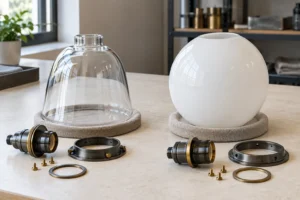
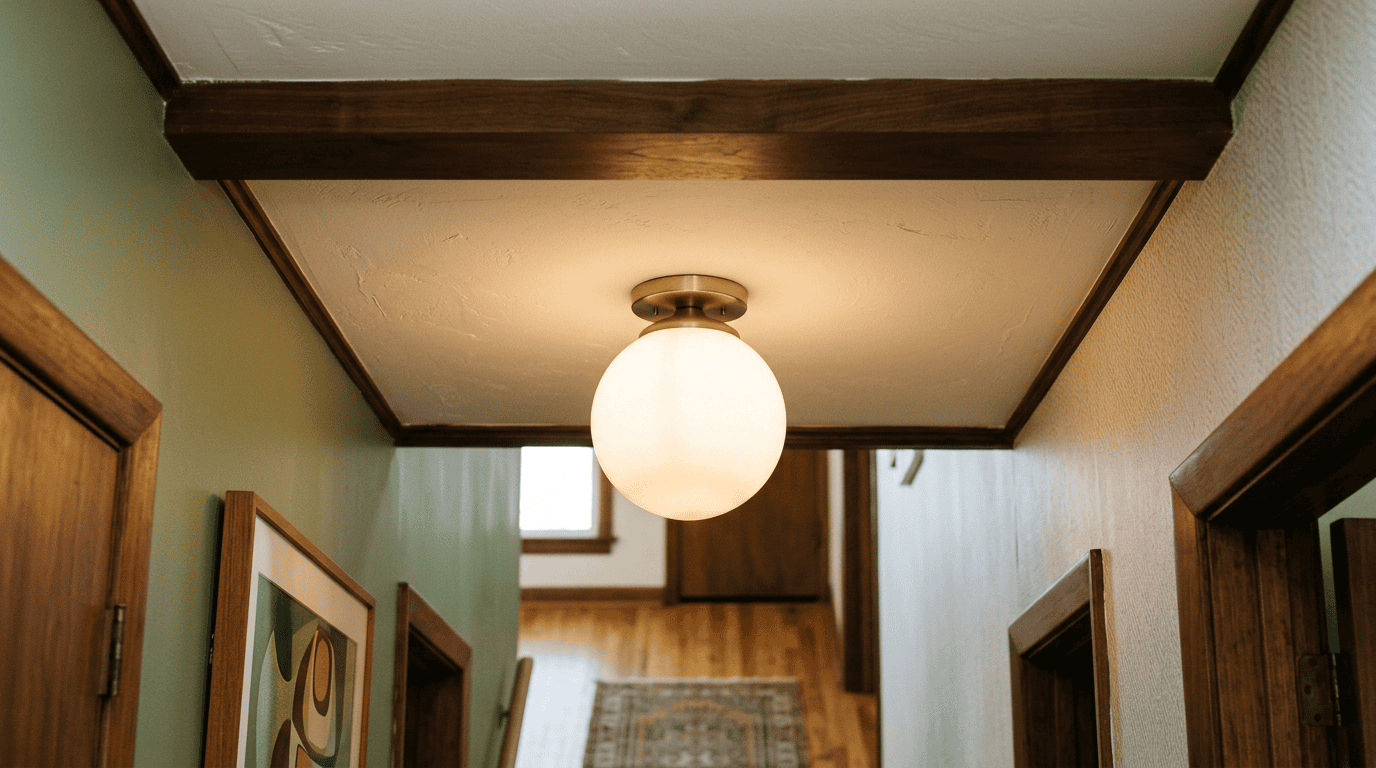
A ceiling-light fitter is the mechanical neck on the underside of a flush-mount or semi-flush ceiling fixture that holds the glass globe. It looks like a small ring of metal protruding from the fixture’s body, with three thumb screws threaded in around its circumference. The thumb screws press inward against the rim of the glass globe, holding it in place against gravity.
The fitter neck inner diameter is the only measurement that matters when ordering a replacement. Everything else – globe shape, height, finish – is your aesthetic preference. The fitter is mechanical: if it doesn’t fit, the globe physically cannot install.
In North America, the standardized sizes are:
- 3-1/4 inch (82.5 mm) – most common in older flush-mount fixtures, dome closets, and small hallway ceiling lights
- 4 inch (101.6 mm) – the dominant size in modern flush-mount ceiling lights, semi-flush fixtures, and small pendants
- 6 inch (152.4 mm) – large flush-mount center-room fixtures, larger pendants
- 7-1/2 inch (190.5 mm) – oversize flush-mount fixtures and chandelier center bowls
In the UK and Europe, the equivalents are typically metric: 80 mm, 100 mm, 150 mm, 200 mm. These are close enough to the imperial sizes that occasional cross-fitting works, but the safer pattern is to spec to the manufacturer’s stated metric or imperial measurement explicitly.
Why retail listings often confuse buyers
When you browse online, listings show outer diameter of the globe (because that’s what the photograph captures) – not the fitter size. A “6 inch glass globe” might have a 3-1/4 inch fitter neck or a 4 inch fitter neck or a custom size. You can’t tell from the outer diameter alone.
The result: shoppers buy “6 inch globe” expecting it to fit a “6 inch fixture” (where 6 inch refers to globe outer diameter for one product and fitter size for the other). Roughly 30-40% of returned replacement globes trace to this confusion.
Always look at the listing for a stated fitter size number – never the outer diameter. If the listing doesn’t specify the fitter, message the seller before ordering.
How to Measure Your Existing Fitter
You need three numbers and one photograph.
What you need
- Measuring tape (in millimeters, ideally)
- Camera or phone
- 5 minutes
The procedure
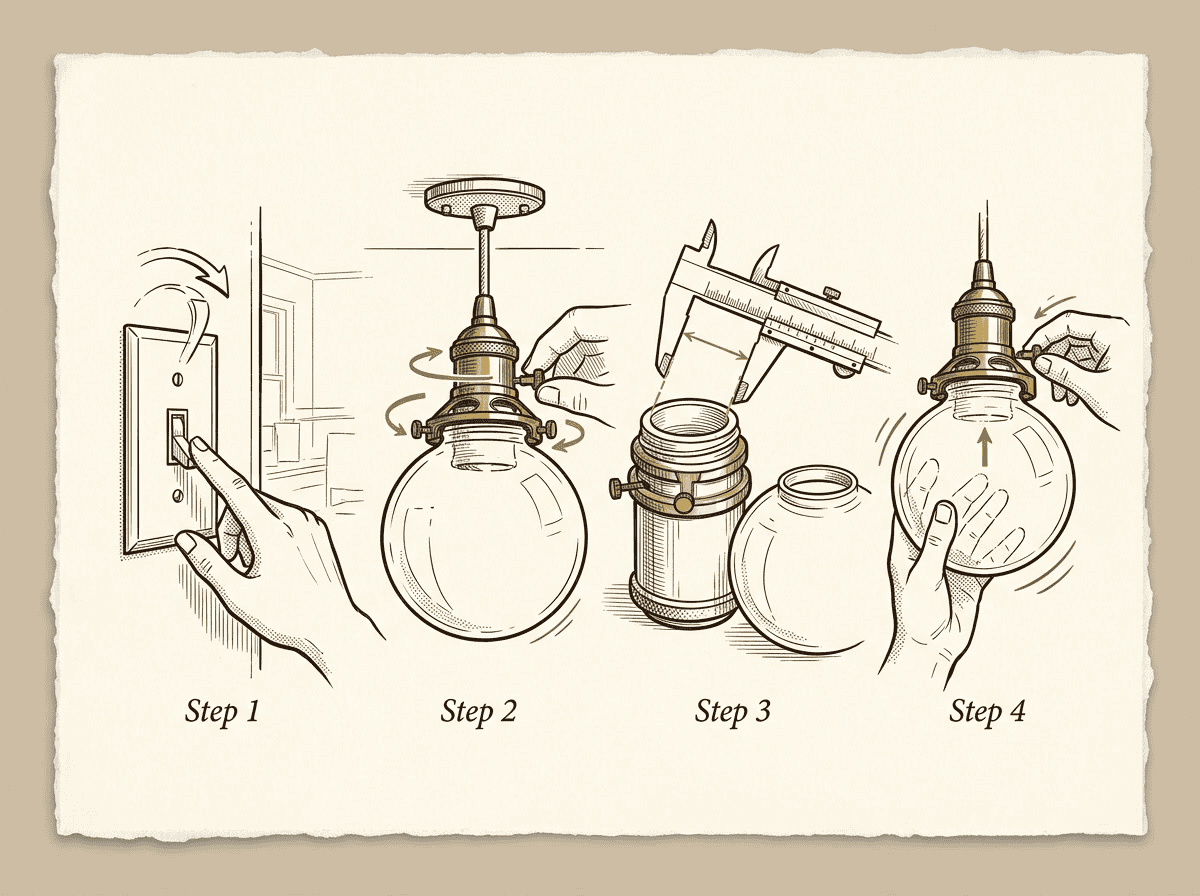
- Turn off the wall switch. Then turn off the breaker if you want to be extra safe.
- Stand on a ladder or chair tall enough to comfortably see the fixture. Have your phone with you.
- Photograph the entire fixture from below, with the existing globe in place. This is your reference shot for shape matching.
- Photograph the fitter from underneath with the existing globe removed (use the procedure in the next section).
- Remove the existing globe. Loosen the three thumb screws around the fitter neck (counterclockwise). Hold the globe with your other hand because it will drop when the last screw releases. Lower the globe down.
- Measure the inner diameter of the fitter neck. Place the measuring tape across the opening at its widest. Record the number. This is the critical measurement.
- Measure the height of the fitter neck (how deep the neck protrudes from the fixture body). This determines how far the globe can sit into the fixture – usually 15-20 mm, but some custom fixtures are deeper.
- Photograph the fitter ring with the measuring tape in place. Send this photo to the supplier alongside the measurement number.
That’s it. Five minutes of measurement saves you a return.
For broader measurement guidance across all lamp types: how to measure a replacement glass lamp shade.
Globe Shapes Available for Each Fitter Size
The fitter size constrains which globe shapes can fit. Here’s the matrix:
| Fitter size | Common globe shapes | Typical outer diameter range |
|---|---|---|
| 3-1/4 inch (82.5 mm) | Sphere, dome, schoolhouse, small drum | 150-250 mm |
| 4 inch (101.6 mm) | Sphere, dome, drum, schoolhouse, cone | 180-350 mm |
| 6 inch (152.4 mm) | Sphere, drum, bowl, fluted dome | 280-450 mm |
| 7-1/2 inch (190.5 mm) | Bowl, large drum, fluted dome | 350-550 mm |
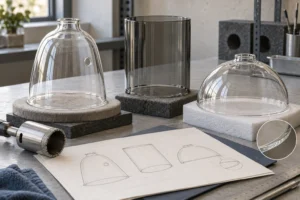
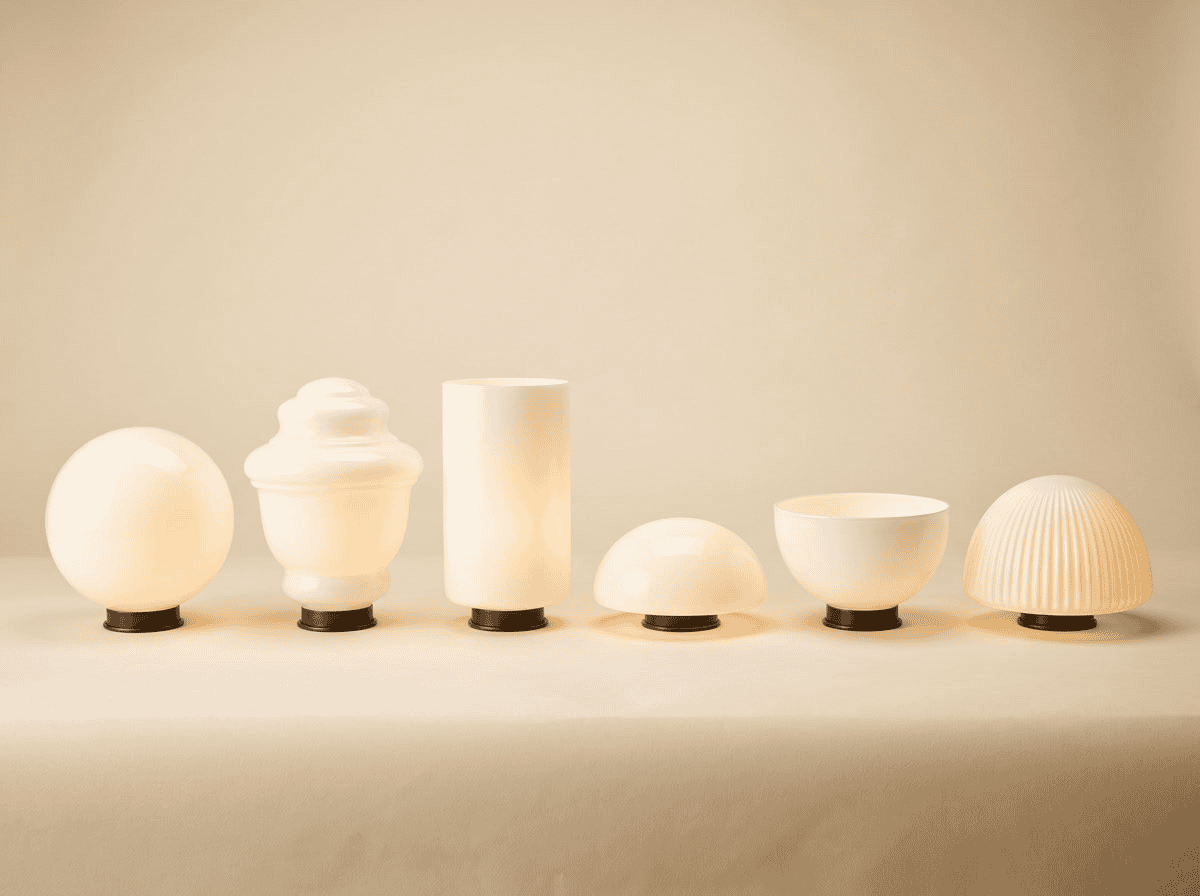
A “globe” in this category doesn’t have to be spherical – the category encompasses any shade with a fitter neck rim that mounts under a flush ceiling bracket. Common shapes:
- Sphere – perfectly round, the classic mid-century modern look
- Schoolhouse – elongated with a curving belly and narrow neck, the traditional American look
- Drum – cylindrical, the modern minimalist look
- Dome – low-profile hemisphere, the streamlined contemporary look
- Bowl – inverted dome with the open side up, used for indirect ceiling lighting
- Cone – tapered, narrow at the top and wider at the bottom, less common
- Fluted dome – ribbed dome with vertical flutes, traditional decorative look
The fitter size cap on outer diameter exists because a too-large globe on a small fitter is mechanically unsafe – the thumb screws can’t grip a thin rim against the weight of an oversized globe. Reputable manufacturers cap their offerings within mechanically safe ranges.
Glass Material and Finish Options
Once the fitter size is locked, the finish choice is purely aesthetic.
Opal glass globes
The most common finish for modern flush-mount and semi-flush fixtures. Opal (white milk glass) hides the bulb completely, eliminates glare from any angle, and reads as a clean luminous object. The ceiling-light context is where opal glass shines most clearly – you’re often looking up at the fixture from below, and opal eliminates the bulb-in-your-eye experience that clear glass creates from that angle.
Most replacement-globe SKUs in the residential ceiling-light category are opal. If you’re not sure what you need, opal is the safe default.
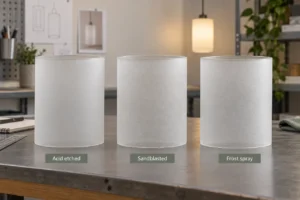
Frosted glass globes
Acid-etched clear glass. Transmits more light than opal (75% vs 50%) but shows some bulb visibility. Use frosted if your existing fixture had it and you want to match, or if the room is large enough that the extra light output makes a meaningful difference.
For the full diffusion physics: glass light diffusion explained: clear vs frosted vs opal glass for lighting.
Clear glass globes
Less common for ceiling fixtures because clear globes show the bulb from any underneath viewing angle. Used in fixtures designed to display decorative filament bulbs (modern industrial pendants and some retro flush mounts). If your current fixture has a clear globe, replace with clear; otherwise default to opal or frosted.
Seeded, hammered, or textured glass globes
Decorative variants. “Seeded” glass has tiny visible bubbles distributed throughout the glass body. “Hammered” glass has a wavy, dimpled surface that scatters light irregularly. “Textured” glass covers many variations – ribbed, fluted, basket-weave embossed. All these reduce glare from underneath like frosted glass, but with a more sculptural look.
Smoked or amber tinted globes
Less common in ceiling lights specifically (more common in pendants and wall sconces) but available. Use only if matching an existing decorative scheme – smoked or amber dramatically reduces room brightness.
The Bulb Inside Matters
For a 4-inch fitter ceiling globe with a typical 250-300 mm outer diameter, the recommended bulb is:
- Type: A19 or A21 LED with frosted envelope
- Lumens: 800-1100 (equivalent to 60-75W incandescent)
- Color temperature: 2700K (warm white) for living spaces, 3000K (soft white) for kitchens and baths
- CRI: 90+ for any room with people, fabric, or food
- Dimmability: Yes if your switch is on a dimmer; otherwise standard non-dimmable LED is fine
- Base: E26 (US/Canada) or B22 (UK), check your fixture’s socket type
The U.S. Department of Energy’s lighting guide covers CCT and CRI selection in plain language.
For globes pairing with multiple bulbs (some larger 6-inch fitter fixtures take 2-3 A19 bulbs), pick the bulb based on the fixture’s total wattage rating, not per-bulb. A fixture rated for 180W maximum could take 3x 60W incandescent or 3x 14W LED (equivalent light, much less heat).
Common Mistakes in Replacement Globe Orders
After supplying hundreds of replacement globes annually to retail and B2B buyers, these are the dominant mistake patterns:
Mistake 1: Measuring outer diameter instead of fitter
Already covered above but worth repeating. The fitter neck is the gate. The outer diameter is the aesthetic preference.
Mistake 2: Confusing fitter sizes between US and metric
A 3-1/4 inch fitter = 82.5 mm. An 80 mm fitter is not the same (close but 2.5 mm off, which is enough to make the globe wobble or not seat). If your existing fitter was made in the US, order to US dimensions. If it was made in the EU/UK, order to metric.
Mistake 3: Ordering a heavier globe than the fixture can support
Some older flush-mount fixtures have thin sheet-metal brackets with small thumb screws. A heavy thick-wall glass globe (6mm or more) puts too much load on these screws. Symptom: the globe slowly drops out of the fitter over weeks. If your existing globe was 3-4mm thin glass, replace with similar thickness. Going thicker requires verifying the fixture bracket can hold it.
Mistake 4: Ordering wrong globe height
Globe height (top-to-bottom) determines how far the bulb sits inside. If you order a too-shallow globe, the bulb sticks below the globe’s lower rim, which looks unfinished. If you order a too-tall globe, the bulb sits well inside and the globe’s lower interior collects dust faster. The right height has the bulb’s top roughly at the globe’s upper third.
Mistake 5: Ordering finish that doesn’t match existing fixtures in the room
If you have 3 flush-mount ceilings in a hallway and you’re replacing one globe, the new one needs to match the others. Opal in a row of opal. Frosted next to frosted. Mixing finishes in a single visual scan looks accidental.
Glass Material Properties for Long-Term Performance
For ceiling-light globes specifically, three material properties matter:
Wall thickness
- 3 mm wall – typical for budget replacement globes. Acceptable for most residential use.
- 4 mm wall – the residential default. Heavier feel, better acoustic damping when bumped during cleaning.
- 5-6 mm wall – premium replacement. Indistinguishable from heritage-quality original installations.
Thermal tolerance
In a ceiling-light fixture, the bulb’s heat rises and accumulates near the top of the globe. With incandescent or older halogen bulbs, internal globe temperatures can reach 80-120°C – which means cheaper soda-lime glass with high residual stress can crack under repeated thermal cycling.
For LED bulbs (almost universal in 2026), internal globe temperatures stay below 40°C, and any annealed soda-lime glass handles this indefinitely. The Wikipedia article on annealing (glass)) explains why annealing matters for cyclic thermal load.
Acoustic feel
Tap a 3 mm globe and you get a thin “ting.” Tap a 5 mm globe and you get a satisfying “thump.” This isn’t snobbery – the acoustic feel correlates strongly with how durable the glass feels under cleaning and handling. Replacement orders that ship light-weight glass often get returned not because anything physical is wrong but because the buyer’s hand registers the cheapness.
Buying Replacement Globes: Channels and Pricing
Three channels for replacement globes:
Big-box retail
Home Depot, Lowe’s, B&Q, IKEA carry a narrow range of standardized globes – typically 3-1/4 and 4 inch fitter sizes, in opal or clear, in 2-3 sizes. Adequate for ~70% of common replacement needs. Walk-in availability is the advantage. Limited customization is the limitation.
Online lighting retailers
Lamps Plus, Wayfair, Lighting New York carry a much wider range. Better filtering by fitter size. Slower shipping. Same overall format: stocked SKUs, no customization.
Direct from manufacturer
Custom dimensions, custom finish, lower prices for any order above 5 units. The route to take if:
- You have an unusual fitter size (anything outside 3-1/4, 4, 6, 7-1/2 inch)
- You need a specific finish or texture not in retail catalogs
- You’re replacing globes across a property (5+ units)
- You need a specific glass thickness or color tint
Wholesale pricing kicks in at 20-50 units depending on the manufacturer. For B2B procurement managing hospitality properties, the manufacturer route is dramatically more cost-effective than retail.
Hospitality Replacement Globe Specifications
Hospitality properties (hotels, restaurants, serviced apartments) replace ceiling-light globes at scale. Common spec requirements:
- Standardized fitter size across the property – usually 4-inch fitter to allow centralized inventory
- Opal glass with inside-frost – eliminates guest complaints about glare from ceiling fixtures while remaining easy to clean
- 4-5 mm wall thickness – balance between weight and durability
- High-CRI bulb compatibility – 90+ CRI is becoming the hospitality standard, particularly for guest bathrooms and corridor lighting
- Replacement inventory – typical hospitality property holds 10-15% of total fixture count as on-hand replacement inventory
For the broader hospitality sourcing context: hotel glass lamp shades.
Future Trends in Ceiling Globe Design (2026 and Beyond)
Three movements are visibly shaping replacement globe design as of early 2026:
| Trend | What changes | Buyer implication |
|---|---|---|
| Integrated LED globes (no bulb needed) | Replacement is whole-fixture, not just globe | New fixtures specify “module” replacement instead |
| Sustainable lead-free opal | Cleaner production, slightly different optical character | Hospitality procurement increasingly specifies this |
| Smart-glass switchable transparency | Globes that can change from clear to opal on demand | Early luxury launches in 2026-2027 |
| Custom-finish at scale | Manufacturers offering one-off bespoke finishes | Designers no longer constrained to stock SKUs |
Per Architectural Digest’s coverage of lighting trends, the residential market is increasingly moving toward custom-spec ceiling fixtures with specific globe finishes, breaking the historical pattern of catalog-driven retail decisions.

Frequently Asked Questions
What’s the most common ceiling light globe fitter size?
The 4-inch (101.6 mm) fitter is dominant in modern residential ceiling lights. The 3-1/4 inch (82.5 mm) fitter is dominant in older fixtures and small hallway lights. If your fixture is from the past 20 years, it’s most likely 4 inch.
How do I tell if my fitter is 3-1/4 or 4 inch?
Measure the inner diameter of the metal neck that holds the globe in place. 82-83 mm is 3-1/4 inch. 100-102 mm is 4 inch. Anything in between is unusual and worth double-checking against the fixture’s spec sheet or label.
Can I install a slightly smaller globe on a larger fitter?
No. The thumb screws need to grip the globe’s rim. If the globe is smaller than the fitter, the thumb screws can’t reach the rim, and the globe falls out. The match has to be exact (or the globe’s rim has to be larger than the fitter, in which case you can’t seat it).
What if my existing globe is glued to the fitter?
This is a sign of a previous owner working around a fitter mismatch. Carefully heat the glue with a hairdryer to soften it, then twist the globe to break the bond. If glued globes are common in your home, the underlying fixture’s fitter is likely worn or non-standard – consider replacing the fixture rather than continuing to source replacement globes.
Can I use any bulb in a replacement globe?
Check the fixture’s wattage rating (printed on the inside of the fixture). For LED, you’re nearly always under the wattage limit. For incandescent (rare in 2026), respect the fixture’s stated maximum – exceeding it can overheat the wiring and the fixture itself.
Are there universal globes that fit multiple fitter sizes?
Some manufacturers sell “adjustable rim” globes with extra ridges molded into the rim that can accommodate 80 mm vs 100 mm fitters. These are rare and rarely look as clean as a size-matched globe. The recommended pattern: measure your fitter, order to spec.
How heavy can a replacement globe be?
A typical 4-inch-fitter ceiling fixture handles up to 1.5-2 kg of globe weight (the three thumb screws together can grip about this much). For larger 6-inch-fitter fixtures, the limit rises to 3-4 kg. If you’re ordering a custom thick-wall or large-diameter globe, ask the supplier for the weight and check it against your fixture’s bracket rating.
The Bottom Line on Replacement Ceiling Globes
Three things to do right and you’ll get this purchase done in one order:
- Measure the fitter neck inner diameter. This is the critical number.
- Order to that fitter size in the finish you want (opal, frosted, clear).
- Match the existing fixture’s general dimensions within ±20% on outer diameter.
For a single residential replacement, retail probably has what you need. For 5+ units (a remodel, a property update, or a hospitality refresh), going direct to a manufacturer gives you better pricing, custom finishes, and dimensional accuracy that retail catalogs can’t match.
Next step: photograph your existing fixture from below, remove the globe, measure the fitter, and send those three things to a supplier. You’ll have a confirmed-fit replacement on order within 24 hours.