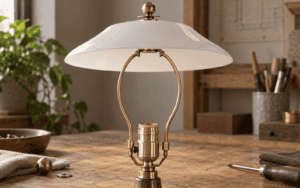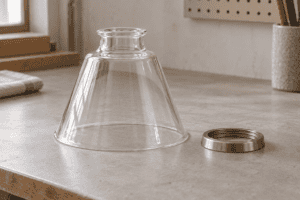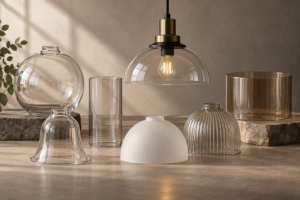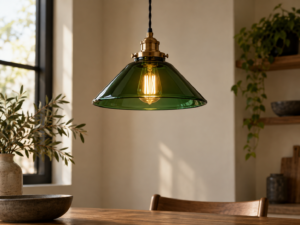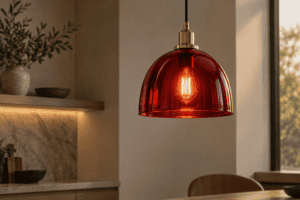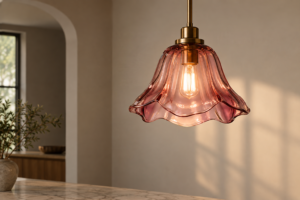
Bell shaped glass lamp shades have a curved body that widens toward the rim. Choose one by fitter opening, overall height, maximum diameter, glass finish, bulb clearance and attachment method, not by appearance alone.
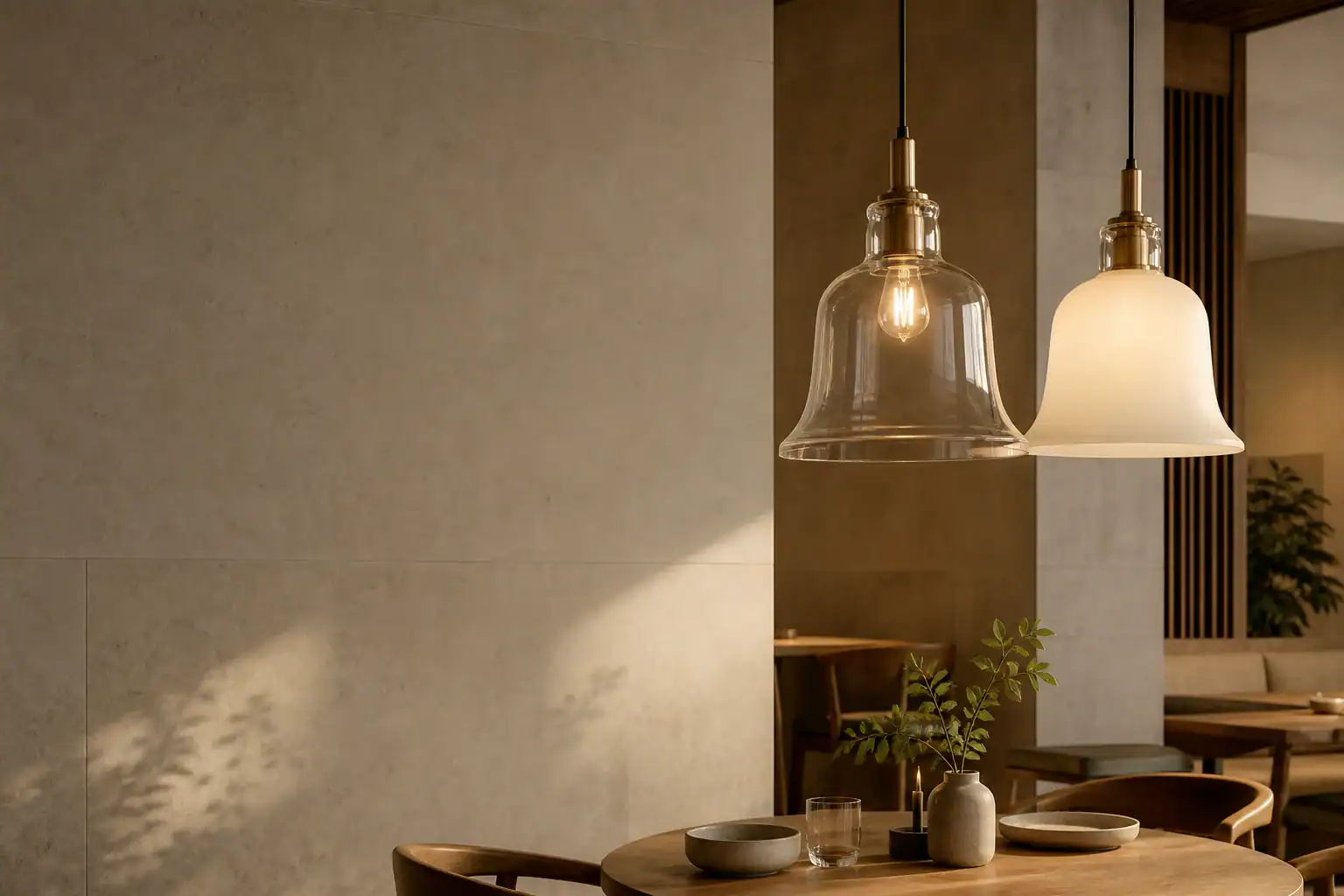
A bell shade can look easy to replace. The curve is familiar, and many listings use the same word for very different parts. One bell glass shade may sit on a retaining ring. Another may have a neck held by set screws. A third may be a custom replacement for an older fixture with a fitter that is no longer made.
That is why a photograph and an outside diameter are not enough. Before you order, identify the profile, measure the connection, record the complete height and widest point, then choose the glass finish that gives the right light. This guide covers those decisions for replacement buyers, lighting brands, distributors and OEM project teams.
What is a bell-shaped glass lamp shade?
A bell-shaped glass lamp shade has a narrow or controlled upper connection and a body that curves outward toward a wider lower rim. The body may be smooth, flared, softly scalloped, ribbed or lightly stepped. The exact silhouette changes the way the shade sits on a fixture and the way light leaves the opening.
The word “bell” describes the outside profile. It does not tell you how the glass attaches, which bulb holder it fits, or whether the glass is clear, opal, seeded or tinted. Those are separate specifications.
The main parts to record are:
- Fitter or neck: the part that meets the fixture, ring or holder.
- Fitter opening: the inside diameter or other connection dimension at the attachment point.
- Shoulder: the transition from the neck into the wider bell body.
- Maximum diameter: the widest part of the shade.
- Rim or lower opening: the edge through which light leaves, if the shade is open.
- Overall height: the distance from the fitting surface to the lowest point of the profile.
The existing JX Lampshade shape glossary is useful for comparing bell with tulip, globe, dome and other glass profiles. This article stays with bell shades because the same outline can still require very different measurements and attachment details.
Glass bell shade versus fabric bell shade
Retail search results often use “bell shade” for fabric lampshades. A glass bell shade is a rigid component with a defined neck, rim, wall thickness and surface finish. The fitting may be hidden inside the top of the glass, or the shade may be held by an external ring.
The distinction matters when ordering a replacement. A fabric shade may be sized mainly by top diameter, bottom diameter and slant height. A glass shade also needs a safe mechanical connection and a check that the bulb, socket and glass do not interfere with one another.
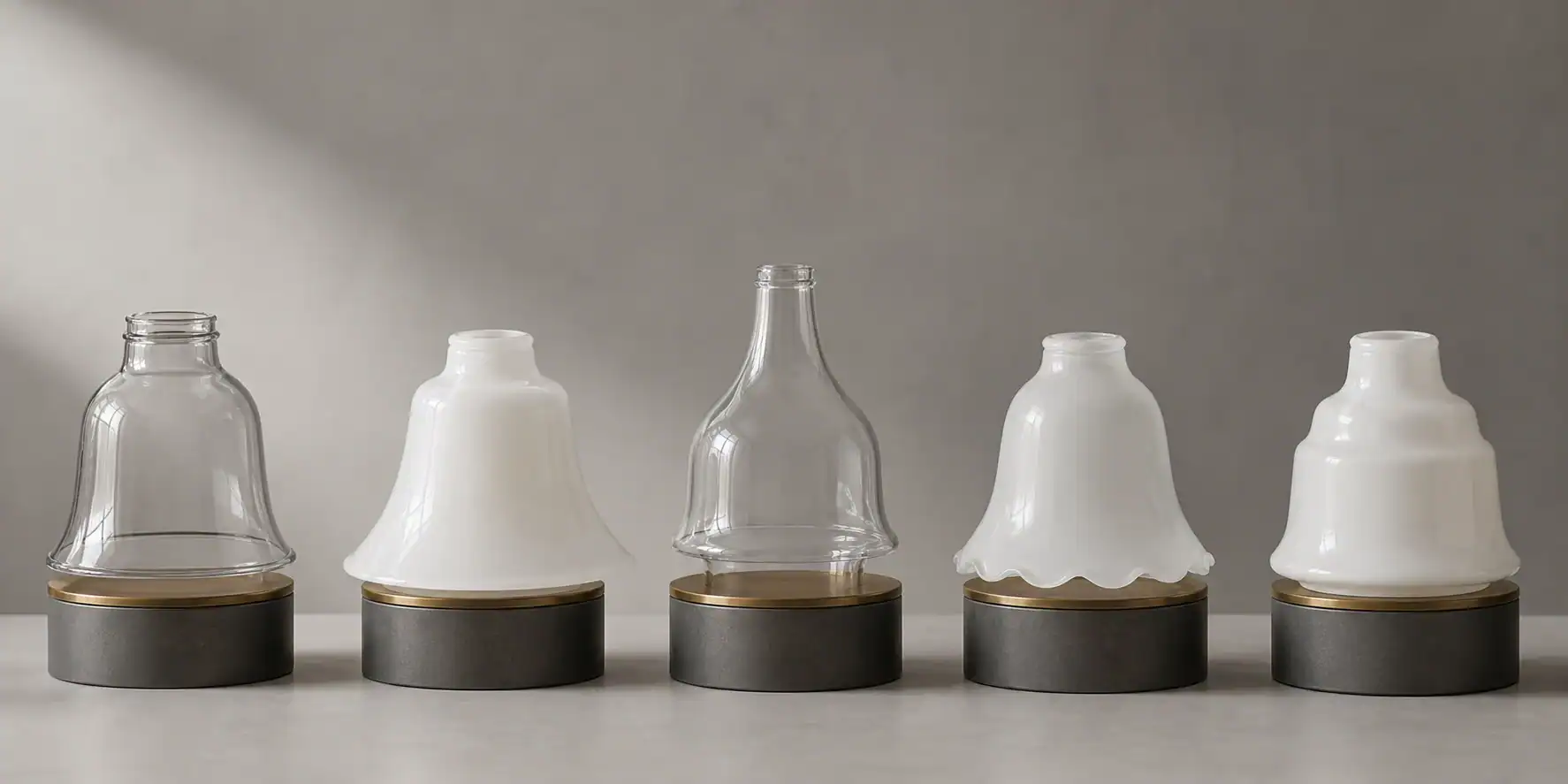
Bell profile variations: classic, flared, scalloped and schoolhouse-adjacent
There is no single universal bell proportion. Two shades can both be called bell-shaped while having different shoulders, openings and visual weight. Compare the side profile before comparing the finish.
| Bell profile | Visual cue | Light behavior | Common use | Main replacement check |
|---|---|---|---|---|
| Classic curved bell | Narrower neck, continuous outward curve | Broad downward and side light | Pendant, table or wall fixture | Neck and overall height |
| Wide flare | Shorter body with a fast outward sweep | More open lower spread | Pendant over a table or counter | Maximum diameter and rim clearance |
| Tall bell | Higher shoulder and longer body | More controlled side view | Decorative pendant or sconce | Height, bulb position and wall clearance |
| Scalloped or ruffled rim | Repeated edge detail at the opening | Edge pattern changes the light line | Decorative or vintage-inspired fixture | Rim diameter and edge profile |
| Schoolhouse-adjacent bell | Rounded shoulder with a flatter lower body | Even room light with a defined outline | Ceiling or pendant fixture | Shoulder position and fitter depth |
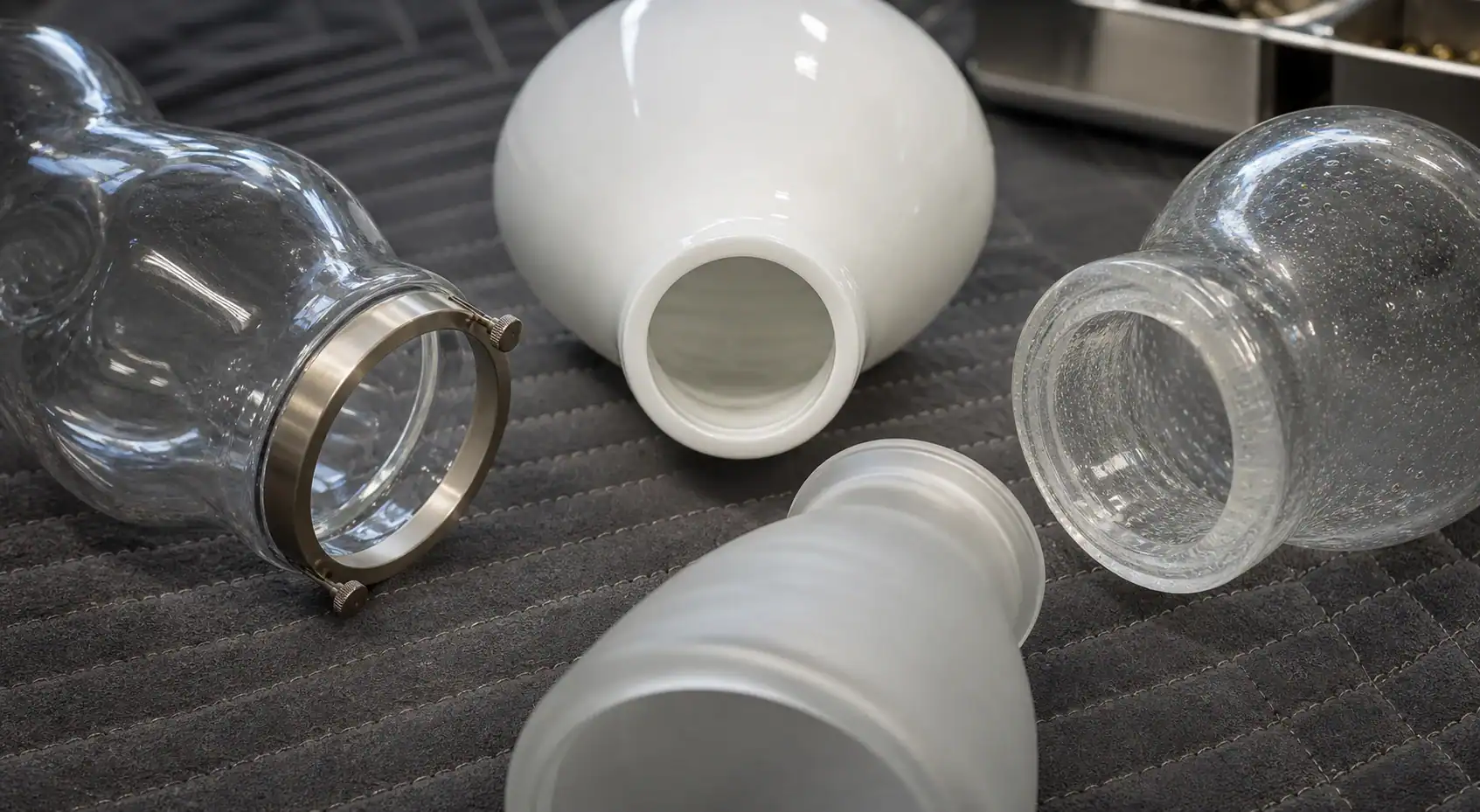
The profile also influences how a shade reads at different viewing angles. A clear bell with a wide flare can show the bulb and holder from below. An opal bell with a taller body hides more of the light source. A scalloped rim may create a softer decorative edge, but it adds another detail to check when a replacement must match an existing fixture.
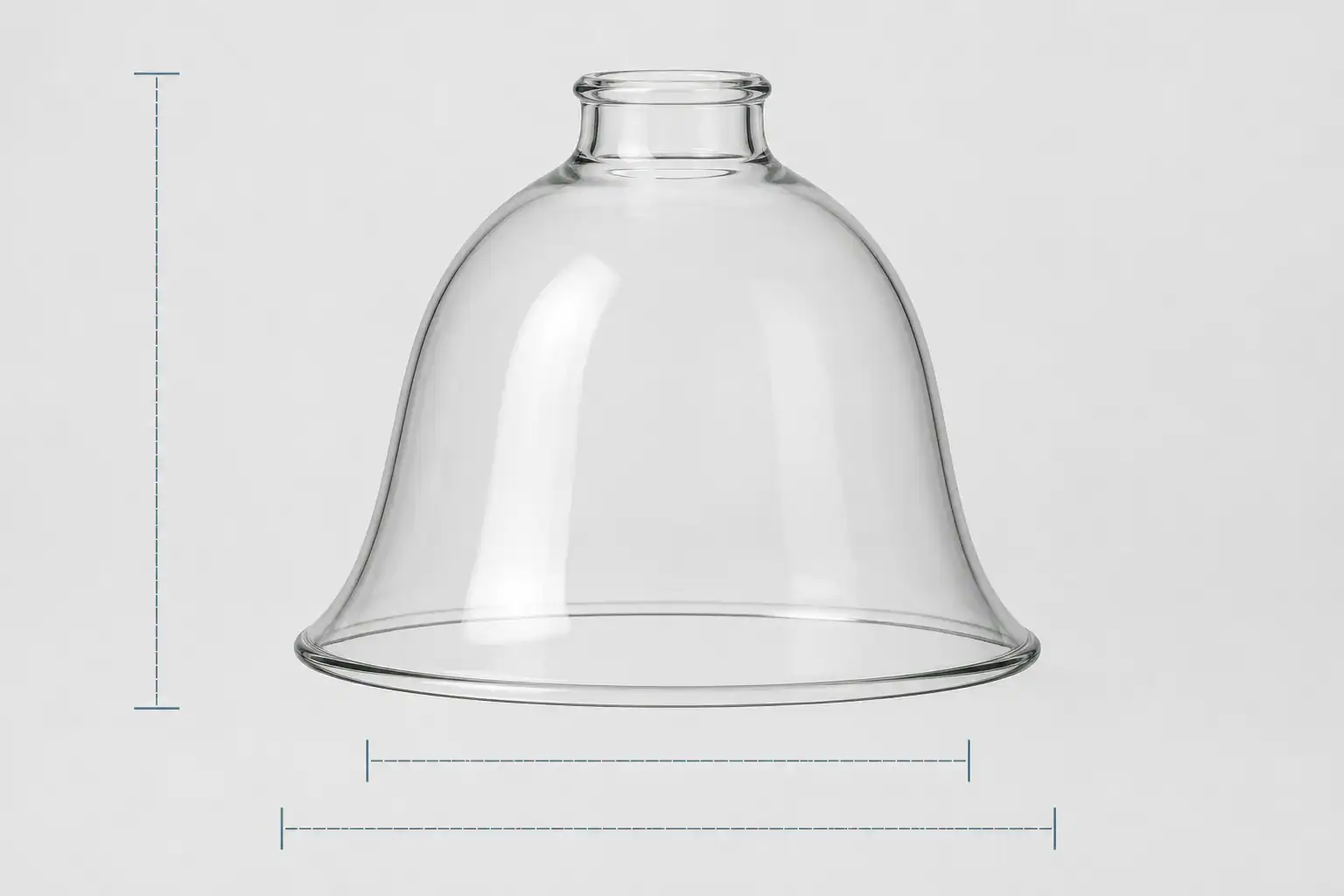
For a repeat order, keep a profile drawing with the opening, widest diameter, height and rim geometry. A product name is helpful for searching, but a drawing or measured sample is what protects the fit.
Fitter openings and attachment methods
The shade fitter is the mechanical connection between the glass and the light fixture. The bulb cap or lamp holder is the electrical component that supports the lamp. They may be close together, but they are not the same specification.
The JX holder and bulb-cap size guide explains electrical terms such as E27, E26, B22 and E14. When you order a bell shade, also describe the glass connection. A matching bulb holder does not automatically mean that the shade will fit.
Ring-held bell shades
A ring-held shade has a neck, lip or seating surface that fits into a metal gallery or retaining ring. The ring may be part of a pendant, wall fitting or chandelier arm. Measure the glass opening and the surface that the ring actually supports. Do not measure only the outside of the metal ring if the glass sits inside it.
Ring-held designs are common in replacement work because the glass can sometimes be changed without replacing the complete holder. The ring still needs enough contact area to support the shade without point loading the rim.
Set-screw bell shades
Some fixtures secure a glass neck with three or more small set screws. For these, record the neck outside diameter, the available screw contact area and the depth at which the screws meet the glass. A replacement neck that is too short may leave the screws near the edge. A neck that is too narrow may not seat securely.
The screw tips should not bear on a fragile edge. The final fit needs to be checked with the actual holder and hardware, especially when the replacement glass is thinner or has a different lip shape.
Threaded or fixture-specific connections
Some bell shades use a threaded neck, a formed groove, a clip system or a fixture-specific adapter. These connections are not interchangeable just because the shade has the same height and outside diameter. If the original part is available, photograph the connection from above, below and the side. If it is broken, photograph the holder and any remaining ring or adapter.
For a complete luminaire, the shade must be secure and the light source must have the clearances specified for the fixture. General luminaire safety requirements such as IEC 60598-1 apply to the complete lighting product, not to a decorative glass shape considered in isolation.
How to measure a bell glass shade before ordering a replacement
Measure the fixture and the glass together. If the original shade is intact, record it before removing it. If it is broken, do not rely on a fragment for every dimension. A fragment can help identify the curve, but the holder usually gives the most useful connection data.
1. Photograph the complete fixture
Take a front view, side view and close-up of the fitting area. Include a ruler in one photo when possible, but do not place a loose ruler where it could scratch the glass or interfere with the electrical fixture. Photograph the underside of the holder and the way the shade is retained.
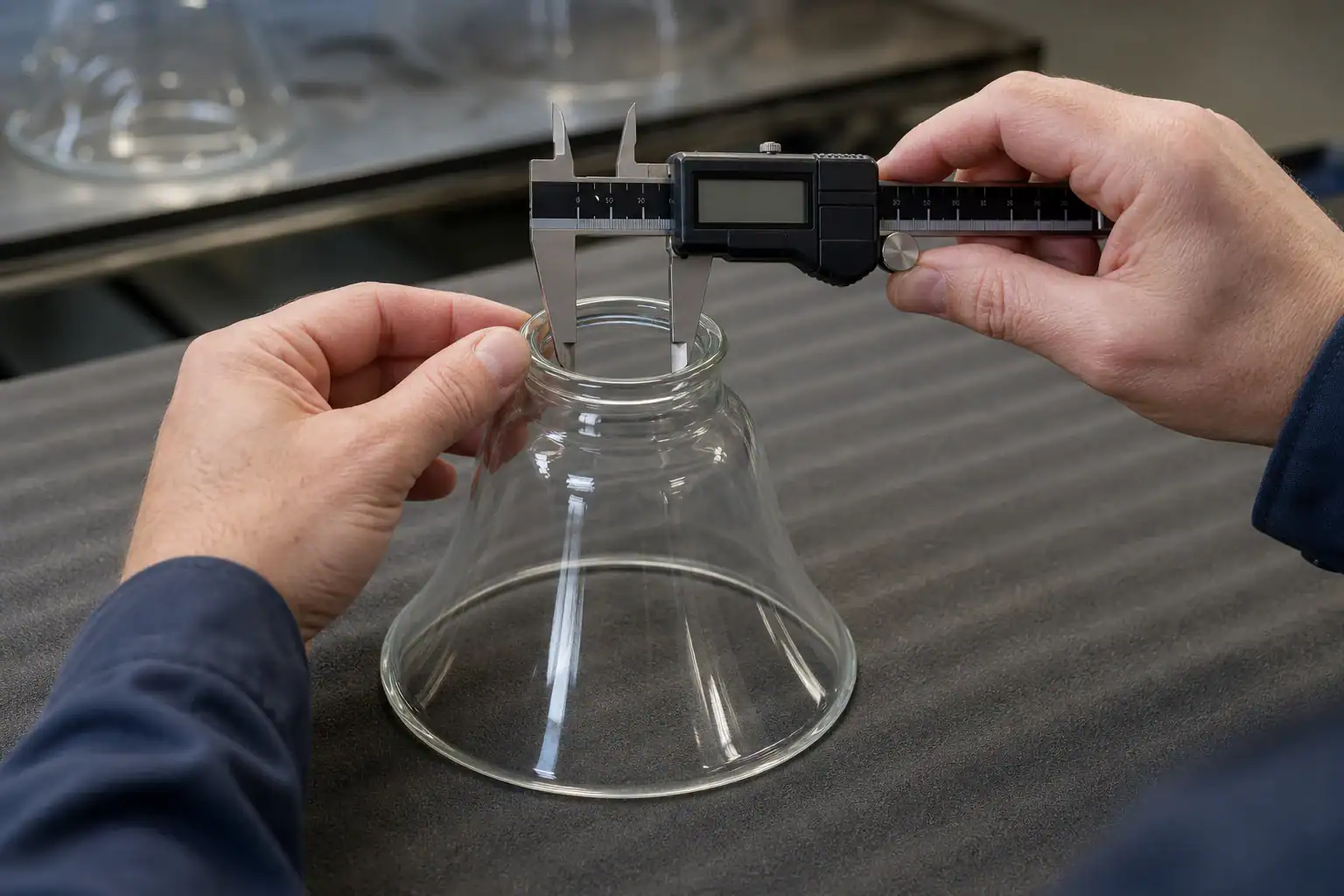
2. Measure the fitter opening
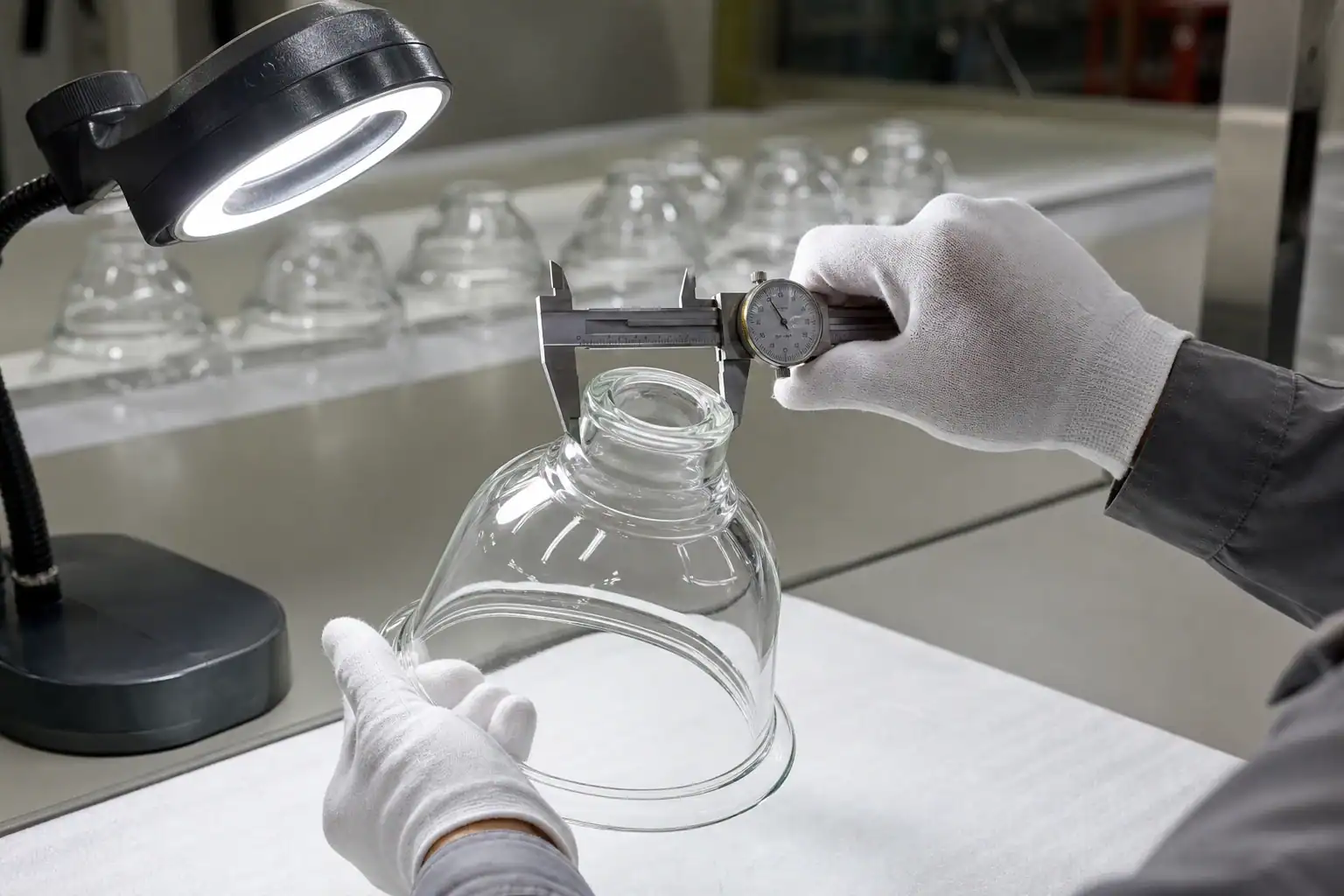
Use a caliper when the opening is accessible. Record the inside diameter where the glass enters the ring or holder. Also record the outside diameter of the neck, the neck height and any lip, groove or thread. If the opening is not round, record the shape and the width at the relevant points.
Measure more than once. If the reading changes around the opening, note the largest and smallest values rather than hiding the variation in one rounded number.
3. Record the profile dimensions
Measure overall height from the fitting reference surface to the lowest point. Then record the maximum diameter and its position from the top. A bell that is 220 mm wide at the rim is not the same component as one that reaches 220 mm at the shoulder, even if both have the same total height.
If the shade is open at the lower end, measure the rim diameter. If the rim is scalloped or irregular, record the smallest opening, largest opening and the number or pitch of the scallops when an exact match matters.
4. Check the bulb and fixture clearance
Record the bulb type, approximate lamp length, socket position and direction of the fixture. Check where the bulb sits in relation to the shoulder and wall of the glass. A shade can fit the holder and still be unsuitable if the lamp touches the glass or if the fixture cannot manage the heat produced by the selected light source.
Do not use one universal clearance number for every fixture. Follow the luminaire maker’s instructions and the requirements that apply in the destination market. The replacement supplier can check the geometry, but the complete assembled fixture remains the final safety reference.
5. Use a measurement sheet
| Measurement | What to record | Why it matters |
|---|---|---|
| Fitter inside diameter | Measured at the actual seating point | Determines whether the shade can enter the holder |
| Fitter outside diameter | Neck or lip outside dimension | Confirms ring and set-screw contact |
| Neck height | Seating surface to shoulder | Controls how far the shade sits over the holder |
| Overall height | Fitting reference to lowest point | Controls proportion and bulb position |
| Maximum diameter | Widest point and its height | Checks surrounding fixture and room clearance |
| Rim diameter | Smallest and largest opening if irregular | Controls light spread and profile match |
| Wall or edge detail | Thickness, lip, groove or scallop | Helps match the original part |
| Attachment method | Ring, screws, thread, clip or adapter | Prevents a visually similar but unusable replacement |
The broader JX lamp shade size guide explains general shade measurements. The narrower cut glass measurement guide is also useful when the replacement has a shaped or detailed profile. For a bell shade, add the shoulder position and fitter details to those general measurements.
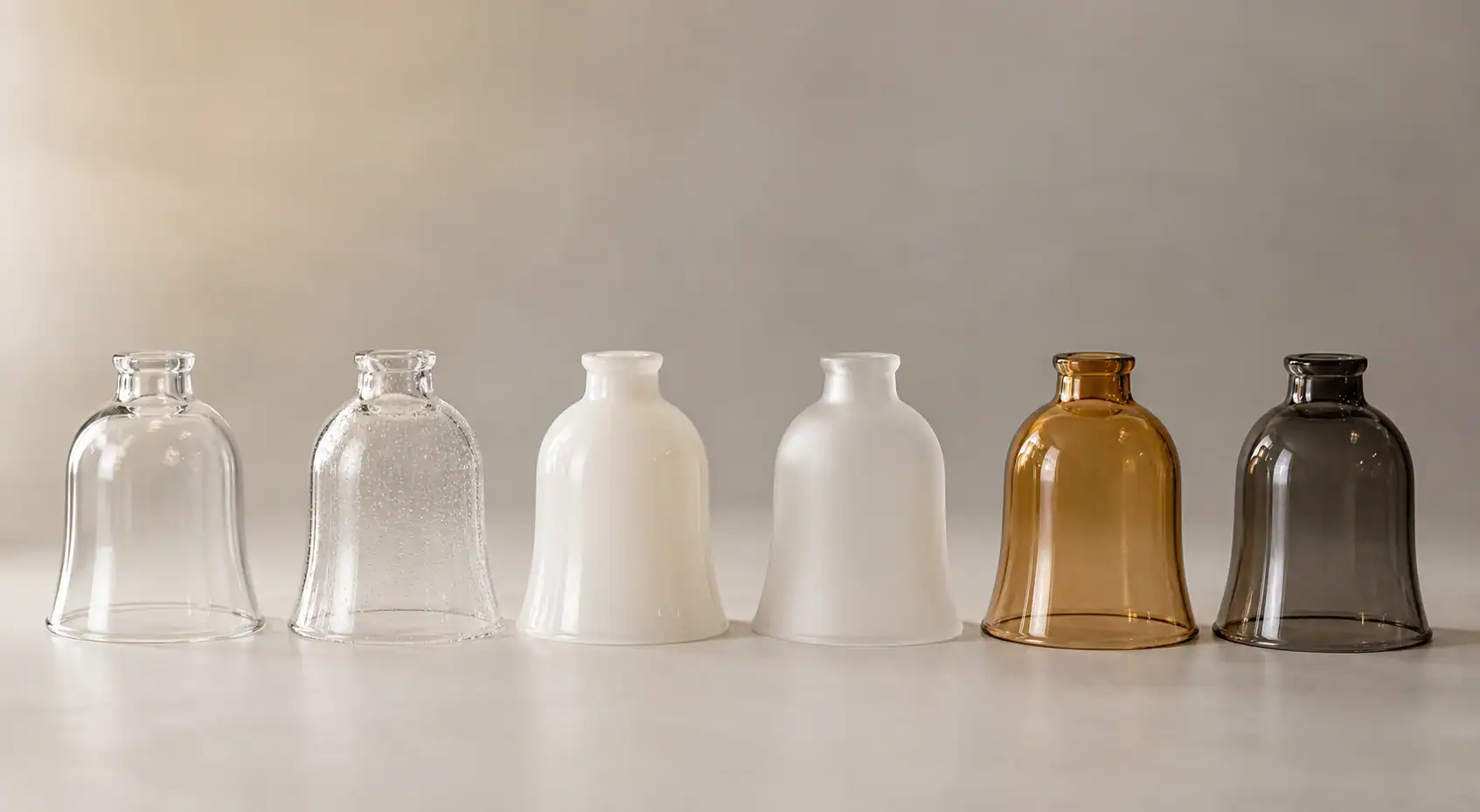
Clear, seeded, opal, frosted, amber and smoke glass
The glass finish changes more than color. It affects how much of the bulb is visible, how the light spreads, how the surface looks when the fixture is off and how easy it is to match an existing installation.
| Finish | Visual effect | Light and glare tendency | Useful when | Check before approval |
|---|---|---|---|---|
| Clear | Shows the bulb and internal hardware | More direct light and more visible glare sources | Decorative bulbs and transparent pendants | Bubble, ripple and edge appearance |
| Seeded | Small bubbles or inclusions add texture | Softens the view without fully hiding the source | Vintage, hospitality and decorative projects | Seed distribution and repeatability |
| Opal | White or milky body hides much of the source | More diffuse appearance with less direct bulb view | General room light and glare control | Color, opacity and surface uniformity |
| Frosted | Etched or coated surface softens reflections | Diffuses the source while retaining some form | Contemporary and replacement work | Frost depth, cleaning and edge finish |
| Amber | Warm transparent or translucent tint | Adds color to the projected light | Decorative and period-inspired settings | Tint consistency and sample match |
| Smoke | Gray or dark transparent tint | Reduces visual brightness and adds contrast | Modern decorative fixtures | Color under the actual lamp source |
Finish names are not enough for a repeat order. Ask for a sample or finish reference under the intended light source. A clear shade seen in a bright factory can look different in a dim restaurant. Opal glass can also vary in opacity, while seeded glass can vary in the size and distribution of inclusions.
Glass composition, wall thickness, forming method and fixture design all affect heat behavior. Do not select a finish as a substitute for a complete temperature and safety check.
Choosing a bell shade for different fixtures
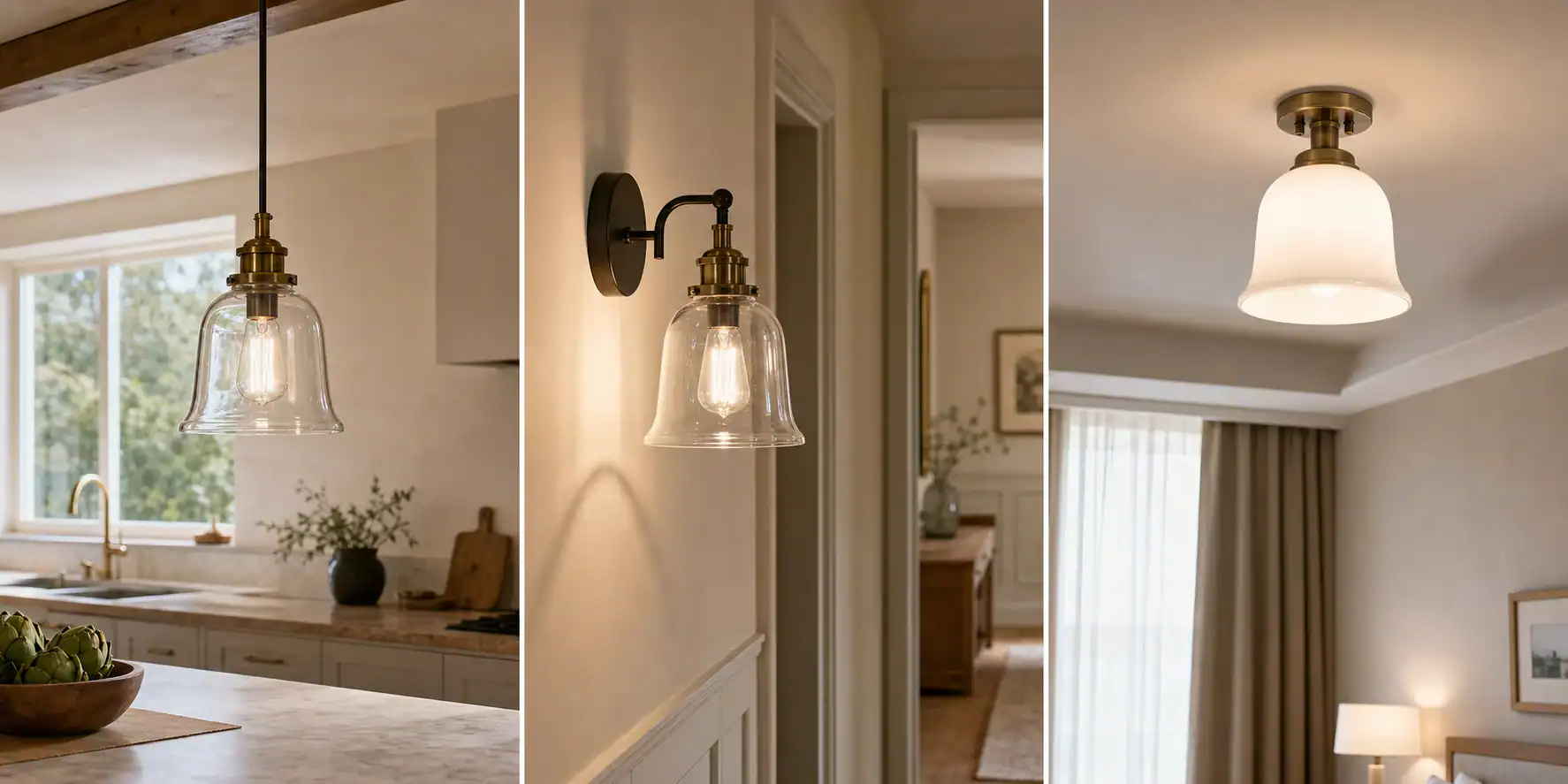
The right bell shade depends on where the glass sits as well as on the shape name.
Pendant lights
For a pendant, check the distance from the fitter to the canopy, the bulb position inside the bell and the lower rim diameter. A wide flare can spread light across a table, but it may also expose more of the bulb when viewed from below. A taller bell can conceal the socket and create a more vertical silhouette.
If several pendants hang in a row, record the same profile reference for every position. Small differences in shoulder height can make a group look uneven even when the outside diameter is close.
Wall sconces
Wall fixtures need a check for wall clearance and the direction of the opening. A bell used on a sconce may need a shorter profile or a controlled side opening so that it does not touch the wall or project farther than the backplate allows.
Also consider cleaning access. A detailed rim can collect dust more readily than a plain edge, particularly when the opening faces upward.
Chandeliers and ceiling fixtures
On a chandelier, the shade may be one of several repeated components. Confirm the neck, ring and screw arrangement for every arm. On a ceiling fixture, check the shade weight, the mounting surface and the space above the glass. A replacement should be tested on the actual fixture rather than judged from a flat product photograph.
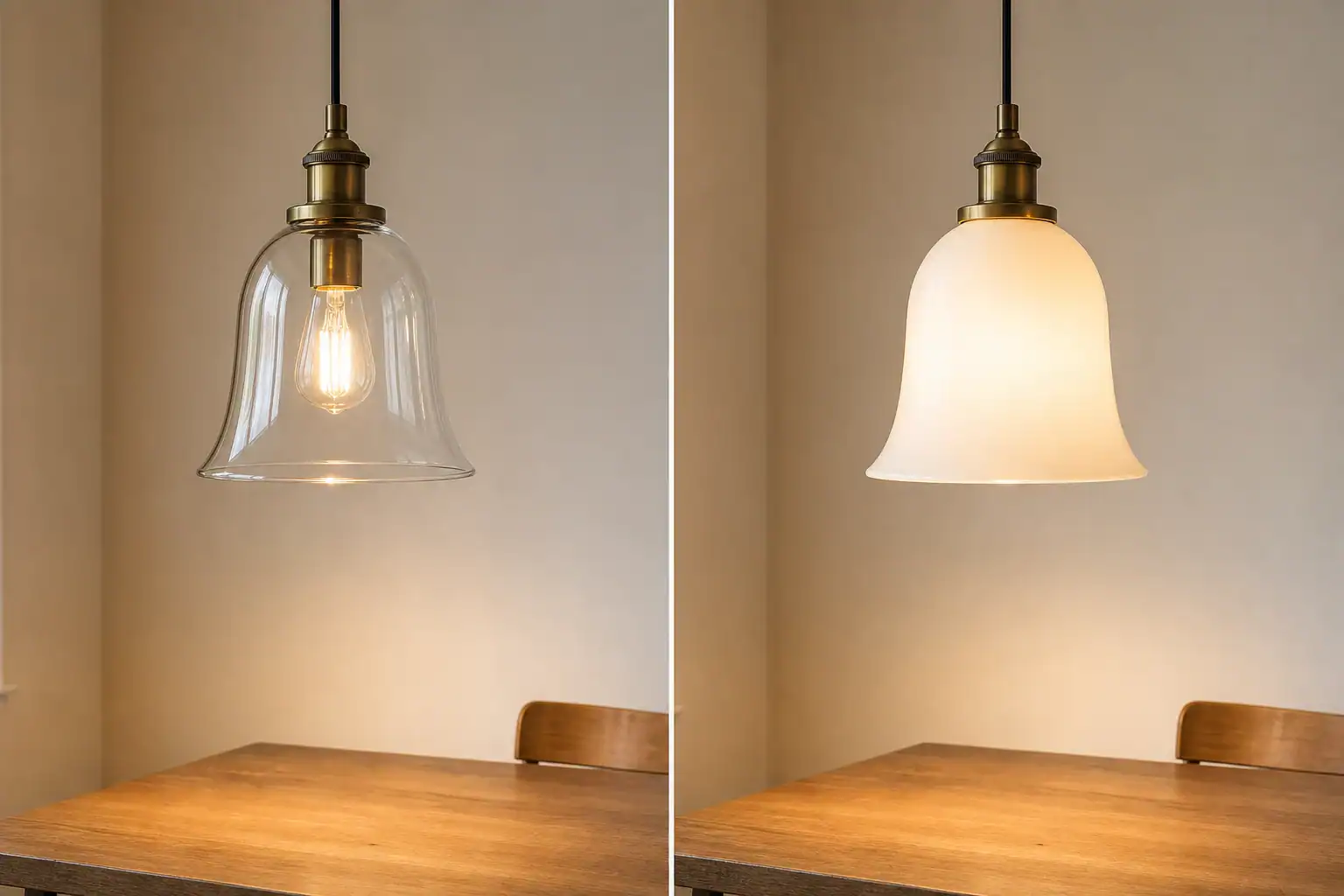
Clear versus opal in the same fixture
Clear and opal bell shades can use the same physical profile but create different lighting results. Clear glass preserves the view of the bulb and can make a decorative filament part of the design. Opal glass reduces the visual contrast of the source and usually gives a softer appearance.
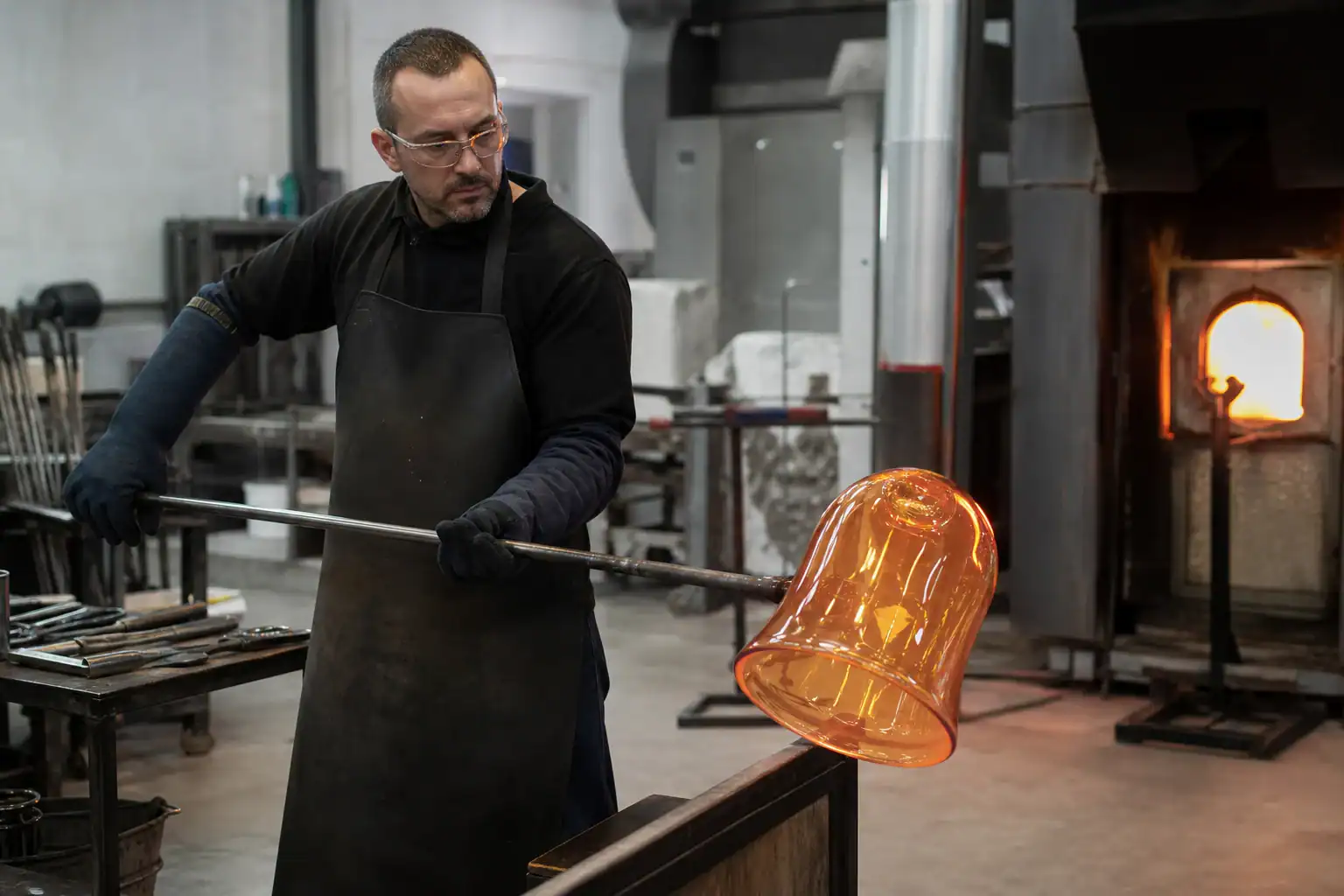
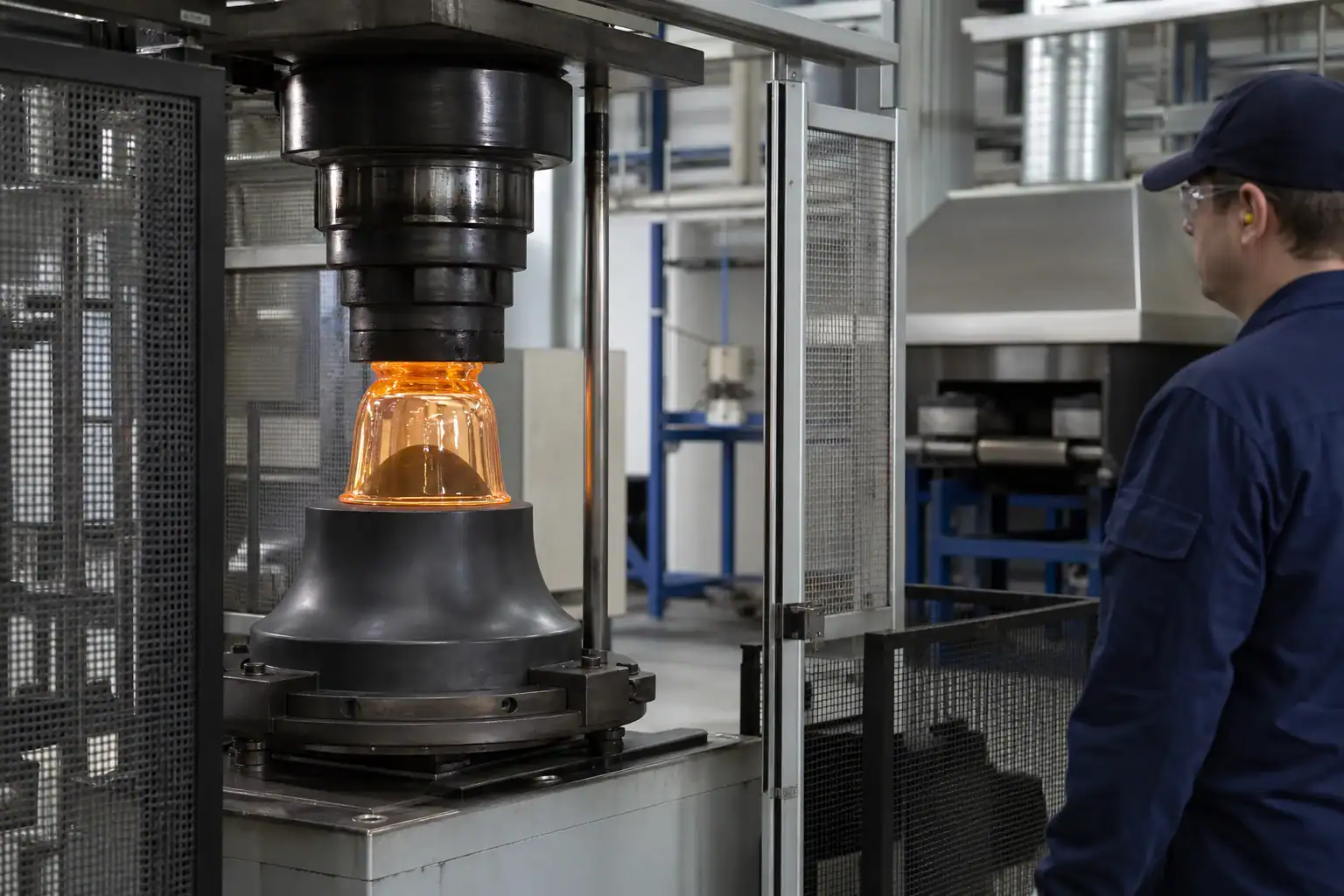
Mouth-blown, pressed and lampworked bell glass
The forming method affects repeatability, surface character, tooling and the type of order that makes sense.
| Forming route | Typical strengths | Points to discuss with a supplier | Suitable order situation |
|---|---|---|---|
| Mouth-blown | Flexible profiles, hand-shaped character and easier development of unusual forms | Dimensional variation, wall distribution, annealing and sample approval | Restoration match, design development or lower-volume custom work |
| Pressed glass | Repeatable shape from a mold and efficient repeat production | Tooling, parting line, edge finish, mold marks and tolerance | Repeat OEM production with a stable drawing |
| Lampworked or tube-formed | Useful for certain small, detailed or heat-resistant glass forms | Material, wall thickness, connection detail and production size | Specialized profiles or technical components |
Mouth-blown forming
A glassworker can change the curve while the glass is hot, which helps when a replacement needs a distinctive shoulder, rim or vintage character. The tradeoff is that the buyer must agree on practical dimensional tolerances and appearance limits. One sample should not be treated as a promise that every later piece will be identical unless the process and inspection standard support that expectation.
Pressed forming
Pressed glass uses a mold to form a repeatable profile. Tooling becomes part of the project decision. The buyer should approve the profile, the opening, the edge, the surface finish and the location of any mold or parting marks before a production run. A pressed bell can be a good choice when a lighting brand needs a stable shape across many units.
Sample approval
For either route, approve a physical sample with the actual ring or holder when possible. Check the shade from the same viewing angles as the installed fixture. Confirm the fitter, shoulder, rim, finish, bulb clearance and weight before moving to a repeat order.
Replacement, small-batch or custom OEM: which route fits?
Start by deciding what problem you are solving.
| Requirement | Best starting route | Information to send |
|---|---|---|
| One broken shade or discontinued part | Replacement match | Photos of the fixture, holder, original shade, measurements and quantity |
| New profile for a design project | Sample development | Sketch or CAD, target dimensions, finish, application and desired sample quantity |
| Repeat production for a lighting brand | OEM production review | Drawing, approved sample, annual quantity, inspection points, packing and destination |
For a replacement, the original shade or a measured holder is more useful than a product title. For a custom project, a simple side-profile drawing should show the fitter reference, overall height, maximum diameter, rim, wall or edge details and finish. Add photos with a ruler only as supporting evidence.
JX’s custom glass lampshade services can be used as the next step after the profile and connection are defined. Ask the technical team to confirm what can be made for the selected glass and process. Do not assume that a stock bell profile can be changed without reviewing the neck, tooling and production method.
What to include in a quote request
Send the following in one message:
- A drawing or clear side and underside photographs.
- Fitter inside diameter and outside diameter.
- Neck height, overall height, maximum diameter and rim diameter.
- Attachment method and fixture type.
- Clear, opal, seeded, frosted or tinted finish reference.
- Bulb or light-source information and available clearance.
- Quantity for the first order and expected repeat demand.
- Packaging or labeling requirements.
- Delivery destination and any inspection points.
This information shortens the first technical exchange and makes it easier to decide whether a replacement match, sample or production quotation is appropriate.
Inspection and packing checklist for glass bell shade orders
Before accepting a sample or production lot, inspect the areas that determine fit first.
- Fitter: Check the inside diameter, outside diameter, neck height, lip and attachment detail against the approved drawing.
- Profile: Check overall height, maximum diameter, shoulder position and rim shape.
- Glass appearance: Check color, opacity, seeded distribution, frosting, bubbles, scratches and visible mold or forming marks against the agreed sample standard.
- Edge: Check the rim for chips, sharp points and an uneven edge that could interfere with the ring or expose a stress point.
- Assembly: Test a sample with the actual ring, holder or adapter. Confirm the bulb remains clear of the glass and the shade sits level.
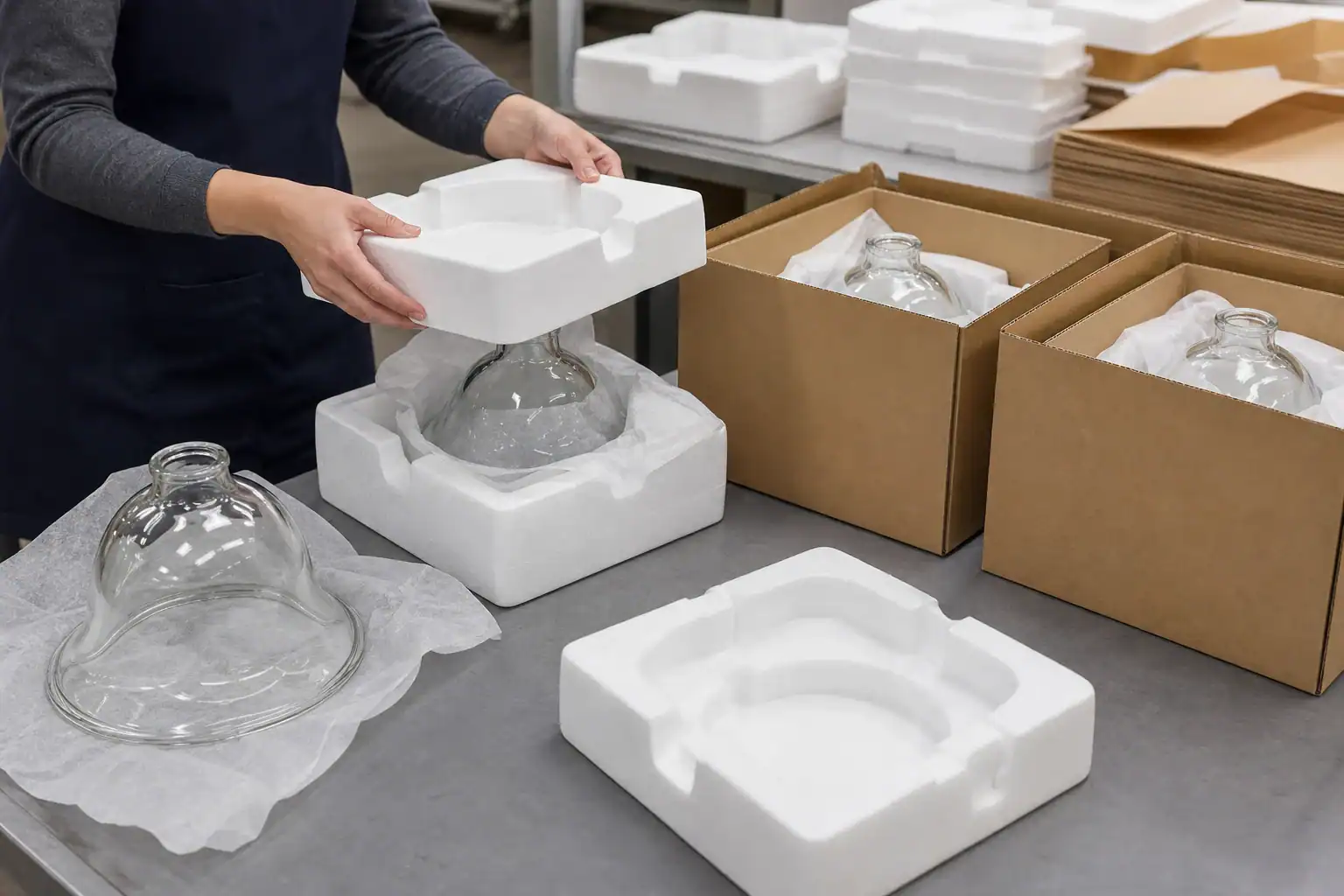
- Packing: Confirm that each shade is separated from neighboring glass, the rim is protected and the carton prevents movement during handling.
The inspection sheet should distinguish measurable requirements from appearance preferences. For example, a drawing may define the fitter and height, while an approved sample defines the acceptable shade of amber or the density of seeded inclusions.
Bell-shaped glass lamp shade FAQs
What makes a glass lamp shade bell-shaped?
A bell-shaped glass lamp shade has a body that curves or flares outward from a narrower upper connection toward a wider rim. The exact shoulder, height, opening and rim can vary, so the word bell identifies the profile family rather than one standard size.
How do I measure the fitter opening?
Measure the inside diameter at the point where the glass actually enters or seats in the holder. Also record the neck outside diameter, neck height, lip or groove and attachment method. A caliper is useful, but do not force it against a fragile edge. Take several readings and note any variation.
Are bell-shaped shades available in different glass finishes?
Yes. Common choices include clear, seeded, opal, frosted, amber and smoke glass. The finish changes how much of the bulb is visible, how the light spreads and how the shade looks when the fixture is off. Approve a sample under the intended light source when color or opacity matters.
Can a vintage bell shade be replaced if the original is discontinued?
Often, a replacement can be developed when the holder or a usable sample provides enough information. Send photos, fitter measurements, overall dimensions, rim details, finish references and quantity. If the glass is broken, the holder and remaining attachment hardware may be more reliable than the fragment alone.
Is a bell shade the same as a tulip or globe shade?
No. A globe is generally round or near-round, while a tulip often has a flower-like opening or flared petals. A bell has a curved body that widens toward the rim. Some profiles sit between these descriptions, so the side drawing and measurements matter more than the product name.
How much bulb clearance should I allow?
There is no single clearance number for every bell shade. The correct space depends on the glass, bulb, holder, fixture design, orientation and applicable safety requirements. Follow the luminaire maker’s instructions and check the complete assembled fixture. The glass should not touch the bulb or hardware unless the fixture was specifically designed for that arrangement.
Can a manufacturer make a bell shade from a drawing or sample?
Many glass manufacturers can review a drawing, sample or damaged part and advise whether the profile suits mouth-blown, pressed or another forming route. The review should cover the fitter, dimensions, wall or edge details, finish, quantity and sample approval process before production is quoted.
What information should I include in a quote request?
Include the drawing or photographs, fitter opening, neck and rim dimensions, overall height, maximum diameter, finish, fixture type, bulb information, quantity, packaging needs and delivery destination. If the shade is a replacement, include the original holder and a photo of the installed fixture whenever possible.
Send the fitter, profile and photos
A bell-shaped glass lamp shade is selected by the connection and profile together. Once the fitter, height, diameter, rim, finish and application are documented, a replacement or custom review can start with useful information instead of guesswork.
For a technical review, send a drawing or sample details with the measured fitter opening, profile dimensions, glass finish, quantity and fixture application. Use the JX custom glass lampshade service to request the next step.
Request a Custom Quote or Send Your Drawing for Review.