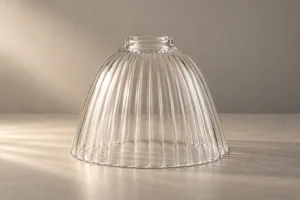
When two glass lamp shade supplier quotes arrive in different formats, the lowest unit price is rarely a fair comparison. A quote may use FOB while another includes delivery, place tooling in a separate line, treat the sample as free, or assume a lighter packing method. The suppliers may also be quoting different drawing revisions.
For a useful comparison, freeze the part, finish, quantity, drawing revision, sample reference, Incoterm, named port, packing basis, and destination. Then calculate two numbers for every supplier: the first-order cost and the repeat-order cost. A supplier with a slightly higher unit price may be the lower-cost option once tooling, freight, protection, and reorders are put on the same basis.

The short answer: compare two totals, not one unit price
Start with a comparison sheet that separates one-time costs, recurring costs, and destination costs. Use the same quantity and the same part revision for every supplier.
First-order comparable cost = goods value + tooling + sample and sample freight – credited sample cost + agreed packaging + pre-shipment inspection or testing + freight and insurance assumptions + destination duties, fees, and handling.
Repeat-order comparable cost = repeat goods value + current packaging + freight and destination costs + label or document updates + expected replacement or claim handling. Add tooling only when the design changes, a mold needs rebuilding, or the supplier has stated a recurring tool charge.
These are buyer planning formulas, not a customs quotation. Keep invoice charges separate from internal scenario allowances. A breakage reserve, for example, can help compare risk, but it is not the same as a supplier charge.
Illustrative comparison, not a JX quote
The example below uses invented numbers to show the method. It is not a JX Lampshade price indication and should not be used as a market benchmark.
| Cost line | Supplier A | Supplier B | Why it matters |
|---|---|---|---|
| Goods value at quoted basis | USD 8,400 | USD 8,750 | A lower unit line does not settle the comparison |
| Tooling paid with first order | USD 900 | USD 0 | Confirm whether B already has a usable tool and who controls it |
| Sample and sample freight | USD 260 | USD 180 | Check what the sample proves and whether the fee is credited |
| Export packing difference | USD 120 | USD 480 | A stronger packing specification can change the landed result |
| Freight and destination scenario | USD 1,650 | USD 1,650 | Use the same shipment assumptions for both suppliers |
| First-order planning total | USD 11,330 | USD 11,060 | Compare the same cost boundary, not goods value alone |
| Repeat-order planning total | USD 10,430 | USD 10,880 | Tooling and one-time sample costs do not repeat in the same way |
The correct decision may still depend on technical fit, sample approval, schedule, claim terms, and reorder control. The table only shows why both totals deserve a place in the buying decision.

Freeze the quote comparison sheet before comparing prices
Ask each supplier to quote the same controlled brief. If one supplier receives a profile drawing and another receives only a product photo, the resulting prices are not comparable. Record the following fields before you rank anything:
| Field | What to record | Why the field controls cost |
|---|---|---|
| Buyer SKU | Your internal part number and fixture position | Prevents a similar-looking shade from entering the comparison |
| Supplier SKU | Supplier reference, if one exists | Makes later sample and reorder records traceable |
| Drawing revision | File name, revision, date, and critical dimensions | A revised opening or height can change tooling and packing |
| Sample ID | Physical sample, photo set, or approval code | Defines which finish and profile the price represents |
| Glass and finish | Glass direction, color, opacity, texture, coating, and edge finish | Finish work can change both price and lead time |
| Quantity | Pieces by SKU, trial quantity, and expected repeat quantity | MOQ and unit price often depend on the quantity band |
| Currency | Quoted currency and exchange-rate assumption, if used | Stops exchange movement from looking like a supplier price change |
| Incoterm and named place | For example, FOB named port or another agreed term | States where transport cost and risk move between parties |
| Packaging basis | Pieces per inner pack, carton, insert, pallet, and labels | "Export packing" is incomplete without the configuration |
| Quote date and validity | Date, validity period, and conditions for revision | Lets the buyer identify stale prices and changed assumptions |
| Destination scenario | Port, country, delivery point, mode, and broker assumption | Landed cost changes when the destination changes |
Mark a quote as incomplete when a supplier leaves a field blank. Do not silently fill it with the most favorable assumption. Send the same question to every supplier and keep the answer with the quote version.

FOB versus landed cost: make the commercial boundary visible
FOB is a cost boundary, not a synonym for delivered price. Under the ICC FOB rule, the seller delivers the goods on board the vessel at the named port. The buyer takes the risk and cost after that delivery point. FOB is a sea or inland waterway rule, so the transport mode and named port must be written into the comparison. Read the ICC FOB rule when the quote uses FOB without a clear port.
For a procurement comparison, keep these lines visible:
| Cost boundary | Questions to ask |
|---|---|
| Goods value | Does it include the exact SKU, finish, quantity, and approved revision? |
| Origin handling | Which export documents, terminal charges, and local handling are included? |
| Main freight | What route, mode, container or consolidation assumption, and validity period were used? |
| Insurance | Is insurance included, excluded, or left for the buyer to arrange? |
| Import entry | Who appoints the broker and pays entry-related charges? |
| Duty, tax, and official fees | Which party pays them, and where can the buyer verify the applicable treatment? |
| Inland delivery | Does the scenario end at the port, a warehouse, or the buyer's door? |
| Damage and claim handling | Who documents a damaged carton, and which evidence and deadline apply? |
For a United States import, do not add a generic duty percentage to every glass shade. U.S. Customs and Border Protection explains that duties, taxes, and fees depend on the goods and entry circumstances. Its import duty, tax, and fee guidance is a safer starting point than a copied rate from an unrelated product.

If a supplier uses FOB and another uses DDP, ask both to restate the price on a common comparison basis. Keep the original commercial term in the file, but add a normalized planning column so the buyer does not mistake included freight for a lower product cost.
Tooling and molds: compare the asset itself, rather than the charge alone
Tooling is often the line that makes a low quote look attractive. One supplier may include an existing mold, while another lists a new mold separately. Neither position is automatically better. The buyer needs to know whether the tool creates the same profile, finish, opening, and production capacity as the approved sample.
Ask each supplier these questions:
- Is the tool new, adapted, repaired, or already in production?
- Does it produce the exact buyer SKU and drawing revision?
- Who owns the mold after payment?
- Where is it stored, and how is it identified?
- Who pays for maintenance, modification, or a rebuild?
- Can the tool be used for later orders, related sizes, or only this SKU?
- What happens to the tool if the program stops or moves to another supplier?
- Is the tooling charge paid once, amortized into the unit price, or repeated at a defined interval?
- Which tool photos, drawings, or inspection records will be kept with the project?
Write the answer in the quote comparison sheet. A phrase such as "mold included" does not tell the buyer whether the mold is usable, exclusive, transferable, or already priced into the units.
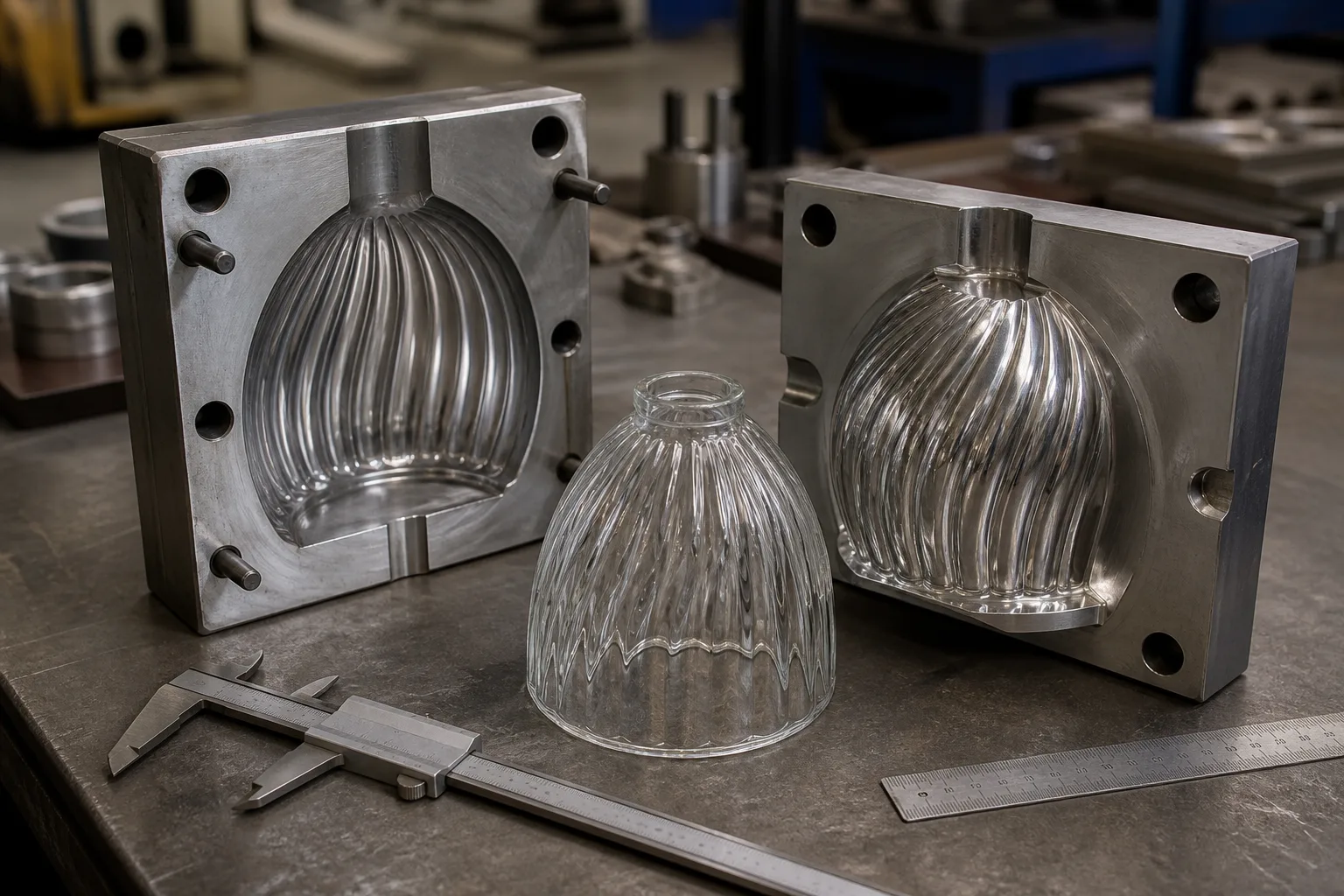
Do not carry an old supplier price range into a new project. Tool size, glass route, finishing, cavity count, and revision work can change the number. Treat tooling as a project-specific commercial item until the supplier confirms the scope.
Samples: compare approval evidence and credit terms
The sample question is not only "Is the sample free?" A free sample with the wrong process may tell the buyer less than a paid production-intent sample. Compare what each sample proves.
| Sample field | Record in the quote comparison |
|---|---|
| Sample type | Catalog piece, color chip, hand sample, pilot piece, or production-intent sample |
| Profile and interface | Drawing revision, opening, fitter, holes, rim, and assembly hardware |
| Finish | Color, opacity, texture, coating, polish, frosting, and visible variation |
| Quantity | Number of pieces and whether the buyer needs a matched set |
| Fee | Sample cost, development cost, and shipping shown separately |
| Credit | Amount or percentage credited to a defined bulk order, if any |
| Revision treatment | Cost and timing when the buyer changes the profile or finish |
| Approval record | Sample code, signed photos, comments, and approved date |
A sample approval should tie the price to a physical reference. Keep the approved sample ID beside the supplier SKU and drawing revision. If the buyer approves a finish from a photograph, record the lighting condition and ask whether the production lot will be judged against a retained sample.

When comparing finishes, use a side-by-side set. Clear, frosted, opal, colored, and ribbed glass can look different under transmitted light and reflected light. A finish name alone is a weak approval basis. The glass lamp shade technical drawing checklist can help organize the drawing and sample handoff.
Packaging: compare the protection system
"Standard export packing" is not a complete packaging quote. A glass shade can be protected at the body and still fail at the fitter, polished rim, hole, thread, coating, or thin projection. Ask for the actual packing configuration and a photograph of the packed product.
| Packaging line | What the buyer should confirm |
|---|---|
| Individual protection | Sleeve, paper, foam, molded insert, or another contact method |
| Critical edge protection | How the rim, neck, hole, or fitter is kept away from impact |
| Separation | Whether neighboring pieces can touch or rub during handling |
| Inner pack | Pieces per tray, divider, or inner carton and the allowed movement |
| Master carton | Outside dimensions, gross weight, carton strength, and piece count |
| Pallet or container position | Orientation, stacking limits, corner protection, and humidity exposure |
| Marks and labels | SKU, quantity, carton number, handling marks, and batch traceability |
| Evidence | Packing photos, packing instruction, and carton test or inspection record when required |
| Claims | Damage reporting window, photo requirements, and replacement or credit path |
Packaging should be compared with the same shipment quantity. A supplier that quotes one large carton and another that uses smaller cartons may show different freight and handling costs even when the per-piece protection looks similar. See JX's glass lamp shade packaging solutions guide for the packing questions to carry into a project discussion.
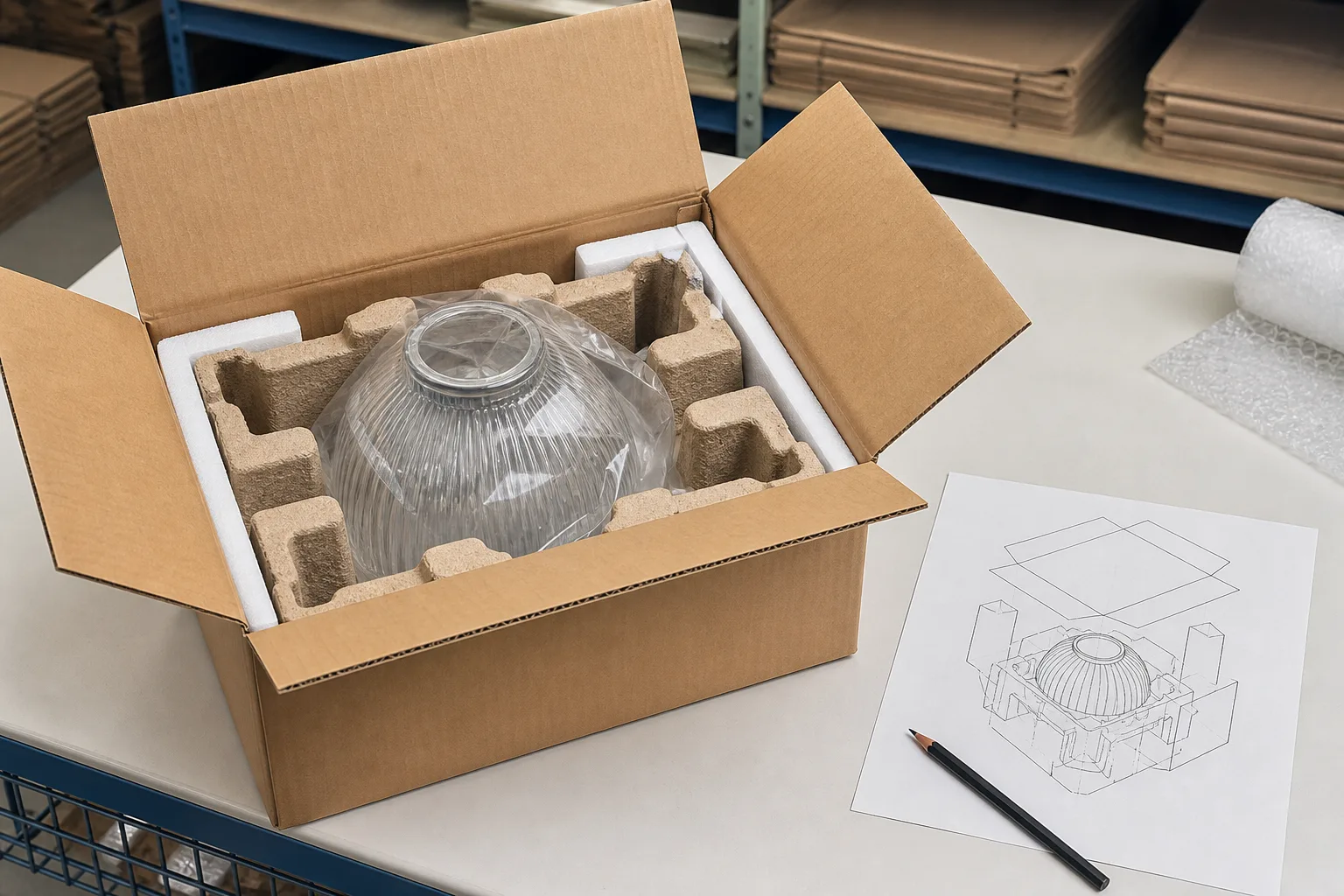
For a high-risk shape, ask the supplier to send one packing sample or a short packing video before the full order. That evidence does not replace a transit test, but it shows whether the quoted carton matches the intended protection system.
Reorder cost: calculate order two before order one
Many buying problems appear after the first shipment. The second order uses a new employee's description, a slightly changed finish, a different carton count, or a mold that was not actually preserved. Reorder cost needs its own record.
Create an approved SKU file containing:
- Buyer SKU, supplier SKU, and fixture position.
- Drawing revision, sample ID, finish reference, and approved photos.
- Material or glass direction, edge finish, fitter, openings, holes, and critical dimensions.
- Tool ID, tool owner, storage status, maintenance note, and revision history.
- Packaging drawing, insert version, carton quantity, labels, and packing photos.
- Reorder MOQ by SKU and the quantity used for the repeat price.
- Price validity, raw material or finish conditions, and the date for reconfirmation.
- Quality inspection plan, defect photos, release documents, and claim procedure.
At reorder stage, ask the supplier to confirm the current tool and process status before asking for a new price. Then compare the new quotation with the approved SKU file. If the supplier cannot identify which sample, drawing, finish, and packing record the new price follows, treat the quote as incomplete.
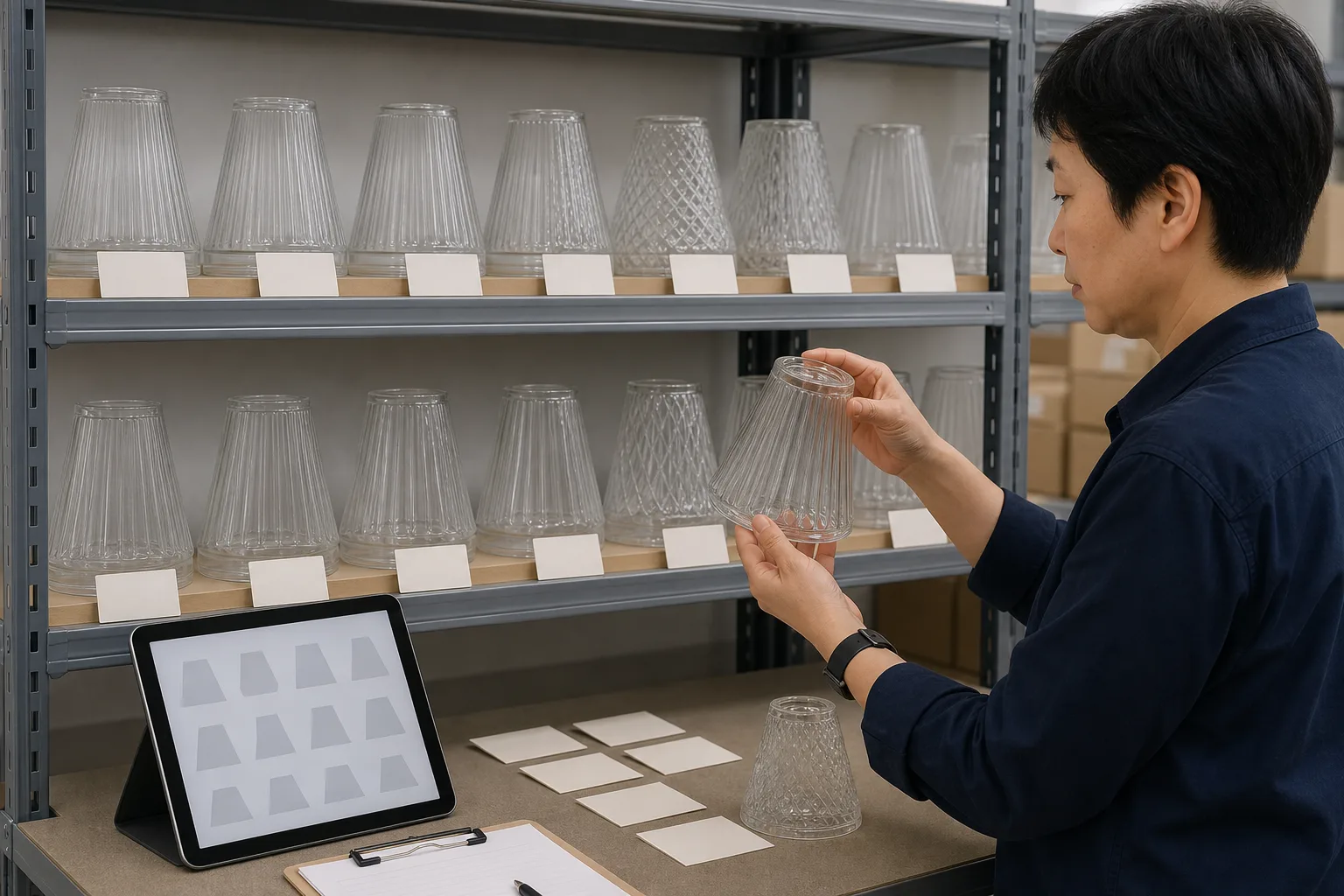
A simple repeat-order scenario
Use a second-order column in the workbook. Include the unit price, current packing, shipping assumption, and any document or label change. Do not add the original sample fee or new-tool charge to the repeat order unless the supplier says it recurs. At the same time, do not assume the tool is free forever. Ask what event causes maintenance or rebuild cost.
The glass lamp shades for distributors page is a useful internal reference for SKU, label, packaging, and reorder conversations. A buyer should still attach its own approved SKU record to the purchase order.
Use a completeness gate before scoring price
Price scoring should start only after the quote passes a completeness check. One practical gate is to score the quote on the following areas, then mark any missing evidence.
| Area | Weight | Pass condition |
|---|---|---|
| Technical identity | 25 | Same SKU, drawing revision, sample, finish, quantity, and interface |
| Commercial scope | 25 | Currency, Incoterm, named place, quote validity, and cost boundary are stated |
| One-time cost visibility | 15 | Tooling, sample, development, inspection, and revision costs are separated |
| Packaging and claims | 15 | Pack configuration, carton data, packing evidence, and claim route are stated |
| Reorder control | 20 | Tool status, approved SKU record, MOQ, repeat price basis, and change procedure are stated |
If a quote is missing a field, return it for clarification instead of awarding it a favorable assumption. A lower number with missing packaging or tooling information is a lower-confidence number, not a lower cost.

For inspection sampling, ISO 2859-1:2026 provides acceptance sampling plans indexed by an acceptance quality limit for lot-by-lot inspection. It does not create a universal AQL or tolerance for every shaped glass lamp shade. Use the ISO 2859-1:2026 reference to understand the framework, then agree the defect classes and acceptance limits for the actual product.
Questions to send to every glass lamp shade supplier
Send one question set with the drawing and sample reference. The answers make the quotes easier to compare and give the buyer a record for later reorders.
- Which buyer SKU, supplier SKU, drawing revision, and sample does this quote cover?
- What glass, color, finish, edge condition, fitter, and openings are included?
- Is the price for the stated quantity, and what changes at the expected repeat quantity?
- Which Incoterm, named port or place, transport mode, currency, and quote validity apply?
- Which costs are one-time, which recur, and which are excluded?
- Is the tooling new or existing, who owns it, and how is it maintained and identified?
- What sample will be made, what does it cost, and what is credited after approval?
- What is the individual and master-carton packing configuration, and can you provide packing photos?
- What will be held constant for a reorder, and what triggers a price, mold, finish, or packing review?
- What inspection record, batch traceability, and damage-claim evidence will accompany shipment?

What to send JX for a project-specific quote comparison
JX Lampshade is the trade name used here for Jingxin Glassware. The legal company name is Yancheng Jingxin Glassware Co., Ltd. The company facts used in this article are limited to the current Week 1 fact sheet: founded in 1999, a 48,430 sq ft factory, and exports to over 120 countries and regions. These are company background facts, not a guarantee that every product, order, or destination uses the same documents or commercial terms.
For an RFQ, send the buyer SKU list, drawing revision, reference samples or photos, glass and finish direction, annual and trial quantities, target destination, Incoterm preference, tooling questions, sample requirement, packaging requirement, and inspection evidence. JX's current planning baseline is catalog items from 500 pieces and full custom OEM from 1,000 pieces. Final MOQ, price, packing, and lead time remain project-specific and should be confirmed in the written quote.
JX also records a Sedex/SMETA audit and can discuss RoHS or REACH documentation for applicable projects. Product and destination certificates should be confirmed against the actual SKU and market. Do not treat an audit or document list as a substitute for the drawing, sample, inspection, or packing evidence your project requires.
Use the custom lampshade RFQ builder to organize the starting files, or review the custom glass lamp shade manufacturer page before sending a broader OEM brief.
Frequently asked questions
Is FOB the final price I will pay for glass lamp shades?
No. FOB identifies a delivery point at the named port under the ICC rule. The buyer still needs a freight, insurance, import entry, duty and fee, inland delivery, and handling scenario. Ask the supplier to state what is excluded.
What should I standardize first when comparing supplier quotes?
Standardize the buyer SKU, drawing revision, approved sample, finish, quantity, Incoterm, named place, packing basis, currency, and destination. Without those fields, a unit-price comparison is weak.
Should tooling be included in the unit price?
Either approach can work if the supplier explains it. The buyer should see the one-time tool cost, the ownership and storage arrangement, maintenance responsibility, and the condition that triggers a new charge. A hidden amortization makes reorders difficult to forecast.
Should a sample be free?
Not necessarily. Compare the sample's process, material, finish, interface, fee, shipping, credit, revision rule, and approval record. A production-intent sample can be worth paying for when it prevents a larger tooling or batch mistake.
How can I compare packaging between suppliers?
Ask for the same shipment quantity, pieces per inner pack, insert or divider, carton dimensions, gross weight, pallet arrangement, labels, and damage-claim procedure. Request photos or a packing sample when the shape or rim is fragile.
How do I protect the reorder price?
Freeze an approved SKU file with the drawing, sample, finish, tool ID, packing version, inspection plan, and change history. At each reorder, ask the supplier to confirm that the new price follows that record.
Send a controlled quote comparison pack
The fastest way to get a useful supplier response is to send one controlled pack rather than several disconnected emails. Include the drawing and revision, buyer SKU, sample reference, finish, quantity, destination, Incoterm preference, tooling questions, packing requirement, and the evidence required before shipment.
Use the JX custom lampshade RFQ builder to submit the information. Ask for the supplier's quote in the same field order so you can compare first-order cost, repeat-order cost, technical completeness, and commercial boundary in one workbook.