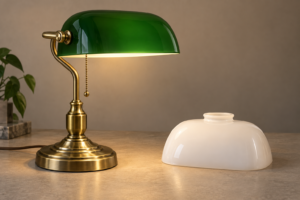
Quick answer: A custard glass lamp shade is a yellow, cream, or pale opaque to translucent glass shade with a soft body color. The name describes an appearance and a historical style more reliably than it describes a single glass formula. Some examples are associated with uranium glass, but color or a UV response does not prove composition. For a replacement or OEM project, specify the profile, fitter opening, outside diameter, height, rim, light transmission, UV requirement, fixture, and destination market separately. A supplier can then review the drawing or sample before recommending a production route.
What is a custard glass lamp shade?
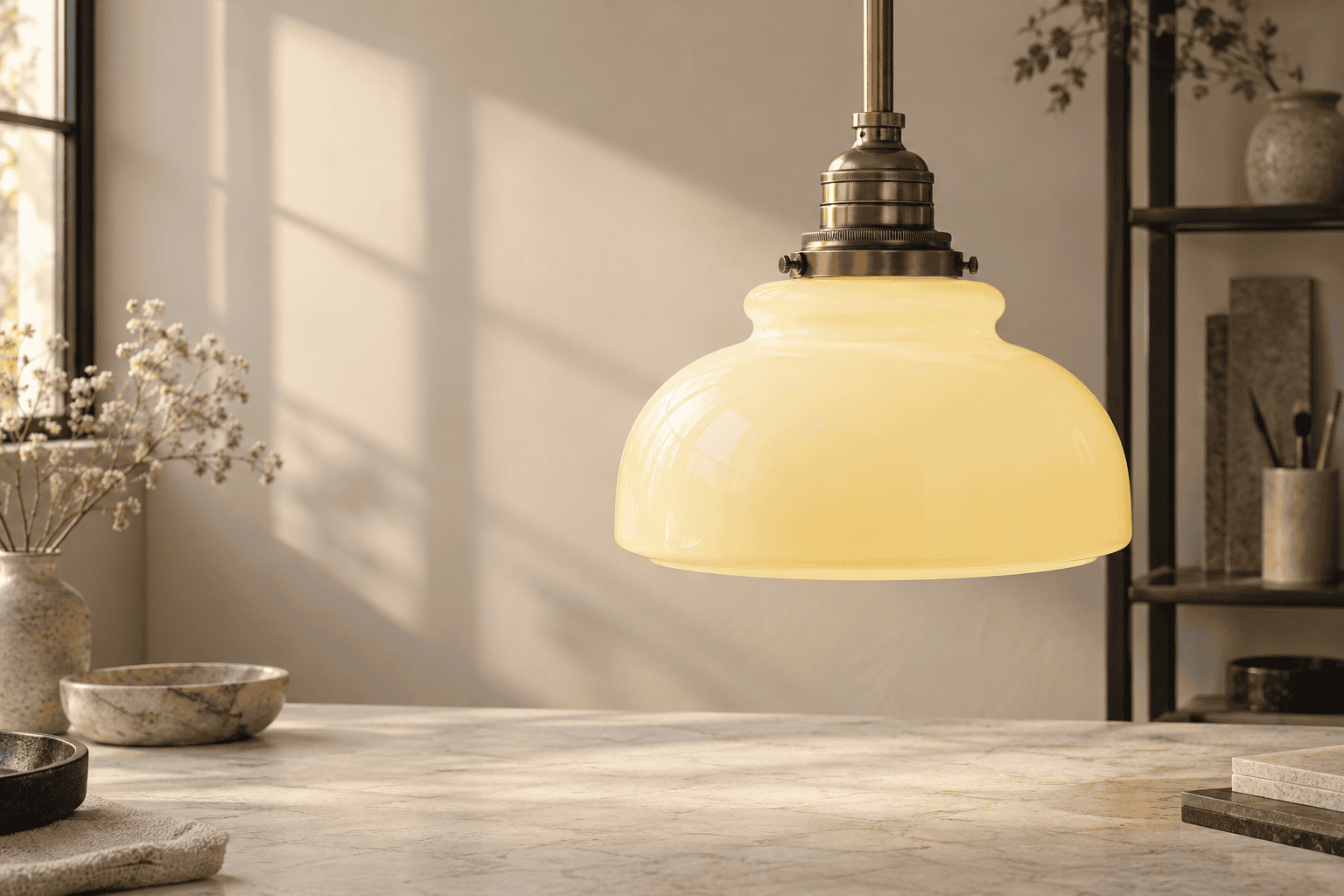
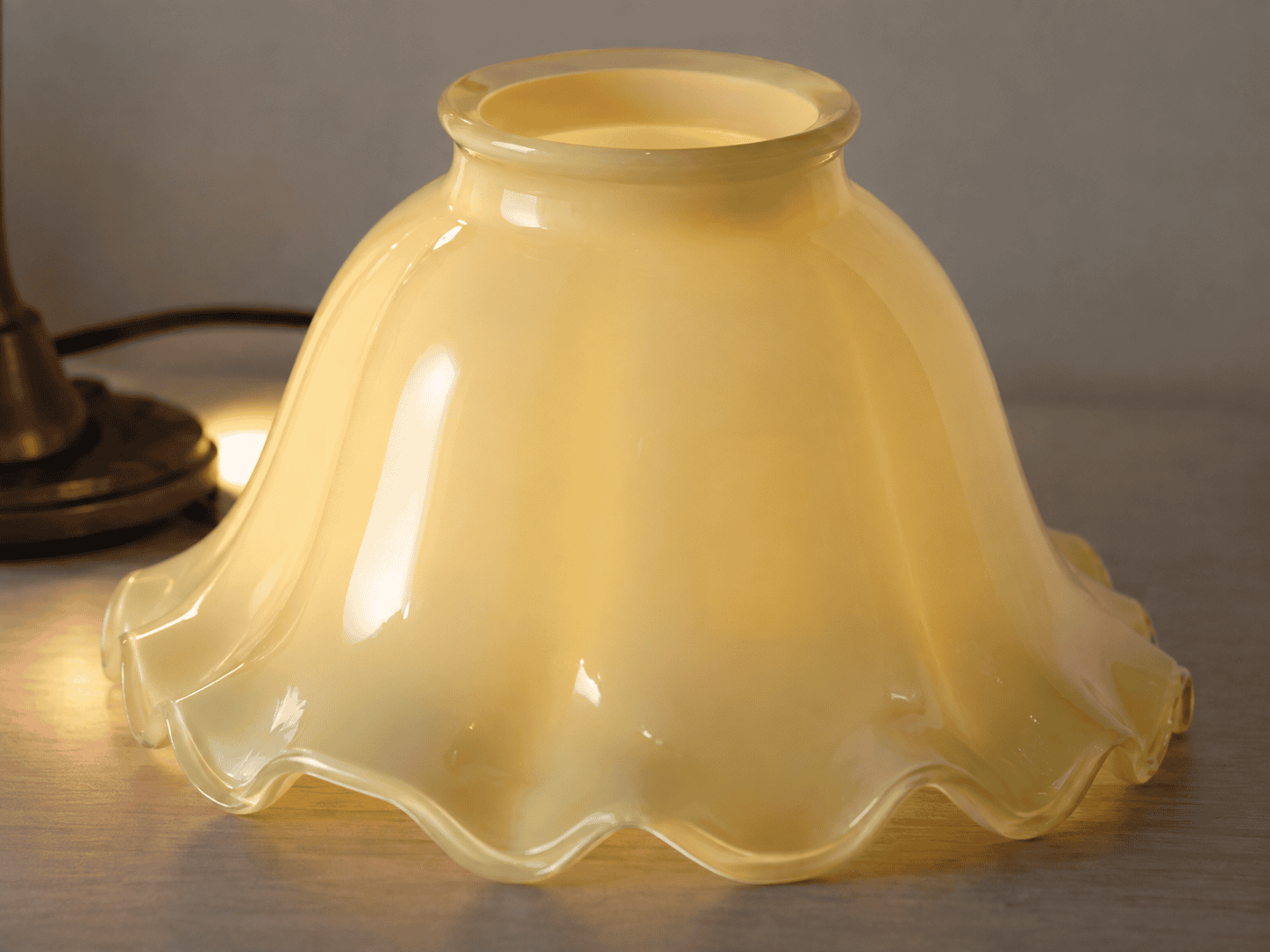
Custard glass is recognized by its warm yellow, ivory, or cream appearance and limited transparency. A thin edge may transmit more light than the main body. When illuminated, the shade can show a gentle internal glow rather than the sharp outline of clear glass.
The term appears in collector descriptions, antique listings, restoration searches, and lighting catalogs. It is useful for finding a reference, but it is incomplete as a production specification. Two shades called custard may differ in opacity, texture, color depth, fitter geometry, and forming method.
Historical terminology overlaps. The Corning Museum of Glass explains uranium glass as glass colored with uranium oxide. The ORAU Museum describes the relationship between Vaseline, uranium, custard, and Burmese glass, including opaque yellow families called custard glass. For buyers, custard is the visual target; composition, fit, process, and compliance are separate decisions.
How to identify custard glass without overclaiming
Identification is a screening exercise. It helps a buyer describe a reference and decide what evidence to request. It does not replace a material declaration, engineering review, or market-specific compliance check.
View the shade in ordinary light first. Record whether the body is opaque, translucent, or transparent. Photograph it against a neutral background and note whether the yellow looks cream, lemon, butter, ivory, or greenish. Then inspect the edge, profile, surface, ribs, seams, and bubbles. Side and top photographs are more useful than a marketplace title when a restoration supplier is matching a broken part.
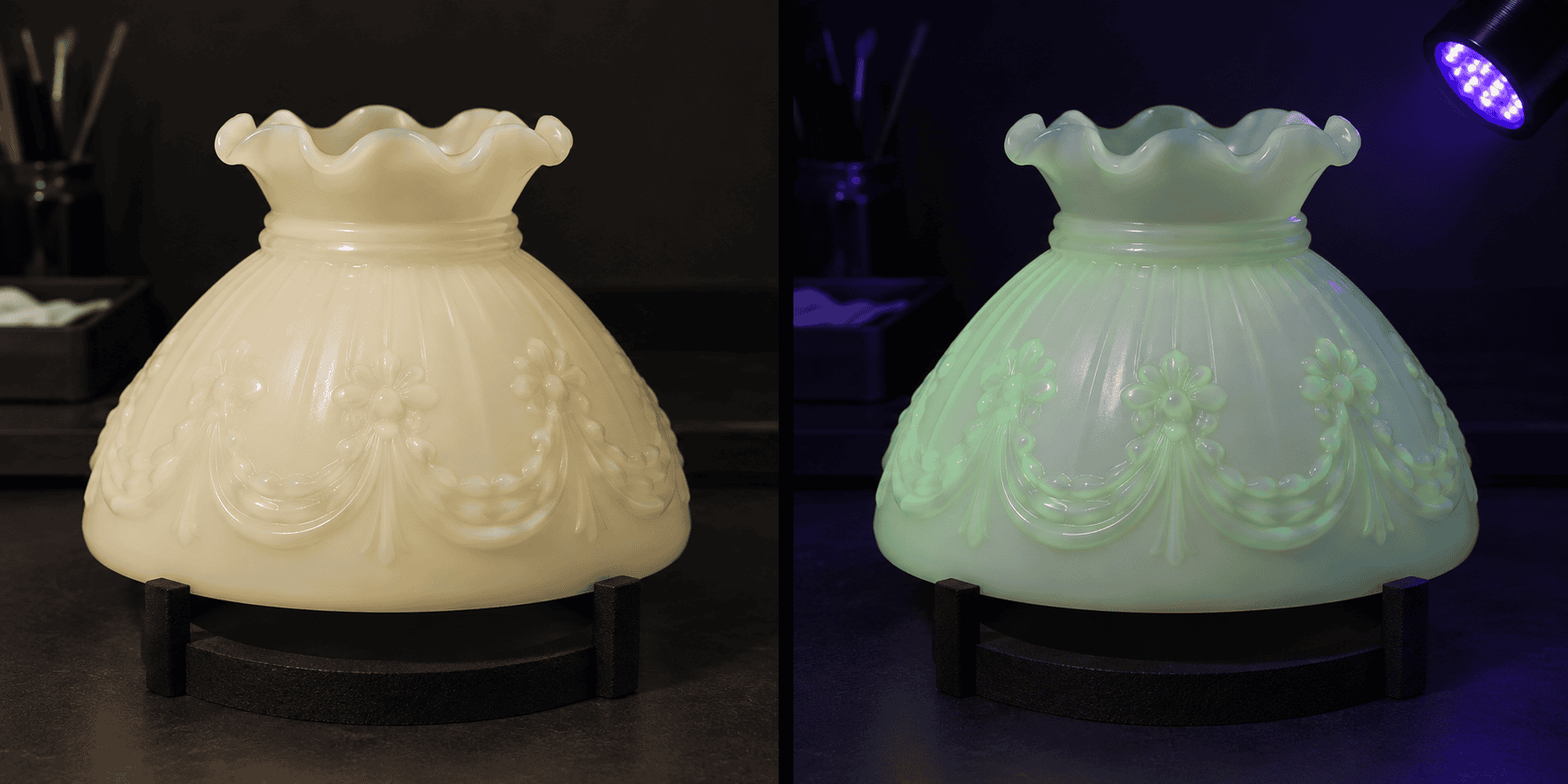
Some collectors use a UV lamp as an additional clue. A green fluorescence can support further investigation, but it is not a universal test. The McCord Stewart Museum notes that uranium combinations can create opaque yellow or white custard glass and that many older objects fluoresce under UV. Neither color nor a glow, by itself, establishes the exact composition of an unidentified shade.
| Identification evidence | What it helps assess | What it cannot prove |
|---|---|---|
| Yellow, cream, or ivory body | Resemblance to a custard style reference | Formula or uranium content |
| Opaque or softly translucent body | Approximate transmission and bulb concealment | Forming method |
| Green response under UV | Whether further material review is useful | That every custard shade glows or is automatically safe |
| Historical label or listing | Search language and possible period context | Fit, condition, or composition |
| Edge, seam, ribs, bubbles, or pressed detail | Surface character and possible forming clues | A guaranteed match |
| Physical sample and fixture | Starting evidence for fit and visual approval | A substitute for a written specification |
If a project requires uranium-bearing glass, state that requirement openly. If the requirement is only a custard appearance, say so instead. The two briefs can lead to different material reviews, sourcing decisions, and destination-market questions.
Where custard glass shades are used
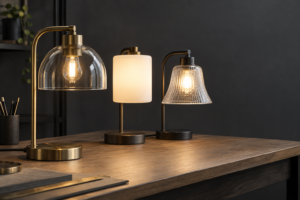
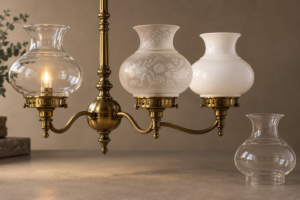
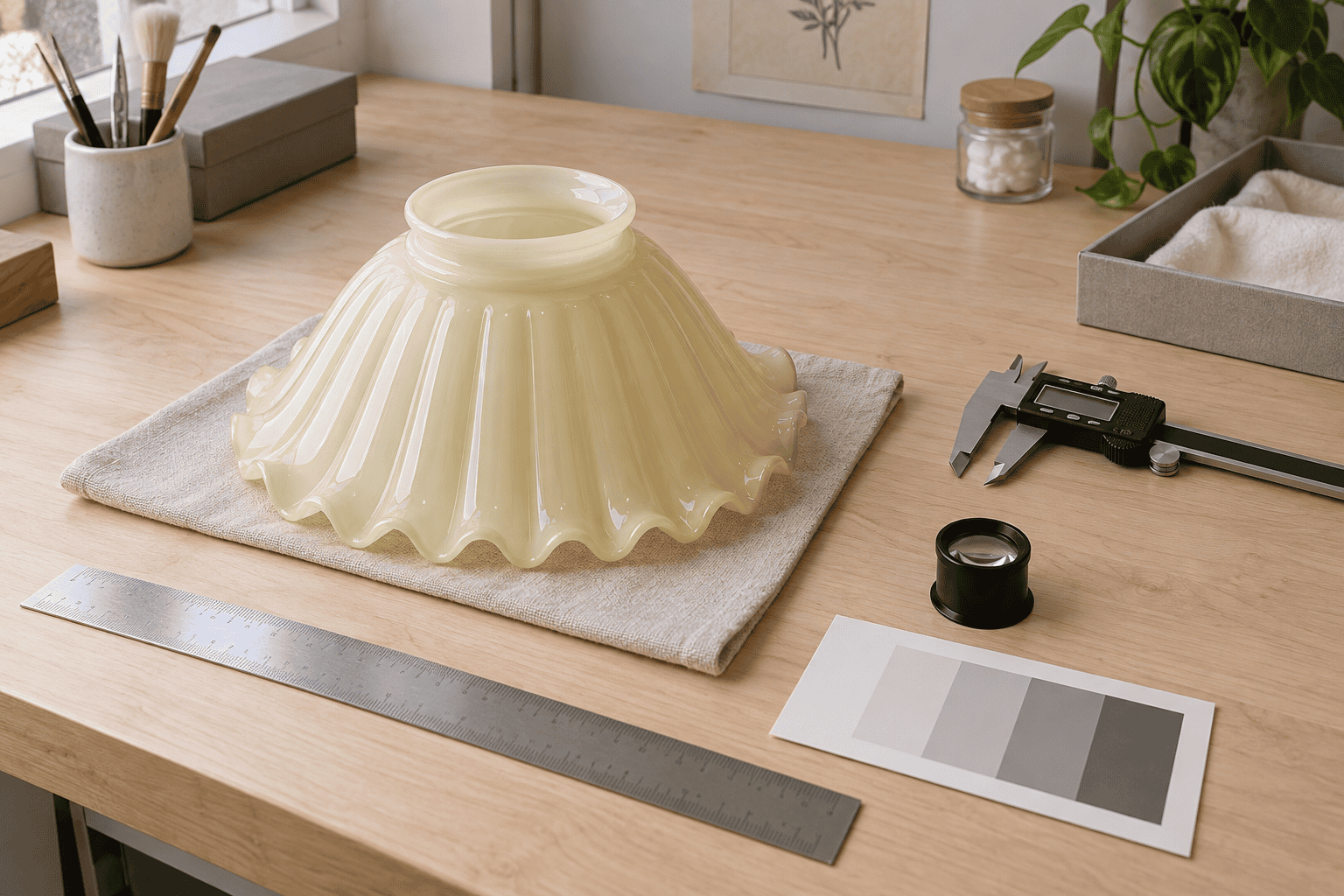
Custard glass lamp shades are usually fixture components rather than stand-alone decorative objects. Common applications include pendant and ceiling fixtures, table or desk lamps, wall sconces, vintage restoration, and new OEM lighting ranges. Each use changes the first checks: an opening and drop for a pendant, seating depth and heat clearance for a table lamp, projection for a wall fitting, or repeatable geometry and packing for a product family.
Send the fixture photo, retaining hardware, measured sketch, lamp source, and destination market. A restoration supplier needs the silhouette and contact surfaces. A lighting brand also needs the drawing revision, quantity, sample expectation, and related-size plan.
Review color on the intended fixture. Brass, dark metal, the bulb, diffuser position, and room background can change the perceived depth.
Choose the profile before you choose the color name
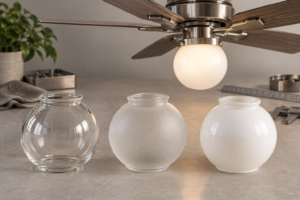
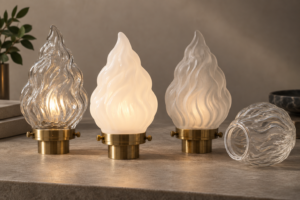
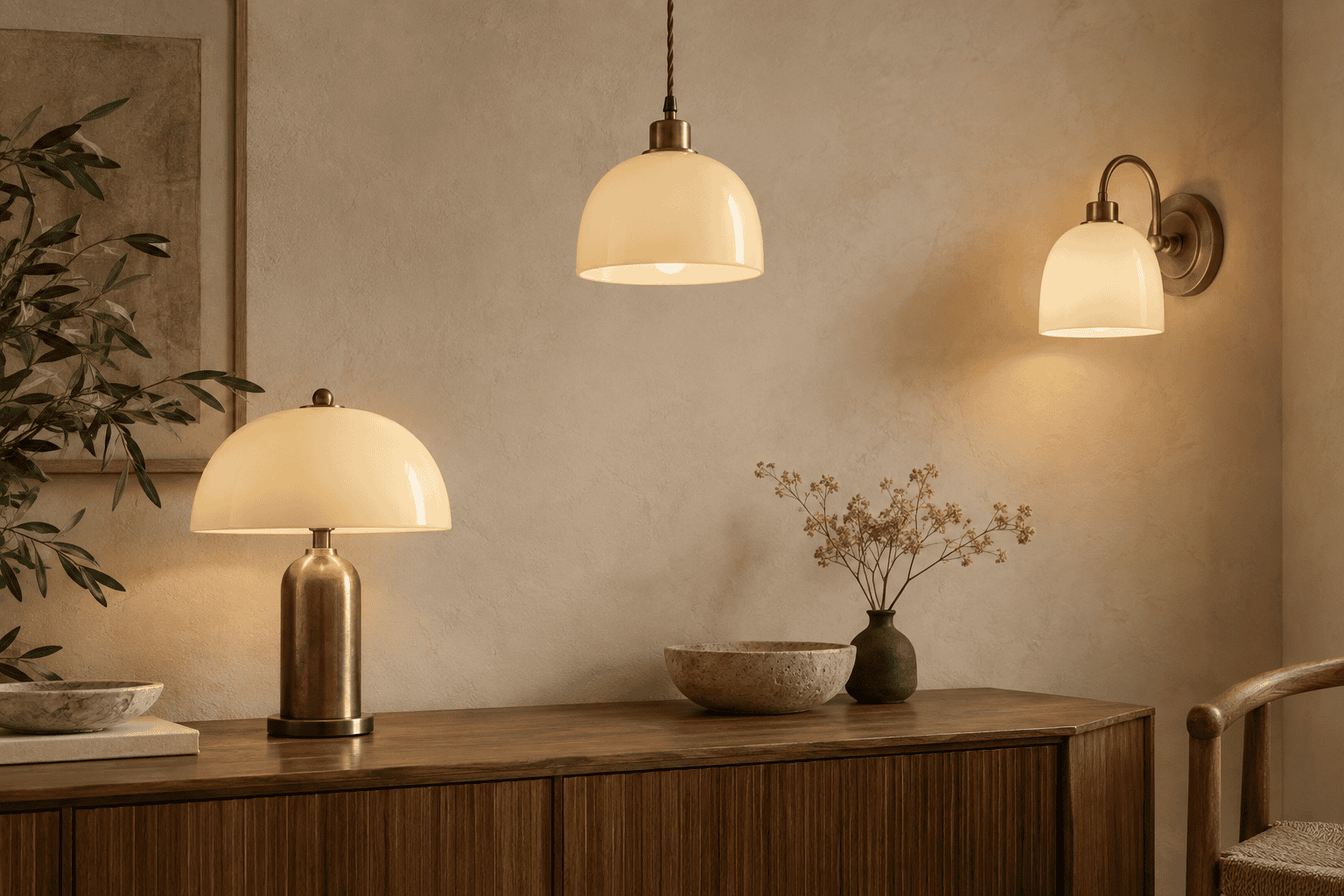
Searches for a custard shade may return dome, globe, bell, mushroom, schoolhouse, flared, ruffled, or ribbed shapes. These terms are useful for discovery, but they are not interchangeable. A mushroom has a short neck and broad shoulder; a bell flares toward the bottom; a globe depends on its roundness and opening position.
The profile sets bulb clearance, widest diameter, packaging shape, and contact surface. For a match, send a side outline or physical sample. On a new drawing, mark the fitter plane, neck transition, maximum diameter, shoulder, bottom edge, and any scallop or ruffle so the supplier can separate assembly dimensions from visual references.
Fitter openings and size references
The fitter is the interface between the glass and the fixture. A lip may sit over a gallery or retaining ring, while a neck enters a holder. Some shades use screws, clips, threads, or a separate support. Sellers do not always measure “fitter size” at the same surface.
Use the JX glass lamp shade fitter types guide to separate the opening, lip, neck, and hardware-supported connection before you request a replacement or OEM quote.
| Search or catalog reference | Exact nominal conversion | What the buyer must clarify |
|---|---|---|
| 2 1/4 inch fitter glass shade | 57.2 mm | Whether 2 1/4 inches describes the opening, lip, or holder |
| 3 1/4 inch fitter glass shade | 82.6 mm | The seating diameter, neck length, and retaining method |
| 4 inch fitter glass shade | 101.6 mm | Whether the fixture accepts a four inch opening or a four inch external ring |
| 6 inch fitter glass shade | 152.4 mm | The support span, shade weight, clearance, and ring geometry |
These are search and project references, not one universal fitter standard. Measure the hardware and glass contact surfaces for a replacement. For OEM work, put the reference plane on the drawing and set the acceptable range after the route is known.
Four inch and six inch fitter shades are not the same sourcing problem
A four inch fitter suits a more compact gallery. A six inch opening usually needs a larger support system, weight and packaging review, and a clearer bulb clearance check. Ask for the opening, lip or neck, seating depth, rim, and widest diameter, plus a retaining-ring drawing or photo.
How to measure a replacement custard glass shade
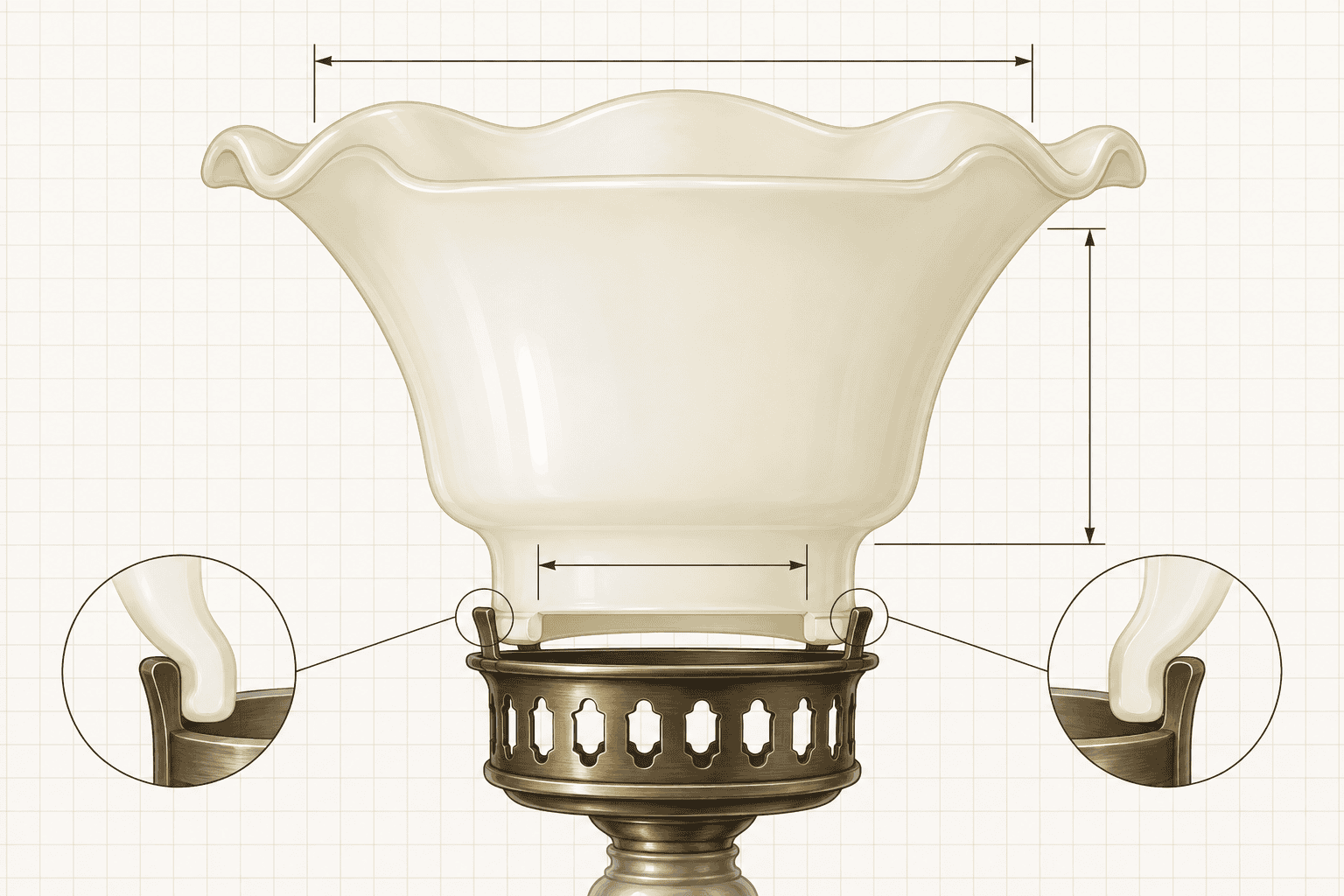
Measure the fixture before ordering. If the original is broken, keep the largest safe fragment and photograph the fracture without assembling it. The rim, neck, or shoulder can identify the interface.
- Mark the reference plane. Use the top of the gallery, ring face, or another fixed surface for every height measurement.
- Measure the opening twice. Take readings at right angles because old hardware may be out of round.
- Measure the glass contact diameter. Record the surface that rests on or enters the holder, not the hardware's outside diameter.
- Record seating depth and lip height. A matching diameter can still fail if the neck or lip is too deep, short, or differently shaped.
- Measure maximum diameter. Note the height of the widest point for clearance and packaging.
- Measure height and bottom edge. For scallops or ruffles, record both high and low points when clearance is tight.
- Photograph retaining hardware. Show screws, clips, galleries, rings, threads, and contact marks with a ruler.
- Record the visual target separately. Note custard color, opacity, texture, and whether the match is judged unlit, lit, or both.
| Measurement field | How to record it | Why the supplier needs it |
|---|---|---|
| Fitter opening | Inside diameter at the actual seating plane, in millimeters and inches | Establishes the basic interface |
| Lip or neck outside diameter | Outside diameter of the glass feature that meets the holder | Prevents confusion between glass and hardware dimensions |
| Seating depth | Axial distance from the reference plane to the contact point | Controls how far the shade enters or sits on the fixture |
| Maximum diameter | Largest outside diameter and its height from the reference plane | Checks visual proportion, clearance, and carton size |
| Overall height | Reference plane to bottom edge, with high and low points if needed | Controls fixture scale and bulb clearance |
| Rim condition | Ground, polished, fire-polished, rolled, scalloped, or another agreed finish | Affects contact, handling, and visible edge appearance |
| Appearance | Sample, neutral-light photos, opacity direction, and surface reference | Gives color and diffusion a reviewable target |
Use the JX technical drawing checklist to organize these fields. Send the original with the drawing when available.
Custard, milk, opal, clear, and frosted glass compared
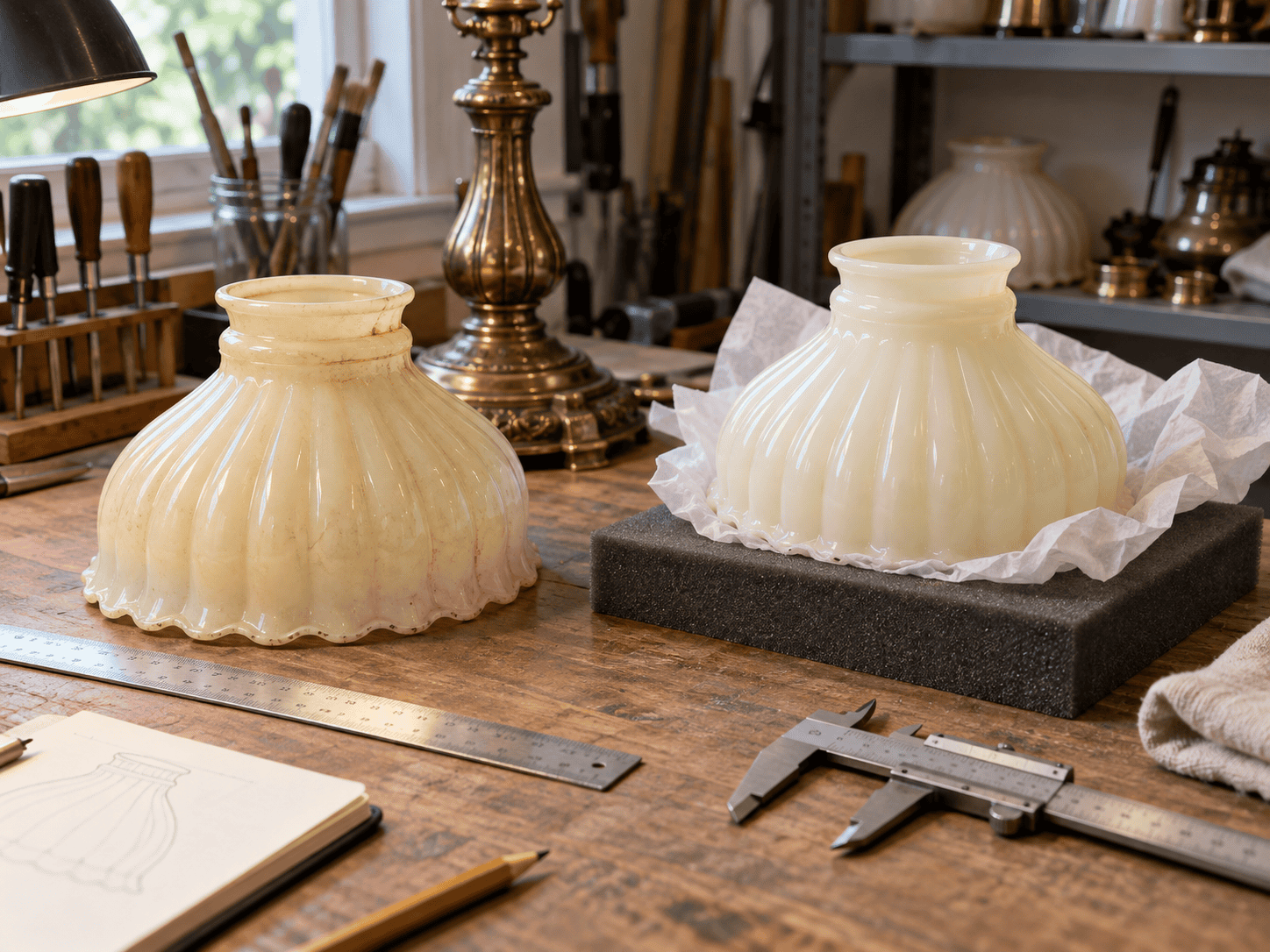
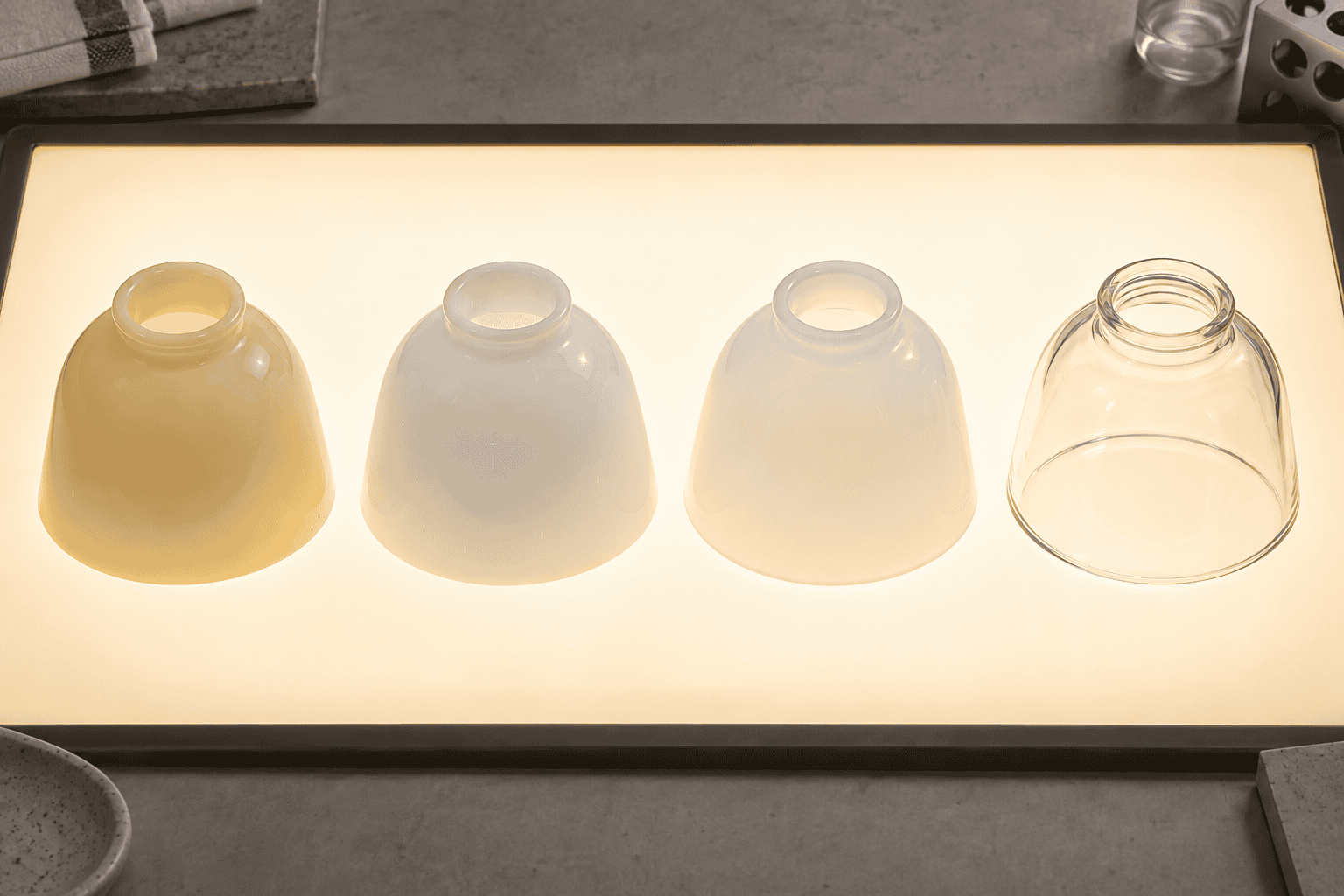
Approve color and diffusion under a defined light source. “Yellow” says little about how much of the bulb will show. “Opaque” also needs a visual boundary because thin edges and transitions can transmit more light than a broad wall.
| Glass appearance | Unlit view | Lit view | Suitable when the buyer wants | Approval point |
|---|---|---|---|---|
| Custard glass | Warm yellow to ivory body, usually opaque or softly translucent | Gentle colored glow with reduced bulb detail | A historical or warm colored reference with a quiet surface | Hue, opacity, edge transmission, and sample under the intended bulb |
| Milk glass | White body with a soft, even appearance | Diffuse light with low visual contrast | A classic white shade that hides much of the source | Whiteness, wall opacity, and visible rim transition |
| Opal glass | White or lightly tinted, often more evenly translucent | Broad diffusion and a smooth luminous field | Comfortable general illumination and controlled source visibility | Transmission, tint, and whether the finish is integral or applied |
| Clear glass | Transparent body with a strong view of the source and hardware | Directer transmission and sharper highlights | A visible filament, clear profile, or maximum brightness through the shade | Clarity, bubbles, surface marks, and reflected glare |
| Frosted or satin etched glass | Softened reflections and a less mirror-like surface | More even glow with reduced sharp highlights | Lower glare and a quieter visual finish | Uniform treatment, boundary line, cleaning requirement, and color shift |
| Seeded or textured glass | Visible texture or intentional inclusions | Scattered highlights and less uniform projection | A handmade or period surface character | Inclusion size, density, location, and acceptable variation |
Wall thickness, surface treatment, and light source can make the same custard color read differently. Approve a physical sample unlit and lit; an unlit phone image is not enough for an OEM diffusion decision.
Mouth-blown or machine-pressed production?
The forming route should follow the shape, quantity, visual character, tooling budget, and repeatability the project needs. Mouth-blown glass can suit a prototype, shaped reference, or smaller run where hand finishing is part of the brief. Machine-pressed glass can suit repeated molded profiles and coordinated size families, but tooling, cooling, trimming, mold wear, and edge finishing still need control. A hybrid route adds another approval surface whenever a formed body receives separate edge, coating, or decorative work.
Mouth-blown work does not automatically match better, and pressed glass does not solve every visual problem. A pressed mold can repeat a profile while still requiring review of the lip, cooling, color batch, and finishing. A blown sample still needs an agreed variation range.


See JX manufacturing before confirming a route.
Custom mold development and dimensional control
Custom mold development starts by defining what must remain stable. A sample does not reveal every assembly dimension. Identify the fitter plane, critical opening, maximum diameter, height, rim, visible surface, and any feature that must match an existing family.
| Development stage | Buyer input | Output to request |
|---|---|---|
| Reference review | Sample, fixture, photos, and open questions | Feasibility notes and missing dimensions |
| Drawing and mold | Profile, fitter, size, finish, ownership, and cost basis | Marked drawing and mold scope |
| First sample | Lit and unlit appearance, fit, rim, and surface | Sample and inspection record |
| Production release | Approved sample, revision, packaging, and inspection plan | Controlled production reference |
Do not insert a generic tolerance or glass thickness into the RFQ simply to make the drawing look complete. The correct dimensional tolerance and wall thickness depend on the geometry, glass type, forming route, finishing operation, and the way the part is held. The safe wording for an open item is: “Confirm with our engineering team based on the drawing, glass type and production method.”
For a replacement, the fixture often supplies the strongest constraint. For OEM work, trade fitter precision against tooling and finishing cost before mold release. Approve color under the agreed light source because thickness can change its apparent depth.
Quality inspection for an OEM or replacement shade
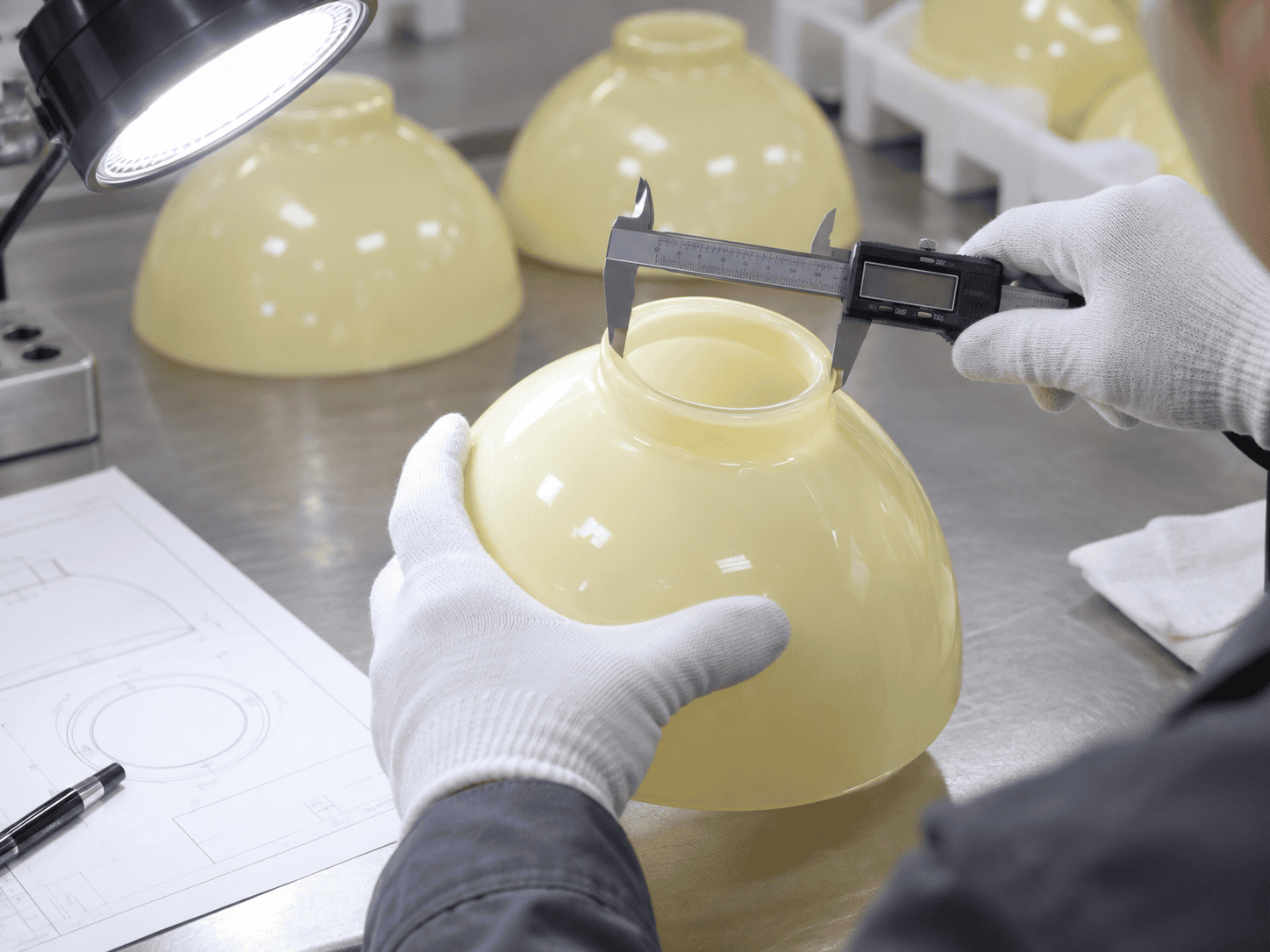
Inspection should follow the approved drawing and sample. Separate assembly dimensions from appearance, and state how color, opacity, bubbles, seams, edge marks, and intentional texture will be judged.
The JX glass lamp shade quality inspection checklist helps turn a visual reference into inspection points. Agree sampling, acceptance limits, and any stress or thermal checks for the product before production.
| Inspection area | Practical check | Decision to agree before production |
|---|---|---|
| Fitter and mounting surface | Caliper, gauge, or fixture-fit check after final finishing | Critical diameter, seating depth, roundness, and method |
| Profile and overall size | Height, maximum diameter, and outline comparison | Which dimensions are critical and which are reference only |
| Color and opacity | Side-by-side review in agreed unlit and lit conditions | Sample, light source, viewing distance, and allowed variation |
| Surface | Review of scratches, marks, seams, bubbles, stones, and texture | Defect classes, intentional features, and visible zones |
| Edge and rim | Visual and dimensional check after cutting, grinding, polishing, or other finish | Chip limits, edge appearance, contact surface, and rim condition |
| Matched sets | Side-by-side comparison for shades used on one fixture or product family | Allowed difference within a set and across production lots |
Color mismatch can come from formulation, batch variation, wall thickness, surface treatment, or approval under different lighting. A shade that passes a daylight photo may look too strong beside its approved mate under warm LED light. Keep the master sample and the viewing condition with the production record.
Packaging and international shipping
Glass shade packaging should protect the fitter and widest body, not just fill empty space. A thin replacement lip can be damaged even when the dome is supported. A six inch opening can increase carton size and movement inside a master carton.
Ask the supplier to show the individual pack, edge protection, master carton, and pallet arrangement. Foam, EPE, molded pulp, or corrugated dividers may suit different shapes and routes.
If a transit simulation is required, define its method and acceptance condition before production. Agree the evidence behind any export-packaging claim and the damage-claim policy.

MOQ, samples, and mass production planning
A replacement project and a new OEM project should not be quoted from the same assumptions. A new mold can make repeat production practical, but the buyer still needs a signed sample and stable drawing revision.
| Project type | First information to settle | Output to request |
|---|---|---|
| Vintage replacement | Fixture, fragment, fitter, silhouette, color, and clearance | Fit review, sample comparison, and packing recommendation |
| Existing product replacement | Approved sample, drawing revision, inspection points, and batch history | Controlled sample, production drawing, and lot consistency plan |
| New OEM or ODM | Profile, fitter, appearance, quantity, annual demand, and destination | Feasibility review, mold proposal if needed, sample route, and quote |
| Repeat order | Retained sample, change rules, packaging, and reapproval triggers | Confirmation of what remains constant and what requires review |
For planning, the current JX project profile lists catalog items from 500 pieces and full custom OEM projects from 1,000 pieces. Final MOQ, price, sample arrangement, packaging, and lead time remain project-specific and should be confirmed in the written quotation. Small replacement or trial quantities can also be discussed case by case rather than assumed from this planning baseline.
Do not promise a tolerance, certification, formulation, lead time, or production capacity from a general article. Confirm with our engineering team based on the drawing, glass type and production method, and confirm destination-market documents against the actual SKU.
Buyer RFQ checklist for a custard shade
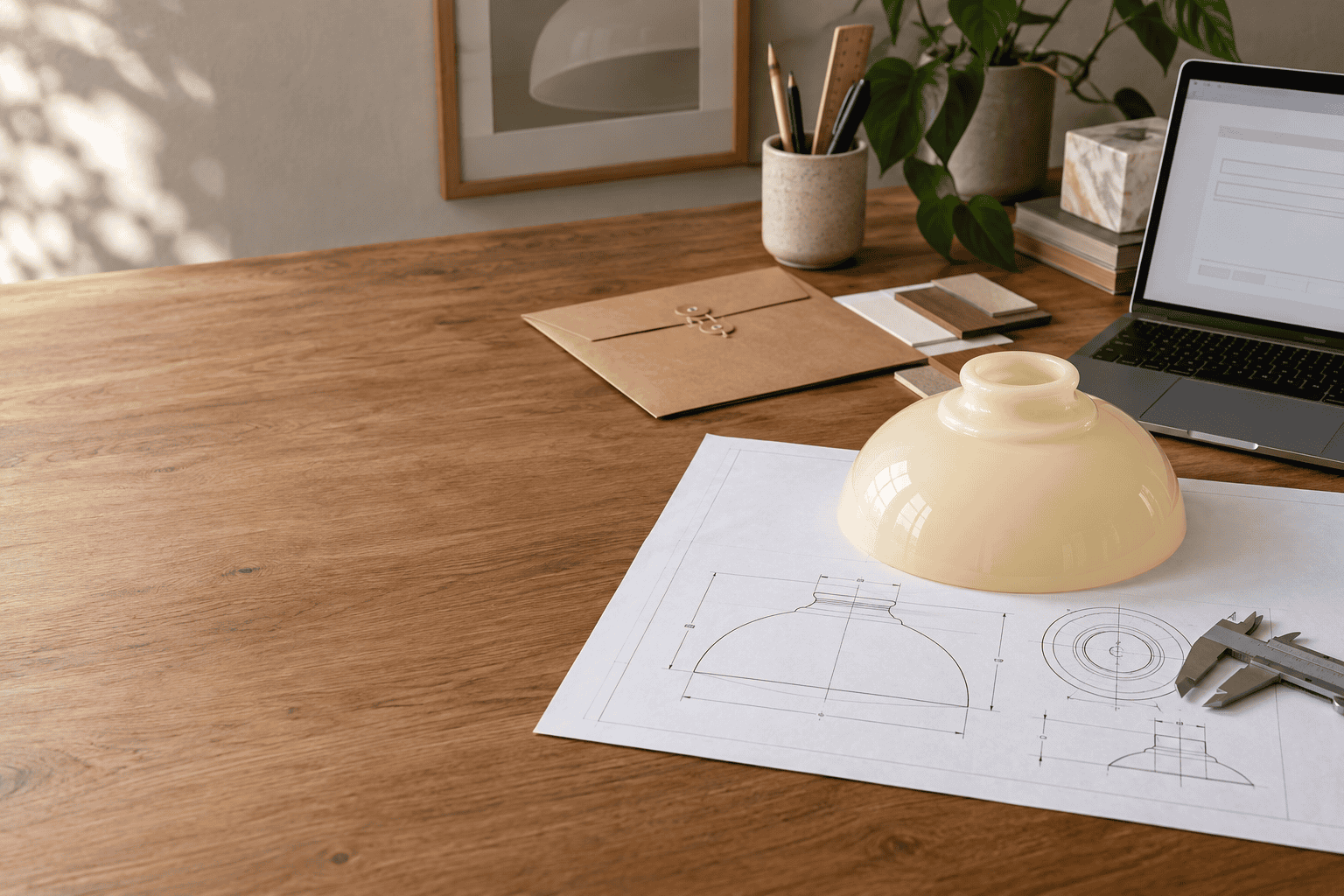
Send the following information in one package when possible. If a field is unknown, label it as open instead of allowing the supplier to guess.
| RFQ field | Minimum useful information |
|---|---|
| Project type | Vintage replacement, existing product replacement, new OEM, or ODM development |
| Reference | Physical sample, fragment, fixture, photographs, sketch, or CAD file |
| Fitter | Opening, lip or neck diameter, seating depth, retaining method, and reference plane |
| Dimensions | Height, maximum diameter, rim, critical profile stations, and units |
| Glass appearance | Custard color target, opacity, texture, edge appearance, and unlit/lit reference |
| UV or composition | Appearance only, UV response as an observation, or a specified material requirement |
| Application | Pendant, ceiling, table, wall, outdoor, decorative, or complete luminaire component |
| Quantity | Sample quantity, trial quantity, expected repeat quantity, and annual estimate if known |
| Quality | Critical dimensions, visual limits, approved sample, inspection records, and matched-set rules |
| Packaging | Individual protection, master carton, pallet preference, labeling, and shipping route |
| Destination | Country or region, required documents, and importer or product obligations |
| Commercial questions | Tooling status, mold ownership, MOQ, price basis, sample credit, Incoterm, and quote validity |
Buyer questions
What is custard glass?
Custard glass is a yellow, cream, or ivory glass family with an opaque or softly translucent appearance. It is a visual and historical term, not a complete material specification. A new shade still needs a composition, profile, fitter, dimensions, and sample.
Does all custard glass glow under UV?
No. A UV response varies with composition, color, thickness, and viewing conditions. A glow supports investigation, but does not prove composition or safe use. Record the UV setup if it is part of the brief.
Is custard glass the same as Vaseline glass?
No. Vaseline glass commonly means a more transparent yellow to yellow-green appearance, while custard usually points to opaque or softly translucent yellow glass. Use the visual target and material requirement separately in an RFQ.
Is custard glass safe to use in a lamp?
Color alone cannot answer that question. The shade must fit the fixture, remain sound, and suit its thermal and mechanical conditions. If uranium-bearing material is proposed, review the formulation and destination market first. The U.S. Nuclear Regulatory Commission guidance explains that products containing source material can involve exemptions, licensing, and transfer conditions.
How do I identify a custard glass lamp shade?
Start with body color, opacity, profile, rim, fitter, and surface character in ordinary light. Use controlled UV only as an additional clue. Compare a physical sample under the intended light source, and request a material review if composition matters.
How do I measure a replacement custard glass shade?
Measure the reference plane, inside opening, glass contact diameter, seating depth, lip or neck, maximum diameter, height, and retaining method. Take two-direction readings and send photographs with a ruler. A sample fragment or original fixture is more useful than a listing title.
Which fitter sizes can be made?
Fitter sizes are project-specific. A buyer may search for 2 1/4 inch, 3 1/4 inch, 4 inch, or 6 inch references, but the opening, lip, neck, seating depth, and hardware belong on the drawing. Confirm dimensions and tolerances with engineering after the glass type and forming method are known.
Can JX reproduce a custard glass shade from a sample?
JX can review a sample, drawing, profile, fitter, finish, quantity, and intended market for a custom glass lamp shade project. Reproduction still requires confirmation of appearance, composition, forming route, mold, dimensions, and compliance before quotation and sampling.
What should I send for a custom quotation?
Send the shade or fixture reference, marked dimensions, fitter details, target color and opacity, finish, application, UV or composition requirement, quantities, destination, packaging, and inspection expectations. Include the drawing revision and open items.
Turn a historical shade reference into a production brief
For a replacement or new lighting range, the useful first step is to turn “custard glass” into a measurable brief. Separate the color name from composition, the fitter label from the actual opening, and a visual preference from an acceptance limit. That gives the supplier a clear path to review the sample, forming route, mold, inspection plan, and packaging.
JX Lampshade can review custom glass lamp shade requirements for replacement, OEM, and ODM projects. Send the drawing or sample through the custom glass lamp shade manufacturer page or the JX contact page. Ask engineering to confirm the glass type, production method, dimensional tolerance, sample route, MOQ, packaging, and destination-market documentation for the actual project.
Related glass shade resources
| Glass lamp shades | Vintage glass lamp shades | Glass lamp shade fitter types |
| Glass lamp shade technical drawing checklist | Glass lamp shade quality inspection checklist | Custom glass lamp shades manufacturer |