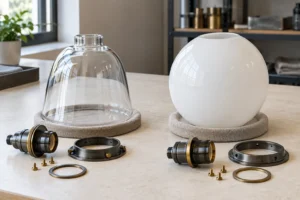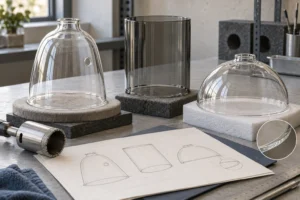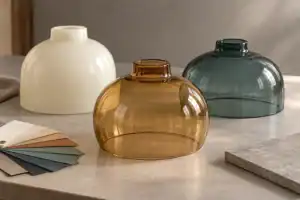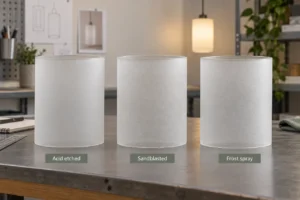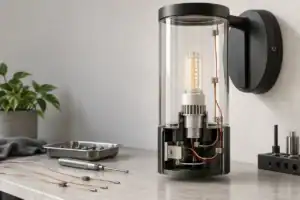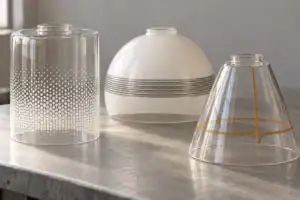
Direct answer: Cut glass ceiling light shades are faceted glass covers for ceiling-mounted fixtures including flush mounts, semi-flush fixtures, chandeliers, and pendant ceiling roses. They attach via ceiling canopy covers, gallery rings, or chandelier cup fittings. The overhead position creates strong prismatic ceiling and upper-wall effects — different in character from floor or table lamp shades.
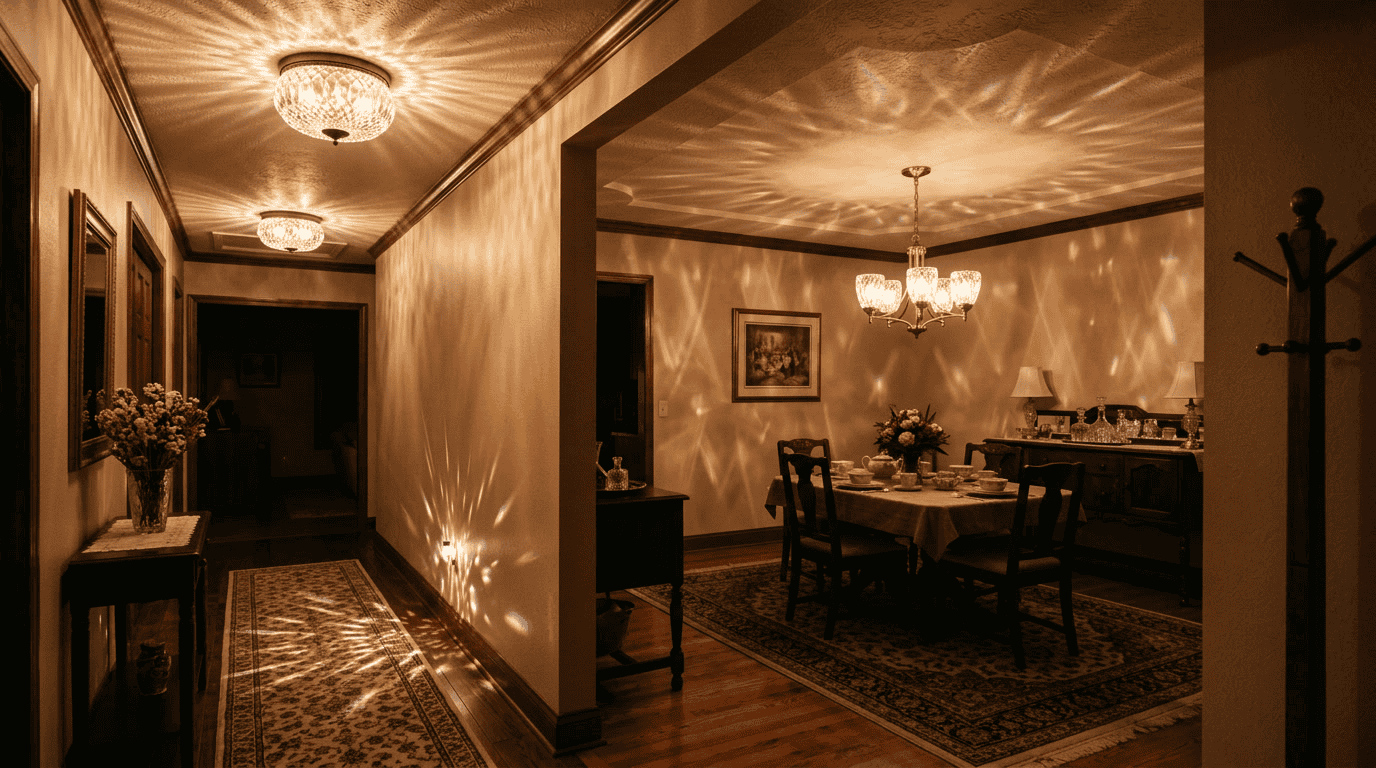
Ceiling-mounted cut glass shades create a different lighting experience than floor or table lamp versions. The overhead position means light projects downward through the faceted glass onto the floor and furniture below, and — importantly — upward from the light source through the glass toward the ceiling. The prismatic patterns from a ceiling cut glass shade are projected across the full room volume simultaneously, making these the highest-impact cut glass application in residential and commercial interiors.
The technical requirements are also different from floor and table lamp shades: ceiling mounting means fitter hardware must support the shade in an inverted or lateral position under gravity, often without the benefit of a gallery ring below to catch the shade if the hardware loosens.
Ceiling Fixture Types and Compatible Cut Glass Shade Forms
Not all ceiling fixtures use the same shade attachment. The fixture type determines the available shade form and fitter type.
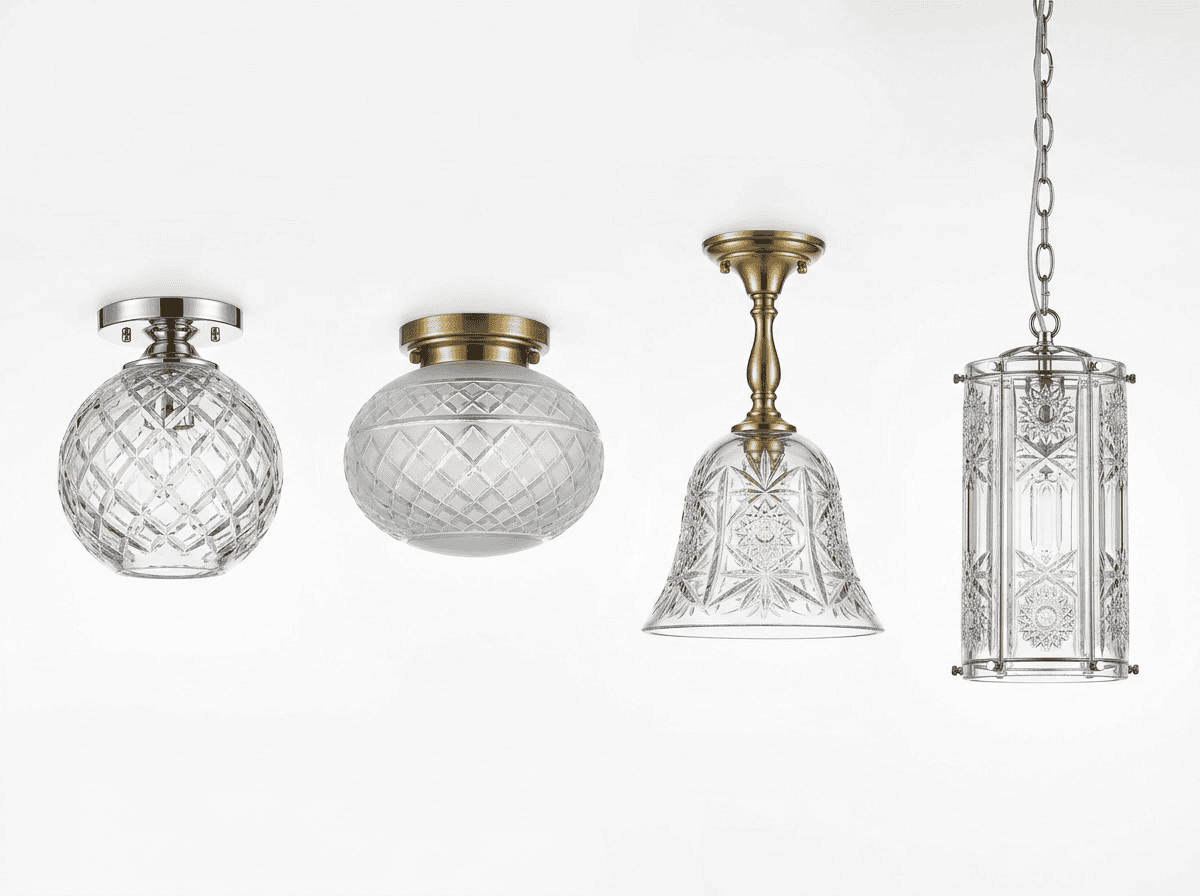
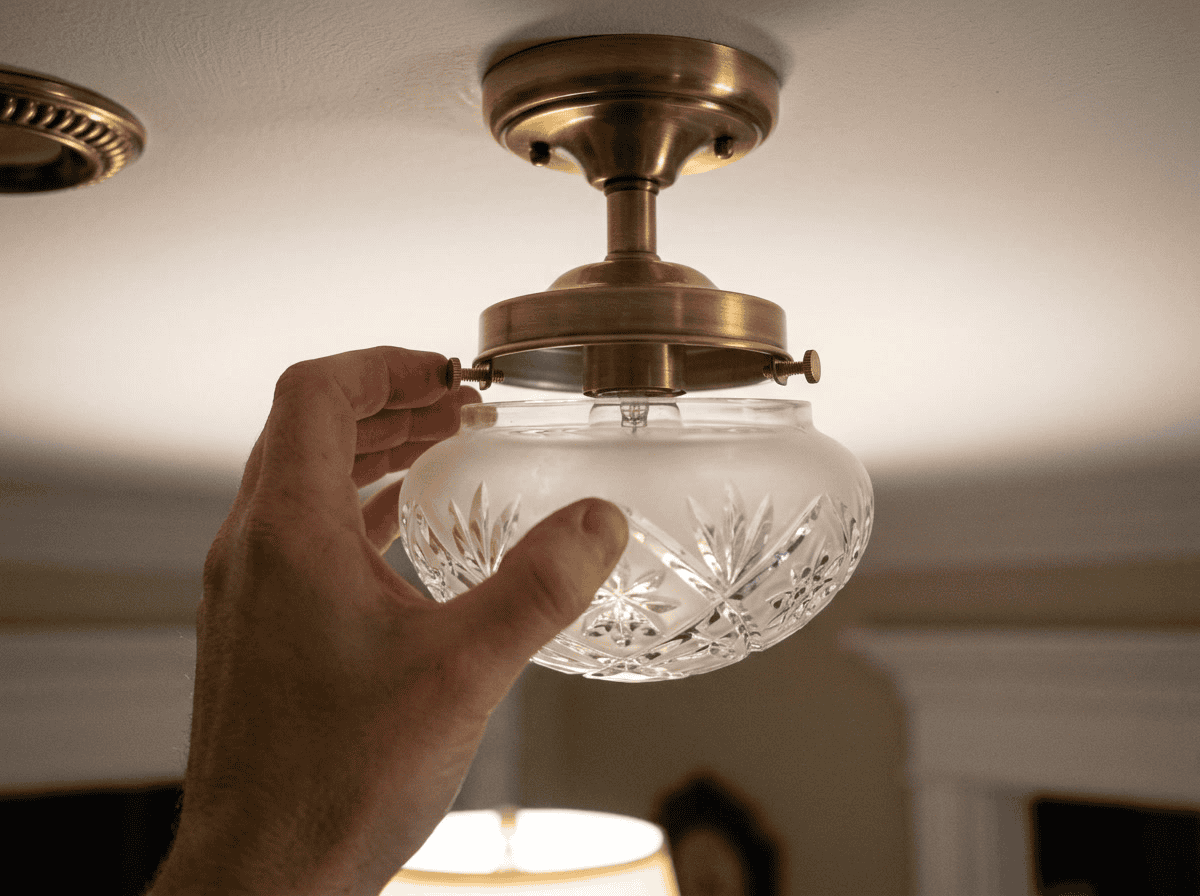
Flush mount ceiling fixtures: The fixture sits directly against the ceiling with no gap. Cut glass flush mount shades are typically bowl or dome-shaped, with the opening facing up and the glass body facing down into the room. The bowl form captures downward light, while light escapes through the faceted glass sides to project laterally. Flush mount shades attach via a threaded collar, set screws through the rim, or a latched gallery collar at the top. A very common replacement need in older homes with flush mount ceiling lights.
Semi-flush / close-to-ceiling fixtures: Similar to flush mount but with a short stem (2–8″) dropping the shade slightly below the ceiling. The gap allows some uplight onto the ceiling surface. Semi-flush cut glass shades are often bell or drum forms hanging from the stem collar. Semi-flush fixtures are more complex mechanically than flush mounts — confirm the stem length and collar diameter when specifying a replacement shade.
Chandelier bobeches and cups: Chandeliers use small cut glass cups (bobeches) or larger shade-cups over individual bulbs. These are the most widely produced cut glass ceiling components — found in traditional chandeliers from period homes through to contemporary multi-light pendants. A bobeche is a small disc with a center hole for the bulb socket; a shade-cup is a small bell or cone form. Both attach via set screw, press-fit, or collar thread.
Pendant ceiling shades: A pendant shade hangs from a ceiling rose or canopy on a cord, chain, or rod. Cut glass pendant shades are typically globe, bell, or cylindrical forms. Unlike table or floor lamp pendant shades, ceiling pendants usually hang at head height or above, with the light source visible through the shade from below.
| Fixture type | Shade form | Typical diameter | Attachment method |
|---|---|---|---|
| Flush mount | Bowl / dome | 8–16″ | Collar lock, set screw, or gallery |
| Semi-flush | Bell / drum / globe | 8–14″ | Stem collar and set screw |
| Chandelier cup | Bobeche / small bell | 2–5″ | Center-hole press fit or set screw |
| Chandelier shade | Small bell / cone | 4–8″ | Collar clip or set screw |
| Pendant ceiling | Globe / bell / cylinder | 8–16″ | Pendant chain from gallery ring |
Cut Glass Patterns for Ceiling Applications
The visual requirements for ceiling-mounted cut glass are different from floor and table applications. In a ceiling shade, the light source is above or behind the glass — the viewer looks up at the shade from below. This changes which pattern elements are most visible and most effective.
What matters most for ceiling shades:
- Light transmission: how much light the faceted pattern allows through the glass (more transmission = brighter room illumination)
- Reflection: how much light the facets redirect downward (affects task lighting effectiveness under the fixture)
- Side scatter: how much light the facets project laterally (affects prismatic wall and upper-wall effects)
Diamond crosshatch: Excellent for ceiling shades — good light transmission through the glass panels, significant side scatter for prismatic effects. The most versatile choice for flush mount and semi-flush ceiling applications.
Hobstar: Higher visual density than diamond — more facets per unit area means more light refraction but slightly lower total transmission. Best for decorative ceiling fixtures where ambient effect is more important than raw illumination.
Fluted: Good directional transmission for ceiling shades — the vertical flutes channel light mostly downward and laterally, with less all-around scatter than diamond. Appropriate for ceiling applications where more focused downward illumination is needed.
Fine pressed diamond: Excellent choice for ceiling applications where budget is a consideration. Fine-pattern pressed diamond at quality mold finish is difficult to distinguish from cut glass when viewed from below in a lit ceiling fixture.
Hobstar with fan cut borders: Period-appropriate for formal dining room and entry ceiling fixtures. The combined pattern creates a rich visual effect when the fixture is lit.
Sizing Cut Glass Ceiling Shades
Ceiling shade sizing requires precision because the shade must mate correctly with fixed ceiling hardware. Unlike table lamps where an approximate fit is sometimes acceptable, ceiling shades that don’t fit correctly will fall.
Critical measurements for ceiling shades:
| Measurement | What to measure | Why it matters |
|---|---|---|
| Fitter opening diameter | Inner diameter of the shade opening | Must match the ceiling fixture collar or ring |
| Fitter lip / rim dimension | Width of the rim around the opening | Must seat properly on the fixture hardware |
| Shade outer diameter | Widest point of the shade body | Visual proportion and clearance from ceiling |
| Shade depth / height | From fitter opening to bottom of shade | Determines how far the shade hangs below ceiling |
| Wall thickness at fitter | Glass thickness at the rim | Affects how firmly the shade grips the hardware |
For replacement of an existing shade: The existing shade dimensions are the specification. Measure the broken shade if possible, or measure the ceiling fixture hardware directly — the fitter opening diameter of the fixture is the fixed constraint.
For new ceiling fixtures: The shade dimensions are part of the fixture specification. Check the manufacturer’s specification sheet for shade compatibility; many ceiling fixtures are designed for specific shade families.
According to Wikipedia’s overview of ceiling fixtures, flush mount and semi-flush ceiling lights became standard in American residential construction in the post-World War II era, when low-clearance housing designs made pendant-style fixtures impractical. This created large demand for standardized flush-mount glass shade formats — which is why replacement pressed glass shades are still widely available in the most common flush mount sizes.
Installation and Safety for Ceiling Cut Glass Shades
Ceiling shades present safety requirements that floor and table lamp shades do not. Gravity works against the installation rather than with it.
Fitter integrity is critical. A ceiling shade that comes loose falls — from ceiling height, onto whatever is below. Before installing any ceiling cut glass shade:
- Inspect the shade’s fitter rim for chips or cracks — a damaged fitter rim can fracture under the stress of the ceiling hardware
- Verify the fixture’s attachment hardware is in good condition — worn or corroded set screws should be replaced before installing a new shade
- Test the fit before fully tightening — the shade should seat evenly without gaps around the fitter rim
Weight limits: Ceiling fixture hardware has explicit weight ratings. A large cut glass bowl shade can weigh 3–6 lbs; a set of four chandelier shade-cups can add 4–8 lbs to a chandelier’s total weight. Verify that the fixture’s canopy, stem, and ceiling box can support the combined fixture and shade weight. For heavier installations, a fan-rated ceiling box (rated for 50+ lbs) is appropriate even for non-fan applications.
Heat management: Unlike floor lamp shades where heat rises away from the shade, ceiling shades are above the bulb and trap heat. This is particularly relevant for flush mount bowl shades where the bulb is enclosed. Use LED bulbs — they produce dramatically less heat than incandescent equivalents. Never use incandescent or halogen bulbs in an enclosed ceiling shade unless the fixture is specifically rated for that use.
For ceiling fixture installation guidance, This Old House’s ceiling light installation guide covers the electrical and structural requirements for ceiling fixture mounting.
Replacing Chandelier Cut Glass Shade-Cups and Bobeches
Chandelier cups and bobeches are the most commonly replaced cut glass ceiling components — individual cups are broken during cleaning or bulb changes, and finding matching replacements requires knowing the exact attachment dimensions.
Standard chandelier bobeche sizes:
- 2″ diameter: small decorative chandeliers, 2–3 bulb fixtures
- 3″ diameter: standard 5–8 bulb chandeliers (most common replacement size)
- 4″ diameter: larger chandeliers and multi-tier fixtures
- Custom: some European and antique chandeliers use non-standard dimensions
Attachment types:
- Center-hole press fit: bobeche has a center hole that slides over the bulb socket; held by the socket nut
- Set screw collar: bobeche attaches to a collar on the bulb socket arm via a set screw
- Slip ring: bobeche has a ring that slides onto the socket assembly
When replacing chandelier cups, replacing all cups simultaneously produces a more consistent result than replacing one at a time — slight color and clarity differences between production runs are visible when old and new cups are mixed.
For full selection and specifications, cut glass lamp shades at JX Lampshade includes ceiling shade forms and chandelier cup specifications. For the best prismatic results from ceiling applications, see also crystal cut glass lamp shades — crystal composition produces superior prismatic effects particularly noticeable in chandelier applications where multiple cups contribute simultaneously.
For cleaning ceiling cut glass shades — which may be more difficult to access and remove than floor or table shades — how to clean cut glass lamp shades covers both in-place and removal cleaning techniques.
According to Houzz’s chandelier selection guide, the diameter of a chandelier should be approximately one-half the width of the table or room it serves — a guideline that applies to the full fixture including cut glass shade cups, which add apparent diameter to the fixture’s visual mass.
Prismatic Effects from Ceiling Cut Glass: Room-by-Room
Cut Glass Ceiling Shade Sizing by Room Type
| Room | Recommended fixture type | Shade diameter | Dimmer? |
|---|---|---|---|
| Entry hall | Semi-flush or pendant | 12–16″ | Recommended |
| Dining room | Chandelier with cups | 24–36″ overall fixture | Essential |
| Living room | Semi-flush or chandelier | 14–20″ | Recommended |
| Bedroom | Flush mount | 10–14″ | Optional |
| Bathroom | Flush mount (damp-rated) | 8–12″ | Optional |
The ceiling position of these shades creates specific visual effects that vary by room:
Entry halls and foyers: The ceiling is typically high and the room purpose is transitional — guests arrive and form a first impression. A cut glass ceiling fixture in an entry hall projects prismatic patterns across the full entry volume. The effect is most dramatic when the entry has light-colored walls and ceiling, which display the prismatic projections clearly.
Dining rooms: The most traditional application for cut glass ceiling fixtures — the chandelier with cut glass cups over the dining table is a centuries-old configuration. Dimmer control is essential for dining room applications: full brightness for task and ambient use, reduced brightness for atmospheric dining. Cut glass effects are most visible at reduced brightness levels.
Bathrooms: Cut glass flush mount ceiling shades are common in traditional bathroom design. The prismatic effects on white or light tile surfaces are visually spectacular. In bathrooms, moisture-resistance of the fixture is important — the shade itself (glass) is moisture-resistant, but the electrical hardware must be rated for damp locations.
Bedrooms: Cut glass ceiling fixtures provide both ambient illumination and decorative character for bedrooms. Frosted or opalescent pressed glass is sometimes preferred for bedrooms because it produces softer, more diffuse light — pure clear cut glass can be visually intense at close range from a ceiling position.
Living rooms with coffered or architectural ceilings: Architectural ceilings benefit most from cut glass ceiling fixtures — the prismatic projections interact with architectural elements (beams, coffers, moldings) to create layered visual effects.
For room-specific styling guidance for cut glass lighting, Architectural Digest’s interior lighting guide covers the relationship between fixture type, shade choice, and room function.
Frequently Asked Questions
How do I measure a flush mount ceiling shade for replacement?
Measure the inner diameter of the shade’s fitter opening (the hole at the top), the outer diameter at the widest point, and the height from the fitter opening to the lowest edge of the shade. Also note the attachment method — whether the shade locks via set screws, a threaded collar, or a gallery ring. The fitter opening diameter is the critical fit dimension.
Are cut glass ceiling shades safe in rooms with children?
Ceiling-mounted cut glass shades are safer than floor or table lamp shades in homes with children, because they are out of reach. The safety concern for ceiling shades is the installation itself — secure attachment is essential. Properly installed flush mount and semi-flush fixtures with correctly fitted shades present minimal risk.
Can I use cut glass ceiling shades in bathrooms?
Yes, with appropriate fixture selection. The glass shade itself is moisture-resistant; what matters is the electrical fixture’s moisture rating. For bathrooms, use fixtures rated for “damp location” at minimum, and “wet location” for shower enclosure areas. Standard ceiling fixtures are not rated for bathroom moisture; look for bathroom-specific or vanity fixtures.
Why does my cut glass ceiling shade look dim compared to my old one?
Three likely causes: the LED bulb may have less total output than the previous incandescent (check lumen ratings, not wattage); the shade may have accumulated dust on the facets (interior facets on ceiling shades accumulate more dust than table shades since air circulation brings dust up); or the new shade has different glass clarity or thickness. Clean the shade first — accumulated dust on interior facets significantly reduces light output.
How do I remove a stuck cut glass ceiling shade?
First, confirm the fixture is off and cool. For set-screw attachment: loosen the set screws while supporting the shade from below. For collar lock: turn the shade counterclockwise while pressing up. For gallery ring: lift the shade and rotate to disengage. If the shade appears stuck: check whether set screws are fully loosened (they may have multiple screws); never force a glass shade — apply gentle even pressure rather than torque.
What is the ideal ceiling height for cut glass ceiling fixtures?
A minimum of 8 feet ceiling height is recommended for any cut glass ceiling fixture to allow the prismatic effects to develop and spread visually. Lower ceilings (7–7.5′) compress the effect and bring the fixture visually close to occupants. At 9–10′ ceilings, cut glass ceiling fixtures produce their best effects — the prismatic projections have room to spread and become visible as a full room environment effect rather than a concentrated ceiling point.
How many cut glass ceiling shades should I use in a room?
For a single ceiling fixture, one well-chosen shade is typically the right answer — a cut glass ceiling shade is a focal point, and multiple competing fixtures can create visual confusion. For chandeliers with individual bulb cups, matching all cups (4–8 typically) creates a unified visual statement. For very large rooms, two or three cut glass fixtures at different positions can create layered prismatic effects.
Related Articles in This Series
Conclusion
Cut glass ceiling light shades operate at a different scale and with different visual physics than floor and table versions. The ceiling position creates room-wide prismatic effects that no other lighting type replicates, and the overhead mounting creates safety requirements that must be met precisely.
The selection process starts with the ceiling fixture hardware — what attachment type, what fitter dimension, what weight capacity — and then moves to shade form, pattern, and visual character. A cut glass ceiling shade installed correctly, paired with the right LED bulb and dimmer control, produces an effect that defines the character of the room it illuminates.