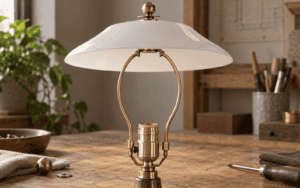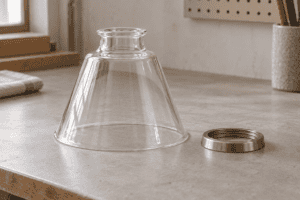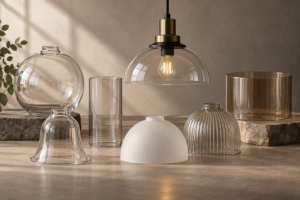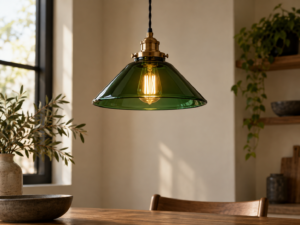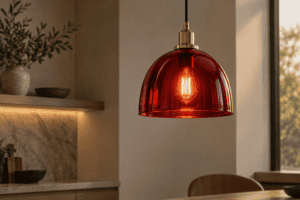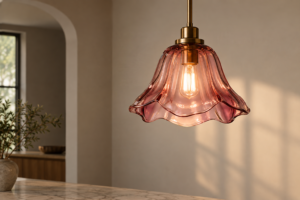
An iridescent glass lamp shade is a glass shade with a controlled surface effect that shifts between colors as the viewing angle or light angle changes. For a replacement, fit still comes first. For an OEM project, specify the glass base, profile, fitter, finish coverage, color target, light source and inspection method before discussing price.

What is an iridescent glass lamp shade?
Iridescence is a visual effect, not a single shade shape. The surface can flash blue, green, gold, violet or several colors at once. The effect changes with the angle of view and the angle of the light source. That is why one product photograph rarely tells a buyer enough.
The Corning Museum of Glass definition of iridescence separates two ideas that are often mixed together. Ancient glass may develop an iridescent surface through long-term weathering. Modern decorative glass can receive an intentional effect through metallic materials or a surface treatment. Those two origins can look similar in a photograph, but they lead to different questions about durability, repeatability and fit.
The phrase "iridescent glass lamp shade" can describe several products:
- A clear or colored glass shade with a thin iridescent surface effect.
- A historic or reproduction art-glass shade with a lustred finish.
- A decorative replacement shade sold for a pendant, sconce, table lamp or chandelier.
- A custom lighting component developed from a reference sample, drawing or color target.
The finish does not tell you the mounting method. A beautiful iridescent bell shade can still be the wrong part if its fitter is too large, its neck is too short or its widest diameter collides with the fixture.
| What you see | Possible origin | What the buyer should verify |
|---|---|---|
| Rainbow color that changes when the piece turns | Intentional iridescent or lustred surface | Finish repeatability, coverage and viewing-angle target |
| Uneven silver or rainbow film on old glass | Weathered surface or later deterioration | Condition, stability and whether the piece is safe to reuse |
| Color that appears built into the wall of the glass | Colored or cased glass base | Base glass color, transmission and batch variation |
| Bright color only around the rim or selected areas | Local decoration or applied finish | Masking boundary, edge quality and abrasion resistance |

How the finish changes the light
The finish and the lamp work together. A shade that looks blue in a showroom may show green or gold under a warm LED, while a cooler source can make the same surface appear more violet. The result also changes with the distance between the bulb and the glass, the background behind the shade, and the direction from which the observer approaches.
For a lighting brand, this means the color brief should describe the lighting condition as well as the surface. A useful approval note might say: "blue-green shift under a 3000 K LED, visible from the front and side, with no bare clear patch around the fitter." It is more useful than "peacock color" by itself.
| Glass base or surface direction | Likely visual behavior | Best question for the sample |
|---|---|---|
| Clear base with a strong surface effect | Bright reflection and pronounced angle shift | Does the finish remain even around the full circumference? |
| Transparent colored base | Base color remains visible beneath the shifting surface | Does the base color stay within the approved color family? |
| Opal or diffusing base | Softer glow with less visible filament detail | Does the effect survive when the lamp is switched on? |
| Dark or smoky base | Deeper contrast and stronger highlight points | Are dark areas intentional or caused by uneven coverage? |
This is why a sample should be viewed with the intended lamp, not only under a factory inspection light. The Smithsonian record for a Tiffany Favrile lamp shade describes an iridescent sconce shade with green, yellow and orange tones. That record also identifies the object as a lamp shade and records its dimensions. For a modern project, the lesson is practical: describe both the color behavior and the physical part.


Choose the profile before the finish
Start with the fixture and the profile. The finish can be tuned after the part can be mounted and the light can be used safely.
| Profile | Typical visual role | Measurements that control the fit |
|---|---|---|
| Globe | Even surrounding glow for pendants, table lamps and decorative fixtures | Fitter or neck diameter, overall diameter and height |
| Bell or tulip | Wider lower opening with a more directional spread | Upper opening, lower diameter, height and rim shape |
| Dome or bowl | Downward or broad ambient distribution | Seat diameter, deepest point, widest diameter and retention method |
| Cylinder | Vertical form for pendants, sconces and compact fixtures | Inside opening, outside diameter, height and wall clearance |
| Organic or custom form | A signature decorative silhouette | Profile drawing, mounting interface, center of gravity and packing support |
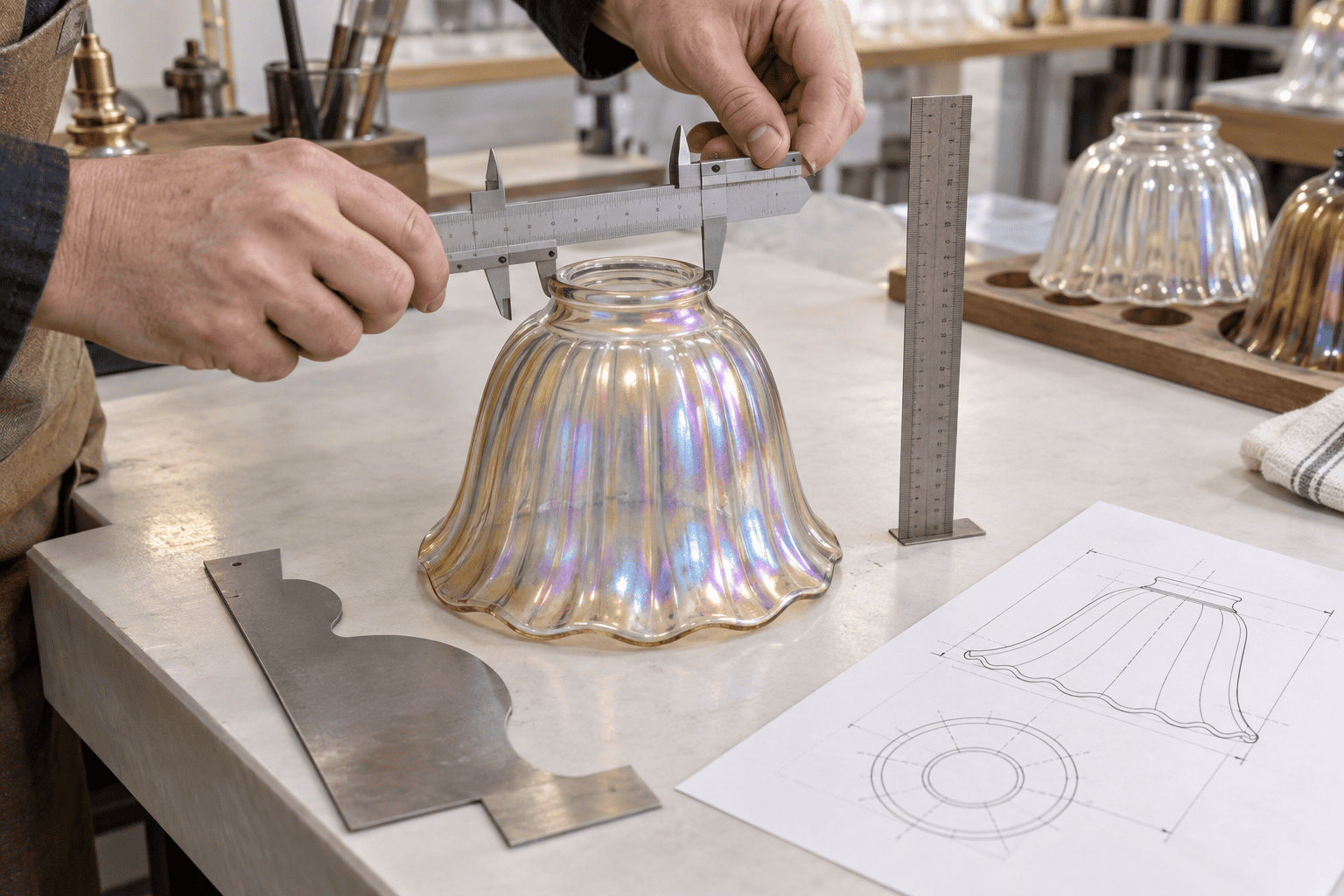
The lamp shade fitter compatibility guide is useful when the original shade is missing. For an OEM project, send more than the outside diameter. A manufacturer needs the working opening, seating surface, height, maximum width, rim condition and how the shade is retained.

The fitter is the non-negotiable dimension
Measure the part of the shade that actually meets the holder. Depending on the fixture, that may be a gallery ring, a threaded neck, a straight cut opening, a small pendant hole or a custom support. Do not treat a nominal product label as proof of compatibility.
| Fitter information | What to record | Why it matters |
|---|---|---|
| Working opening | Inside diameter or hole size | Determines whether the shade seats on the holder |
| Support surface | Lip, shoulder, ring seat or thread | Controls stability and contact area |
| Height | Fitter reference to the lower rim | Affects socket exposure and fixture proportions |
| Widest diameter | Maximum outside width | Prevents collision with arms, walls and adjacent shades |
| Retention | Ring, screws, clips, threaded base or adhesive-free seat | Defines assembly and service requirements |
How iridescent glass finishes are specified for production
There is no single process behind every iridescent finish. The Corning Museum of Glass describes modern iridized surfaces made through fuming or reducing methods, including the use of metallic salts and controlled reheating. The museum's explanation of how glass iridizes is a useful technical starting point, but it does not replace a factory process sheet for a specific product.
For a buyer, the important distinction is not the process name alone. It is whether the process can produce the approved appearance on the selected glass body, at the required quantity, with a finish that remains suitable for the intended fixture and handling conditions.
| Finish brief | Information to include | Approval evidence |
|---|---|---|
| Soft blue and green shift | Reference images, base color, viewing direction and light source | Photos or video from agreed angles under the intended lamp |
| Gold or copper lustre | Coverage area, gloss level and edge boundary | Close-up images plus a physical sample |
| Multi-color art-glass effect | Color order, acceptable variation and no-go colors | Rotating sample video and signed color board |
| Local iridescent detail | Masking line, motif position and repeat direction | Dimensioned artwork or marked sample |
| Large production batch | Batch tolerance, surface inspection and replacement policy | First article approval and incoming inspection record |
Do not ask a supplier to match a web photo without defining what must match. A web image may contain a warm white balance, reflections from the room and post-processing. It can be a reference, but it is not a complete color standard.


Sample approval and quality inspection
An iridescent shade needs two approvals: a physical fit approval and an appearance approval. Passing one does not mean the other has passed.
For the fit approval, test the actual holder or a representative gauge. Confirm that the shade sits squarely, that the retention method does not load the glass edge, and that the socket and bulb remain clear. For the appearance approval, rotate the shade, switch the lamp on and off, and photograph the same positions every time.
The glass lamp shade technical drawing checklist can help a buyer prepare the dimensional side of the RFQ. The quality inspection checklist is the better place to organize incoming checks before a shipment is released.
| Inspection point | Record or test | Common decision |
|---|---|---|
| Color shift | Front, side and rear views with the agreed lamp | Accept, rework or compare with master sample |
| Coverage | Continuous surface, defined masked area or approved variation | Hold any bare patch outside the approved zone |
| Surface condition | Rub, scratch, pinhole, blister, cloud or residue check | Separate cosmetic defects from acceptable character |
| Fitter and rim | Opening, roundness, seat, edge and thread or hole details | Reject parts that cannot mount without force |
| Geometry | Height, widest diameter and profile against drawing | Confirm the lamp proportions and clearance |
| Thermal use | Intended bulb, temperature, enclosure and duty cycle | Require buyer or test-lab confirmation where needed |
| Packing | Individual protection, dividers, carton marks and drop plan | Approve the packing sample before volume shipment |


Safety belongs to the complete luminaire
A glass shade is one component of a lighting product. The shade alone does not establish that the completed fixture meets a market's electrical or mechanical requirements. UL Solutions lists glass support testing among luminaire production-line tests, and its indoor lighting guidance points buyers toward the applicable luminaire and LED standards for the market.
For a project quote, confirm the fixture type, bulb or LED source, maximum wattage, enclosure, operating temperature, mounting orientation and required market documentation. If the shade is a replacement, follow the fixture maker's instructions and do not install a cracked or unstable piece.
What an OEM buyer should send with the RFQ
The quickest quote is usually the one with the clearest fit evidence. Send the original shade if available. If it is not available, send a dimensioned side profile, the holder or ring, several photos with a ruler and the intended light source.
| RFQ field | Minimum useful detail | Optional detail that improves the first quote |
|---|---|---|
| Product identity | Iridescent glass lamp shade, fixture type and replacement or new design | Reference product or collection position |
| Shape | Globe, bell, dome, cylinder or drawing | Section profile and 3D file |
| Fit | Opening, seat, thread, hole, ring or retention method | Holder sample or fixture drawing |
| Finish | Color family, shift direction, gloss, coverage and no-go defects | Physical master, Pantone reference or rotating video |
| Light source | LED, incandescent or other source, wattage and color temperature | Enclosure, duty cycle and dimming conditions |
| Order | Sample quantity, annual quantity, first batch and target market | Forecast, reorder plan and packaging test requirement |
| Commercial terms | Delivery location, packaging and inspection point | Incoterm and replenishment schedule |
JX's custom glass lamp shade manufacturer page explains the type of design-to-production information a manufacturer needs. For a quote comparison, use the glass lamp shade supplier quote guide to separate tooling, sample, packaging and reorder costs instead of comparing only the piece price.


Where iridescent glass lamp shades work well
The effect is most useful when the fixture is seen from more than one angle or when the shade is part of the room's decorative focal point. It can work in a single pendant, a group of pendants, a sconce series or a restoration-style collection. The right profile and light source matter more than the adjective "iridescent".
| Application | Why the finish can help | What to control |
|---|---|---|
| Boutique pendant collection | Gives a repeatable color moment while keeping each shade recognizable | Batch color, rotation and spacing |
| Hospitality sconce | Adds surface interest at eye level without relying on printed graphics | Glare, rim safety and cleaning access |
| Decorative table or desk lamp | Makes the shade part of the lamp's focal point | Fitter stability, bulb clearance and viewing height |
| Restoration or reproduction | Can echo historic art-glass language without claiming an antique origin | Provenance, reproduction labeling and dimensional match |
| Chandelier group | Creates variation across multiple small shades | Weight, balance, finish direction and replacement units |


Buyer questions
Is iridescent glass real glass?
Usually, yes. "Iridescent" describes the changing surface appearance, not a plastic substitute. Confirm the material, thickness, edge treatment and finish method on the product specification or sample record.
Is an iridescent finish the same as antique glass corrosion?
No. Historic glass can develop iridescence through weathering, while modern decorative glass can be intentionally iridized. The Corning Museum of Glass describes both cases. A buyer should ask which one the product is intended to represent and whether the surface is stable for the intended use.
Does an iridescent glass lamp shade change color?
It can appear to change color as the viewing angle, light angle, lamp source or background changes. Put the viewing angles and light source in the approval brief so the buyer and supplier are judging the same result.
Can I use an iridescent shade as a replacement?
Only after checking the fitter, support surface, height, widest diameter, retention method and bulb clearance. A matching color cannot compensate for an incorrect mounting interface.
Is every iridescent shade a Tiffany or Favrile shade?
No. Favrile is a historical glass associated with Tiffany, while iridescence is a broader visual or production effect. The Smithsonian collection includes an iridescent Favrile lamp shade, but that record does not make every modern iridescent shade a Tiffany product.
What should a manufacturer quote for an OEM iridescent shade?
Ask for the glass material, profile, dimensions, fitter, finish route, color target, acceptable variation, light source, sample quantity, production quantity, packaging and inspection point. Send a drawing or a physical reference whenever possible.

Turn the finish idea into a quote-ready shade
Start with the fixture interface and a usable profile drawing. Then define the iridescent effect under the real light source, approve a physical sample and record the inspection points before volume production. If you need a custom color, replacement profile or multi-piece order, request a custom glass lamp shade quote from JX with the dimensions, images and finish brief attached.