
オイルランプフォント解説:種類、適合、交換チェック
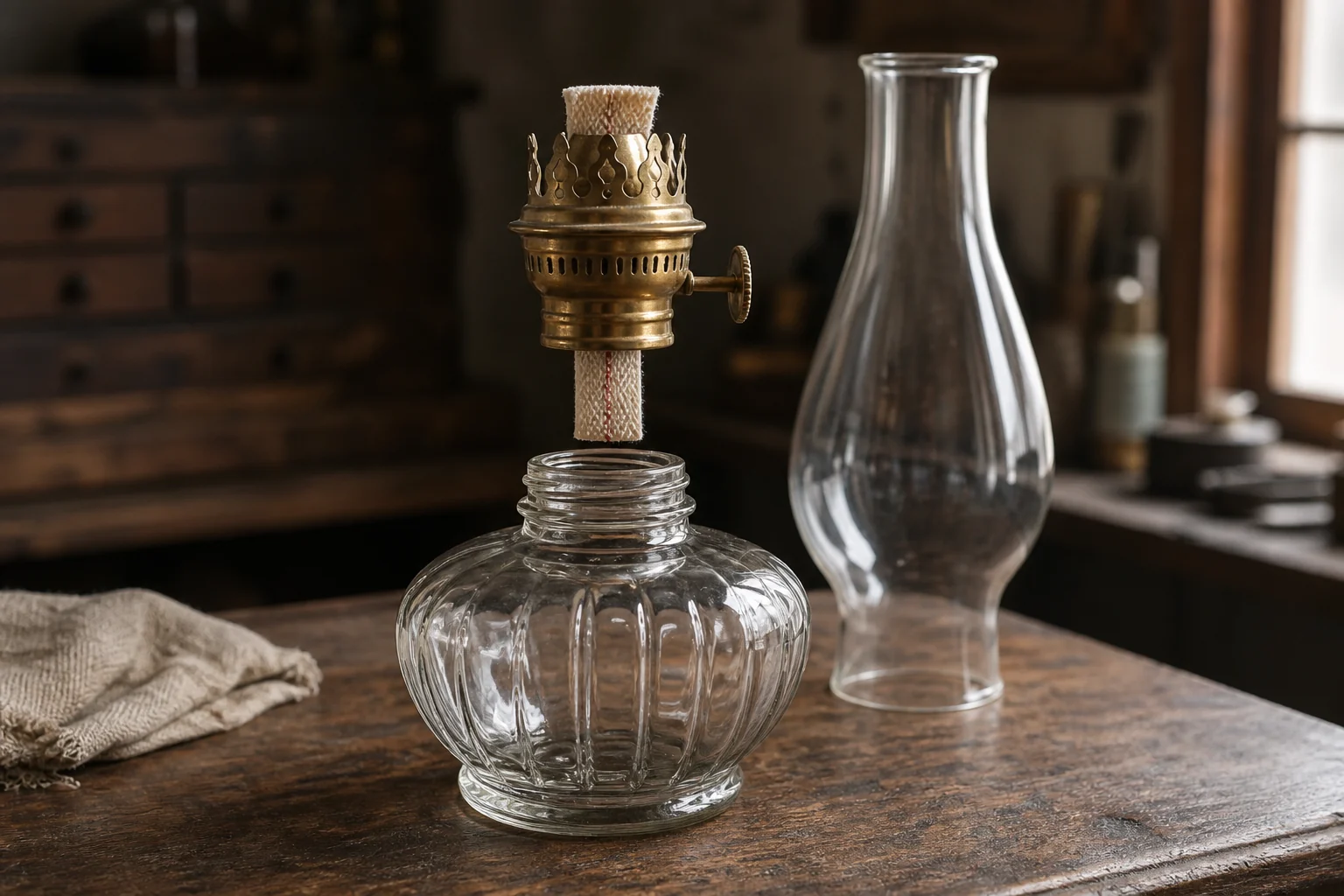
An oil lamp font, also spelled fount, is the reservoir that holds fuel for the wick. On many table and parlor lamps, it is the decorative glass body directly below the metal collar and burner. On bracket or hanging lamps, it may be a removable glass vessel. It is not the chimney, gallery, or outer shade, and those parts should not be ordered as if they were interchangeable.
That distinction matters when an old lamp arrives with missing pieces. A replacement that looks close can still fail at the collar, burner, peg, or support ring. Before buying anything, identify the part, record the complete assembly, and inspect the glass for damage.
What an oil lamp font does
The font stores the liquid fuel below or beside the burner. The lower end of the wick reaches into that reservoir and draws fuel toward the flame. The Milwaukee Public Museum's oil lamp history describes the basic requirements as fuel, a reservoir, a wick, and an air supply. Later lamp designs package those functions in many different bodies, but the reservoir role does not change.
A Smithsonian oil lamp record gives a useful physical example. Its clear glass body is identified as the font, with a metal burner attached at the opening above it. The wick passes through the burner and descends into the font. Supports on the burner hold the chimney. That one object shows why the terms should stay separate: the font stores fuel, the burner controls the wick, and the chimney manages airflow around the flame.
The font may be plain, patterned, colored, or concealed inside a metal body. Some lamps place it on a pedestal. Others suspend it in a bracket or frame. An Argand-style arrangement may place a reservoir beside or above the burner rather than directly under it. Shape alone does not prove compatibility.
Font or fount: which spelling is correct?
Both spellings appear in lamp catalogs, museum records, collector references, and product listings. Font is common in American searches and is the exact phrase used for this article. Fount also appears often, especially in British listings and historical descriptions.
The safest way to search for a replacement is to use both forms:
- oil lamp font
- oil lamp fount
- glass lamp font
- glass fuel reservoir
- bracket lamp font
- peg font for oil lamp
Do not let the spelling distract from the interface. A seller may use font, fount, reservoir, tank, or lamp body for a related part. Photos and dimensions still decide whether it belongs in your assembly.
The parts around the font
An oil lamp is a system. When one piece is missing, identify the neighboring pieces before naming the replacement.
| Part | Main job | What connects to it |
|---|---|---|
| Font or fount | Holds liquid fuel | Collar, burner, base, peg, bracket, or frame |
| Collar | Provides the interface above many glass fonts | Glass neck or seat below, burner above |
| Burner | Holds and adjusts the wick | Collar or font opening, chimney support above |
| Wick | Draws fuel toward the flame | Reaches from the font through the burner |
| Chimney | Guides airflow around the flame | Sits on burner prongs or a chimney seat |
| Gallery or shade holder | Supports an outer shade on some lamps | Often attaches around or above the burner |
| Outer shade | Spreads light and changes appearance | Fits a gallery, ring, or separate holder |
The collar deserves special attention. On many glass lamps it is a metal interface fixed to the top of the font, while the burner is removable from the collar. On other designs the connection works differently. If the collar is loose, corroded, or unidentified, forcing the burner can damage the glass or erase evidence needed for restoration.
Common glass oil lamp font forms
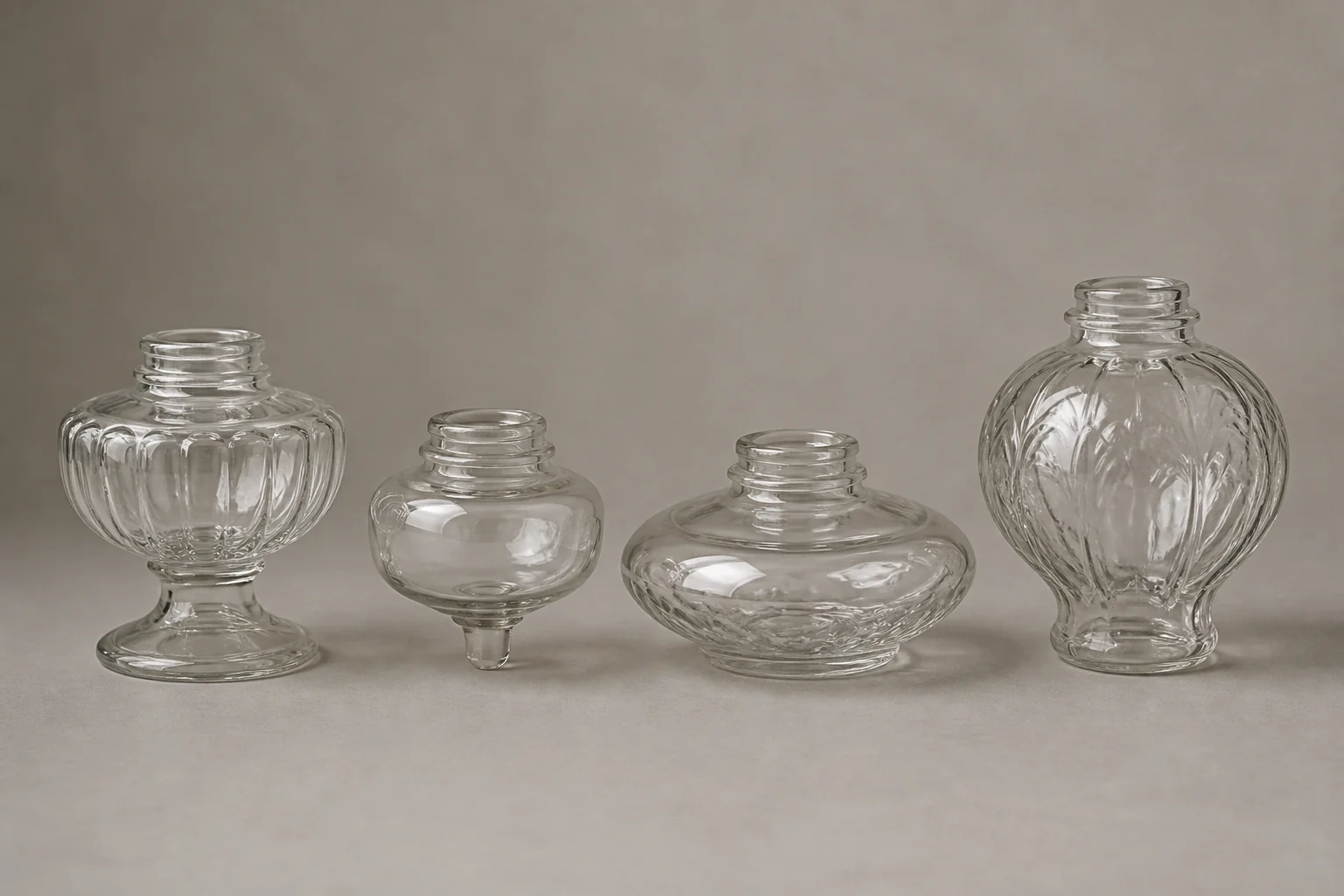
The categories below describe how a font sits in the lamp. They are not universal standards, and names can overlap between sellers.
Pedestal or table-lamp font
This font forms the visible upper body of a freestanding lamp. It may sit on a glass or metal stem and base, or the font, stem, and foot may be made as one glass assembly. The Smithsonian example uses a glass font above a patterned stem and pedestal base.
For replacement work, record more than the reservoir diameter. The height from the supporting base to the collar affects where the burner and chimney sit. A visually similar body with the wrong collar height can change the entire profile of the lamp.
Peg font
A peg font has a projection below the reservoir that fits into a matching support, cup, or socket. The peg carries the font and helps locate it in the lamp body. Peg diameter, peg length, shoulder shape, and the way the font is retained all matter.
Two peg fonts can have similar bowls and completely different lower connections. Measure the peg at more than one point if it is tapered, and photograph the underside straight on. Do not assume that a close outside diameter will seat safely.
Bracket-lamp font
A bracket font is supported by a wall-mounted or framed lamp assembly. It is often a shallow, round reservoir that can be lifted out for service. A current replacement listing may describe compatibility by its bracket style and collar or burner size, but those descriptions apply to that product, not every historic bracket lamp.
Record the maximum body diameter, the support ledge or rim, and the clearance around the bracket. A font that fits the burner can still interfere with the frame.
Hanging-lamp font
Hanging lamps place the reservoir inside a suspended frame or central body. The font may rest in a ring, mount to a center tube, or connect to a burner assembly supported by the frame. Because the lamp moves when serviced, retention and clearances are part of the fit.
Photograph the empty support from above and below. Include the chain or frame only to show how the font is held. Do not measure the decorative shade and assume that it reveals the reservoir size.
Remote or side reservoir
Some lamp systems separate the reservoir from the burner. The Corning Museum of Glass Argand lamp includes cylindrical glass oil fonts linked by brass arms to the burners. That arrangement is mechanically different from a flat-wick table lamp with a reservoir directly under the burner.
If a reservoir is offset, elevated, or connected by a feed passage, treat the whole fuel-delivery system as one design. A generic table-lamp font is not a substitute.
What the glass can tell you, and what it cannot
Glassmaking details help describe a font, but they do not automatically identify the maker or date.
The Henry Ford catalogs an oil lamp font made between 1815 and 1840 as colorless blown glass. Historic New England also records a lard-oil lamp with a blown glass font, pressed base, and pewter collar. Museum collections contain other fonts with cut decoration, molded patterns, and colored glass.
Use visible manufacturing clues as part of a record:
- Mold seams may indicate a molded or pressed component.
- A pontil-like mark may be relevant to a blown piece, but it needs expert interpretation.
- Sharp repeated pattern details may point to mold work or later cutting.
- Wear around the collar, support ring, or peg shows where the part contacted the lamp.
- Bubbles, striations, and small irregularities describe the glass but do not prove age by themselves.
Do not publish an antique attribution based on one clue. A lamp can also contain parts assembled from different periods. If historical value matters, keep the original collar, burner, base, and any maker marks together while a specialist reviews them.
Why a similar diameter does not guarantee fit
Overall diameter is useful for clearance, not for defining the connection. The interface is usually controlled by the neck, collar, peg, support seat, or burner system.
| Check | Why it matters | Common mistake |
|---|---|---|
| Neck opening or collar seat | Determines how the upper metalwork meets the font | Measuring only the outside body |
| Collar type and condition | Connects the burner on many glass fonts | Treating the collar as part of the burner |
| Burner make or model | Helps identify the required interface and wick system | Choosing by visual style alone |
| Peg or lower support | Carries the font in some lamp bodies | Ignoring taper, length, or retaining method |
| Body height and widest diameter | Controls frame and shade clearance | Checking width but not vertical position |
| Chimney and gallery arrangement | Shows what the burner must support above | Ordering the font from chimney dimensions |
A competitor product page, for example, identifies one glass font by a specific 21 mm screw and duplex-burner use. That is useful product data for that exact item. It is not evidence that 21 mm is a general standard for all oil lamps.
How to measure an oil lamp font
Work with the lamp empty, cold, and unlit. If fuel remains, follow the lamp and fuel maker's handling instructions before disassembly. Do not use generated measurements from a photo when an actual part or support can be measured.
1. Photograph the complete lamp
Take front, side, top, and underside views before removing anything. Add close-ups of the collar, burner markings, support ring, peg, fill opening, and any maker marks. Place a ruler in at least one photo for scale, but use direct measurements for the specification.
2. Record the body envelope
Measure overall font height, maximum diameter, and the height at which the maximum diameter occurs. For an oval or irregular body, record width and depth separately.
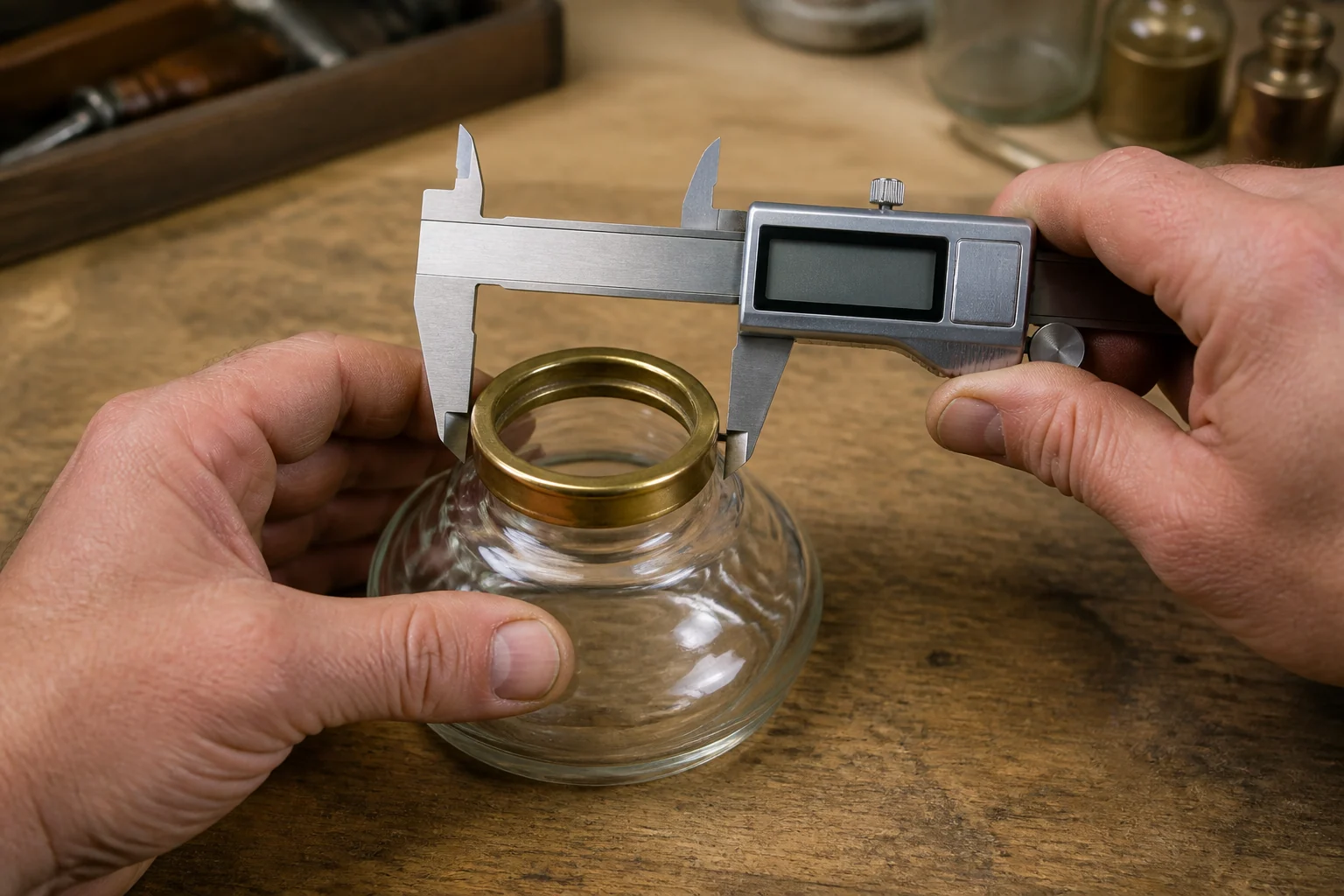
3. Measure the upper interface
Record the glass opening only if it is safely accessible. If a collar remains attached, measure the collar's outside diameter, inside opening, height, and connection style without forcing it off. Note whether the burner screws, twists, clips, or drops into place.
4. Measure the lower support
For a peg font, record peg length, the diameter near the shoulder, the diameter near the tip, and any retaining groove. For a ring-supported font, record the ledge diameter and the contact surface. For a pedestal assembly, record how the font connects to the stem or base.
5. Map the upper assembly
Record burner markings, wick width or type if known, chimney base diameter, and the way a gallery or shade holder attaches. This prevents a reservoir measurement from being confused with a chimney or shade measurement.
| Field to record | Example format | Do not substitute |
|---|---|---|
| Overall font height | mm and in | Total lamp height |
| Maximum body diameter | mm and in | Shade diameter |
| Upper glass opening or collar seat | Diameter plus photo | Burner outside diameter alone |
| Collar connection | Thread, bayonet, slip, unknown | A guessed standard number |
| Peg or support dimensions | Diameter, length, taper, ledge | Base width without support detail |
| Burner identification | Mark, model, clear photos | A similar online photo |
| Condition | Cracks, chips, looseness, staining | "Looks usable" |
Keep the original units from your tools and add the conversion separately. Rounding too early can hide a fit problem.
Inspect the font before it returns to service
An old glass reservoir has to contain fuel near a flame. Appearance alone is not an adequate condition check.
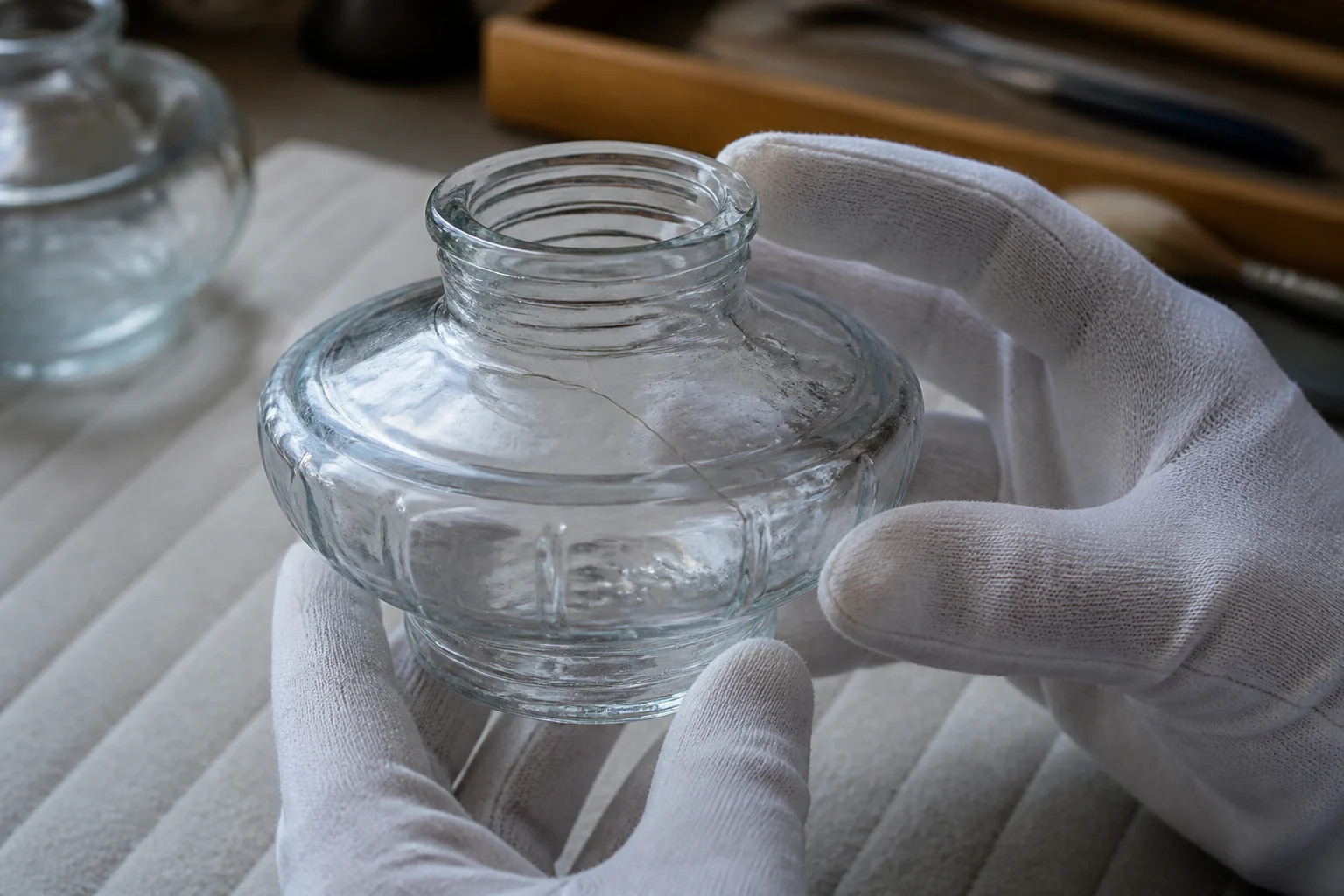
Do not use a font that has a visible crack, an active leak, a loose interface that loads the glass, or a chip where the collar or support bears weight. Staining inside the reservoir may be cosmetic, but it can also hide damage. Inspect under diffuse backlight and rotate the part slowly over a padded surface.
Avoid quick adhesive repairs for a working fuel reservoir. An old repair may be useful evidence for a conservator, but it should not be treated as proof that the lamp can safely hold fuel. If the lamp has collectible value, separate conservation decisions from plans to operate it.
Fuel choice and filling procedure belong to the lamp and burner maker's instructions. The safe oil-lamp use guide covers the operating sequence and chimney checks. The National Capital Poison Center also warns that lamp oil can cause serious injury if swallowed and recommends storing it in its original container, out of children's reach, and supervising a burning lamp. A replacement-parts project should not create a reason to decant or test unknown fuel casually.
Font, chimney, and shade are three different orders
The word glass creates confusion because all three parts may be transparent and removable.
| If you need to replace this | Its job | Measurements that usually matter first |
|---|---|---|
| Font or fount | Stores fuel | Collar or neck interface, body envelope, peg or support |
| Chimney | Controls airflow around the flame | Base diameter, height, bulge, throat, burner seat |
| Outer shade | Diffuses and directs light | Gallery or fitter opening, profile, height, widest diameter |
If the missing part sat below the burner and held fuel, it was the font. If it surrounded the flame and sat on burner prongs, it was the chimney. If it sat farther out on a gallery or ring, it was the shade.
For a missing chimney or outer shade, start with the oil lamp glass shade project page. For a lamp with several missing or mixed-era pieces, the antique glass lamp shade replacement guide helps organize the restoration decision.
Choose a replacement route before spending money
There are four reasonable paths, and the lamp's intended use determines which one fits.
Find an exact period component
This route suits a collectible lamp when originality matters. Preserve maker marks and consult a specialist. A visually close font from another lamp may reduce historical integrity or load the support incorrectly.
Use a documented compatible reproduction
This works when a supplier identifies the exact bracket, collar, burner, or peg system. Compare every listed dimension with the lamp. Ask how compatibility was established instead of relying on fits most language.
Keep the lamp as a display object
Display may be the safer choice when the font is rare, repaired, cracked, or difficult to match. A non-operating conservation mount should be clearly distinguished from a fuel-ready repair.
Develop related replacement glass
If the font is sound but the chimney or outer shade is missing, a glass manufacturer can review that separate component. JX's clear oil lamp chimney product provides one published reference size, while custom projects need their own measurements, photos, and approval route. Do not transfer one product's dimensions to a different burner.
For an unfamiliar fuel font itself, JX production capability is not confirmed in this article. Send the complete part record first. The team can identify whether the request concerns a chimney, shade, or another glass component and route the inquiry without inventing a manufacturing promise.
Frequently asked questions
An oil lamp font is the reservoir that holds fuel for the wick. It often sits directly below the burner, although bracket, hanging, and Argand-style lamps can place or support the reservoir differently.
Yes. Font および fount are both used for the fuel reservoir in oil-lamp terminology. Search both spellings when looking for historical records or replacement parts.
No. The font holds fuel below or beside the burner. The chimney is the glass tube or globe around the flame that guides airflow and sits on a burner or chimney support.
No. The burner must match the font's collar, opening, thread, bayonet, or other documented interface. Similar body diameter does not prove that the connection is compatible.
Record the overall height, maximum diameter, neck opening or collar seat, collar details, lower peg or support, and any retaining features. Add burner markings and clear photos of the complete lamp.
A cracked or leaking font should not be returned to fuel service. Keep it empty, avoid forcing attached metalwork, and ask a qualified restoration or conservation specialist how to preserve the object.
A peg font has a projection below the reservoir that fits a matching support or socket in the lamp body. Peg diameter, length, taper, shoulder, and retention method are part of the fit.
Send photos of the complete lamp, identify whether the missing piece is the font, chimney, or shade, and provide interface, height, diameter, and profile measurements. Include order quantity and whether an original sample is available for review.
Separate the font from the shade before you request glass
Start with one labeled photo of the complete lamp and a second photo showing the empty support or burner assembly. Add the font, chimney, and shade measurements as separate groups. This makes it possible to identify the actual glass request before drawings, samples, lead time, or pricing are discussed.
For a chimney or outer oil-lamp shade project, send the gallery or burner connection, overall height, widest diameter, profile photos, quantity, and any surviving sample. JX can review the information against its published oil-lamp glass resources and confirm the appropriate next step.