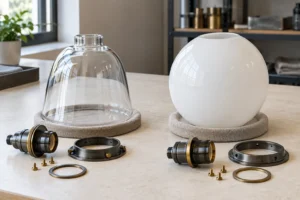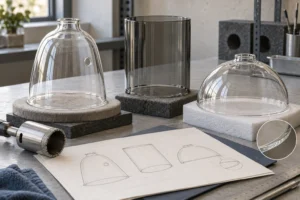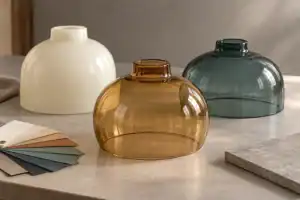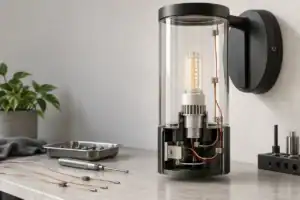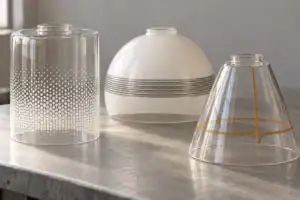
Direct answer: Cut glass floor lamp shades are large geometric faceted glass covers for upright floor lamp fixtures, typically 12–18 inches in diameter. Common forms include bell-shaped torchiere shades, conical downlight shades, and globular side-light shades with diamond, hobstar, or fluted cut patterns. They fit via gallery ring, uno, or spider fitter hardware.
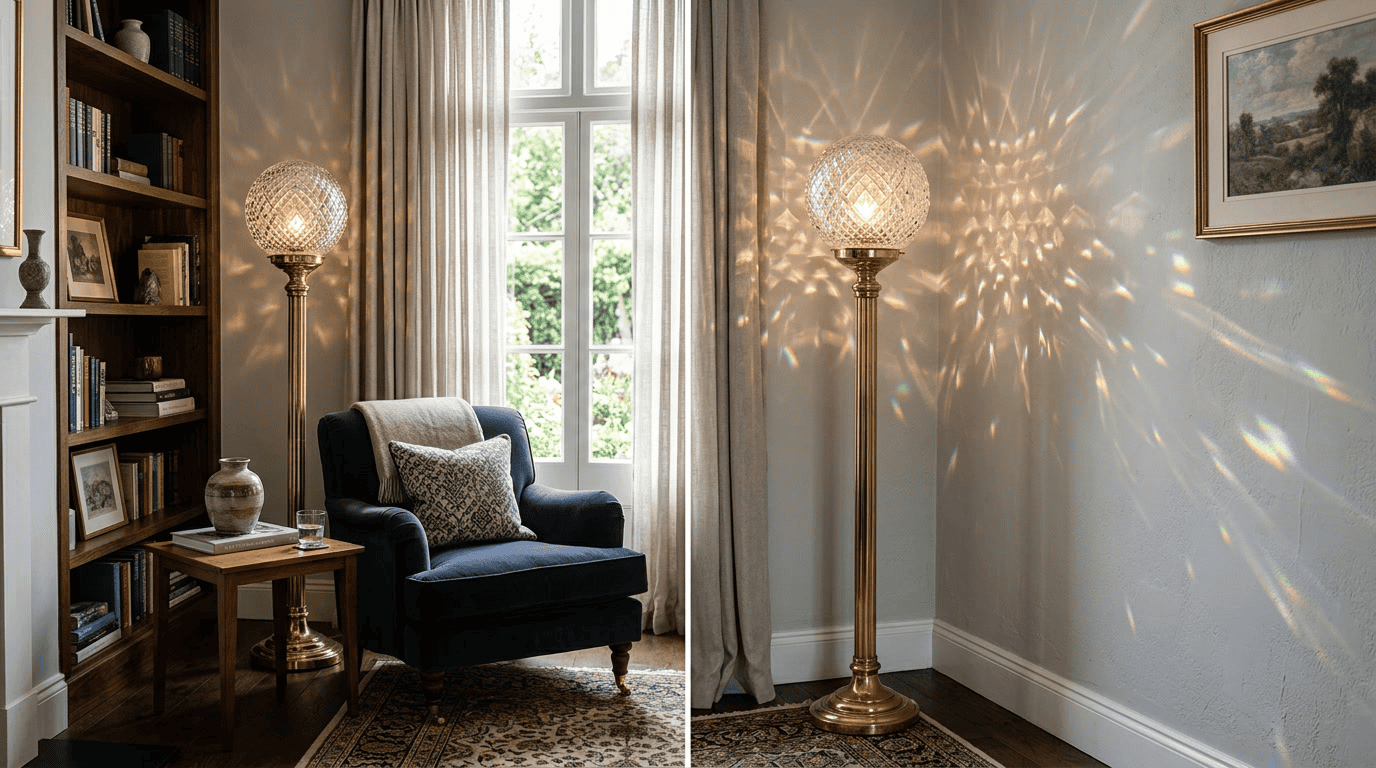
A cut glass floor lamp shade at full height — lit from within, casting prismatic patterns across the ceiling and walls — is one of the most distinctive lighting effects available in residential interiors. The floor position gives these shades a different visual role than table or pendant versions: the light projects upward and laterally at room height, animating the full room volume rather than just the immediate table area.
Floor lamp shades also tend to be the largest format in the cut glass category, which creates specific selection considerations around weight, fitter compatibility, and the visual scale of the pattern against the room.
This guide covers the full cut glass floor lamp shade market: shade forms, pattern options, sizing for common floor lamp types, fitter compatibility, and what to look for in quality production.
Floor Lamp Types and Compatible Shade Forms
Not all floor lamps are designed to use the same shade form. Understanding the lamp base type determines which cut glass shade geometry is appropriate.
Torchiere floor lamps: The shade faces upward, directing all light toward the ceiling for indirect ambient illumination. Torchiere shades are bowl or bell-shaped, open at the top, and designed to project light upward through the glass and directly into the ceiling. Cut glass torchiere shades create extraordinary ceiling effects — the prismatic light from the faceted glass patterns the entire ceiling surface. The shade opening faces upward and must allow heat to escape; do not use enclosed torchiere shades with incandescent bulbs above 100 watts.
Standard downlight floor lamps: Shade faces downward, directing primary light to the floor and reading area. Standard lampshade forms — conical, bell, drum — with cut glass. These create the most conventional reading-lamp configuration but with the added visual interest of cut glass prismatic effects on surrounding walls.
Arc floor lamps: A long arched arm brings the shade out over a seating area. Cut glass arc shades are typically globe or bell forms that direct light both downward and laterally. The arm length puts the shade at a distance from the base where weight becomes important — very heavy cut glass shades can affect arc lamp balance.
Club or bridge floor lamps: Shorter floor lamps with the shade at sitting height, directing reading light at chair level. Shades are typically small-to-medium (8–12″ diameter) and must direct light efficiently downward. Cut glass in this form gives excellent prismatic effects at eye level — very dramatic, but potentially too visually active for focused reading.
| Floor lamp type | Shade form | Typical diameter | Fitter type |
|---|---|---|---|
| Torchiere | Bowl/bell, open top | 12–18″ | Gallery ring 3¼” or 4″ |
| Standard downlight | Conical/bell, open bottom | 12–16″ | Uno, spider, or gallery |
| Arc lamp | Globe or bell | 10–14″ | Uno or gallery ring |
| Club/bridge | Small conical or bell | 8–12″ | Uno or small gallery |
| Pharmacy/task | Small bell or shade form | 6–10″ | Clip-on or uno |
Cut Glass Pattern Options for Floor Lamps
Cut glass patterns for floor lamp shades fall into the same families as all cut glass, but the larger scale of a floor lamp shade changes the visual weight of each pattern. A hobstar pattern that reads as delicate on an 8″ table lamp shade becomes bold and dramatic on a 16″ floor lamp shade.
Diamond crosshatch: The most versatile pattern at floor lamp scale. Regular diamond grid is legible and visually interesting without overwhelming the room. On a 16″ torchiere shade, the diamond pattern produces a ceiling projection with hundreds of distinct prismatic points — very effective.
Hobstar: Dense, heavily cut pattern with maximum light refraction per square centimeter. Excellent at floor lamp scale for formal rooms where the lamp is intended to be a statement object. The hobstar’s visual complexity at large scale can be too much for smaller rooms or casual interiors.
Fluted / vertical cuts: Simple parallel vertical channels running the height of the shade. At floor lamp scale, fluted glass produces clean vertical light columns on surrounding walls — more architectural, less ornate than diamond or hobstar. Well suited to transitional and modern-traditional rooms.
Step / block cut: Horizontal bands of flat-cut rectangular surfaces. Art Deco character. At floor lamp scale, the horizontal banding creates a structured look appropriate for 1920s–1940s revival interiors and contemporary spaces with strong geometric design language.
Clear pressed diamond: Mass-market equivalent of cut diamond pattern. At floor lamp scale, the difference between pressed and true cut glass is more visible than on smaller shades — the pressed pattern has softer edges and less optical precision. Quality pressed glass still produces good light effects at a significantly lower price.
Sizing a Cut Glass Floor Lamp Shade
Floor lamp shade sizing follows different rules than table lamp shades because the visual relationship is to the room, not to a table surface.
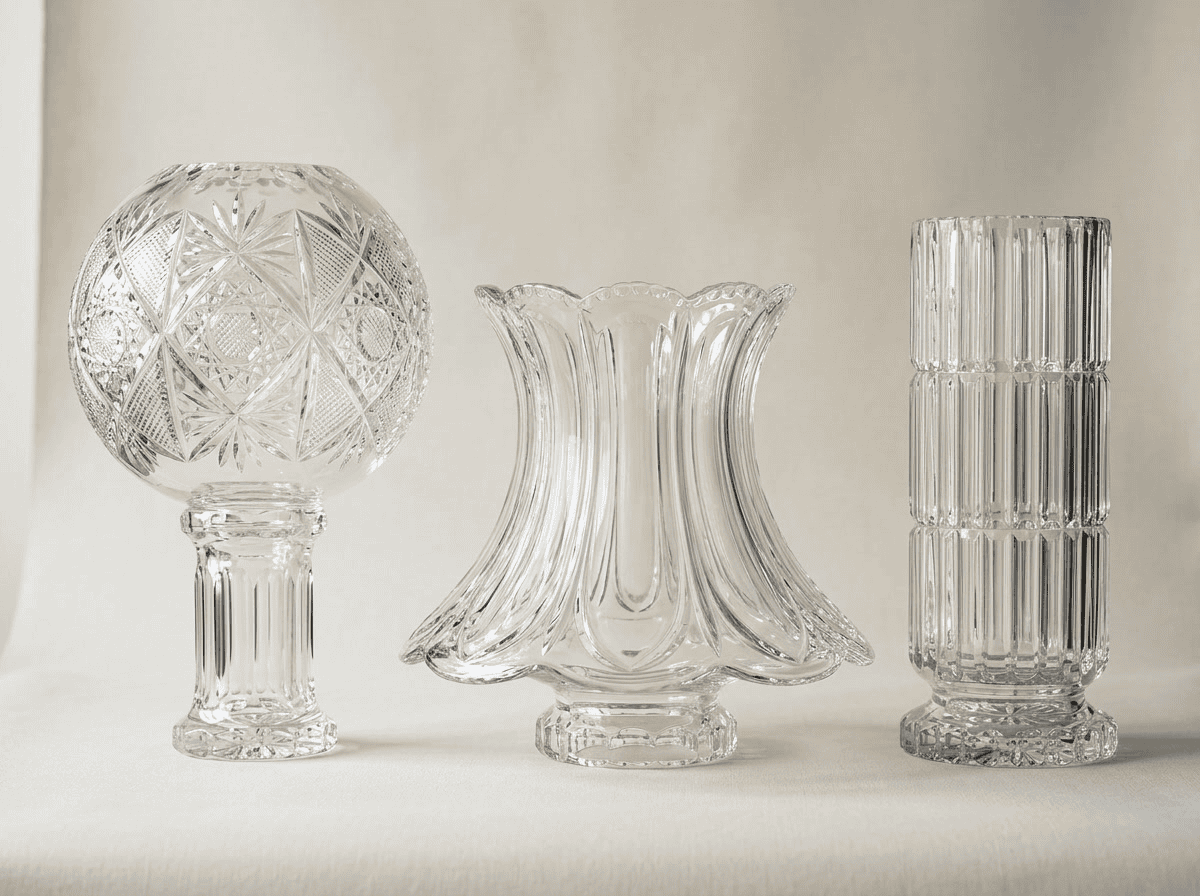
The critical measurement: fitter compatibility. Before choosing any shade dimension, confirm the fitter type and opening size of the floor lamp hardware. A shade that fits the lamp visually but has the wrong fitter type is unusable.
Height proportions for downlight floor lamps: The bottom of the shade should be at approximately seated eye level (38–44″) to direct reading light correctly and to keep prismatic projections at wall height rather than below furniture level.
| Lamp base height | Recommended shade diameter | Shade height | Visual weight |
|---|---|---|---|
| 48–52″ (standard) | 12–14″ | 8–10″ | Medium |
| 52–58″ (tall) | 14–16″ | 9–11″ | Full |
| 60–66″ (arc/torchiere) | 14–18″ | 10–14″ | Statement |
| Below 46″ (club/bridge) | 8–12″ | 6–8″ | Compact |
Weight considerations: Cut glass floor lamp shades are substantially heavier than fabric or acrylic shades of the same diameter. A 14″ cut glass shade may weigh 2–4 lbs depending on glass thickness and whether the shade is true cut glass or pressed. Verify that the floor lamp fitter hardware is rated for the shade weight — most quality floor lamp hardware accommodates shades to 5 lbs, but lightweight or decorative hardware may have lower limits.
Arc lamp weight balance: For arc floor lamps, the shade weight affects the counterbalance at the base. Manufacturer recommendations typically specify a maximum shade weight for arc lamps. Exceeding this risks tipping. Cut glass shades at the upper weight range may require an arc lamp specifically designed for heavier shades, or a lamp with an adjustable counterweight base.
Fitter Types for Floor Lamp Cut Glass Shades
Fitter compatibility is the non-negotiable specification. The most beautiful cut glass shade is useless if the fitter doesn’t match the lamp hardware.
Gallery ring (3¼” and 4″ inner diameter): The standard fitter for most floor lamp shades larger than 12″. The shade’s fitter ring rests on the gallery, which surrounds the socket. The gallery ring inner diameter must match the shade’s fitter outer dimension. Gallery ring fitters are the most stable for heavy cut glass shades.
Uno fitter (7/8″ threaded): Threads directly onto the lamp socket. Common on post-1940 floor lamps. Lighter-duty than gallery ring; typically appropriate for shades up to about 12″ diameter and 3 lbs. For heavy large-format cut glass shades, confirm the uno hardware can support the shade weight.
Spider fitter (saddle/harp mount): A spider ring with 3–4 arms mounts on a harp that attaches to the lamp socket. Common on torchiere floor lamps. The harp height determines the shade position. Spider fitters are secure for large shades but require a matching harp height — standard harp heights are 7″, 9″, 10″, 11″, 12″.
According to Wikipedia’s overview of floor lamp designs, the standard floor lamp emerged in the late 19th century as electricity became available for residential use. Early electric floor lamps used the same shade forms as their oil lamp predecessors, including the heavy cut glass shades that were already established in the Victorian decorative tradition.
Where Cut Glass Floor Lamps Work Best
Formal living rooms with high ceilings: The combination of floor height projection and ceiling distance creates the best prismatic effects. Low ceilings (under 8′) compress the effect; high ceilings (9’+) allow the light to fully develop and spread.
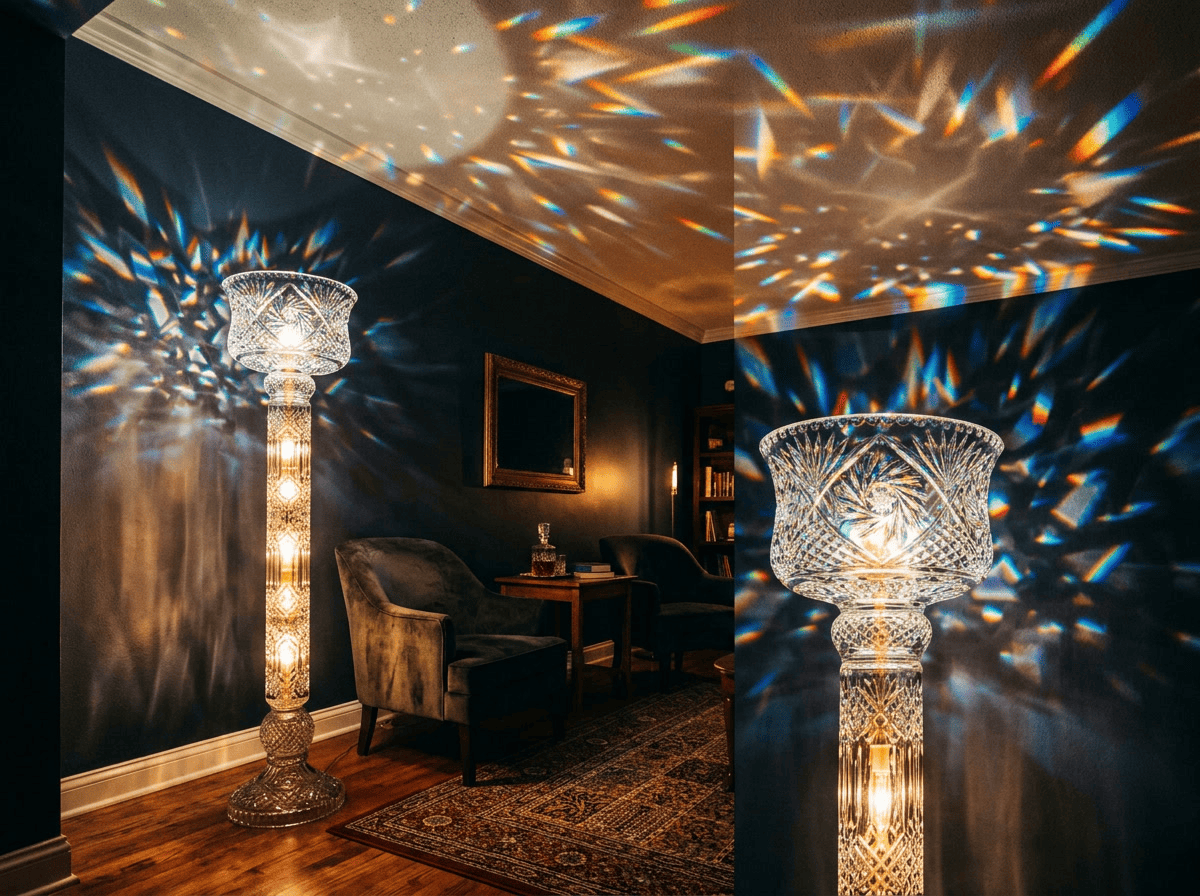
Reading corners and sitting areas: A cut glass floor lamp positioned beside an armchair creates both functional reading light and ambient room character. The prismatic projections animate the corner while the downward component provides sufficient illumination.
Hotel lobbies and reception areas: Commercial environments where a single statement floor lamp needs to create atmosphere for a large space. At floor lamp height, cut glass effects are visible from across a room.
Period-appropriate interiors: Victorian, Arts & Crafts, Art Nouveau, Art Deco, and Edwardian interiors all used cut glass floor lamps as period-appropriate accessories. For reproduction period interiors, matching the pattern family to the period is part of the design accuracy.
What to avoid: Open-plan rooms with low, flat ceilings where prismatic effects cannot develop. Minimalist modern interiors where the visual complexity of cut glass conflicts with the design language. Children’s rooms or high-traffic areas where floor-height cut glass is vulnerable to impact.
For period-appropriate styling in formal rooms, Architectural Digest’s lighting design guide provides context for matching shade style to interior period.
Quality Assessment for Cut Glass Floor Lamp Shades
At floor lamp scale, the quality differences between production tiers are more visible than on smaller shades. Assess these characteristics before purchase:
True cut vs. pressed glass: Run a fingernail very lightly across a facet edge. True cut glass has a sharp, clearly defined edge — you feel the transition between surfaces distinctly. Pressed glass has a softer, more rounded edge. Neither is inherently inferior, but the price difference should match the production difference. At floor lamp scale, true cut glass produces noticeably superior prismatic effects.
Glass clarity: Look through the shade at a light source. Quality glass shows excellent clarity with no bubbles, inclusions, or grey tones. Very clear glass with a slight blue-white tint indicates high optical quality. Yellow or green tints in the glass body indicate lower-grade glass formulation.
Pattern regularity: On a diamond or hobstar pattern, are the facets consistent in size and alignment around the full shade? Irregular facets indicate inconsistent cutting or mold quality. Small variations are acceptable in hand-cut work; major variation suggests poor production quality control.
Fitter rim finish: The fitter opening should be perfectly circular, with the rim ground and fire-polished smooth. Rough or chipped fitter rims are a quality and safety concern — they indicate poor finishing and can damage the lamp hardware.
For large-format cut glass shades for floor lamps, our cut glass lamp shades guide shows current production options across all size ranges with fitter specifications. For maintaining the brilliance of a cut glass floor lamp shade over time, how to clean cut glass lamp shades covers the correct techniques for these larger formats. For replacement options when a floor lamp shade is damaged, cut glass lamp shade replacement covers the full replacement process.
For current LED bulb pairing with floor lamp cut glass shades, The Spruce’s floor lamp guide covers both functional and aesthetic pairing considerations.
LED Bulbs for Cut Glass Floor Lamp Shades
Cut Glass Pattern Characteristics at Floor Lamp Scale
| Pattern | Light scatter | Visual weight | Best room style |
|---|---|---|---|
| Diamond crosshatch | All-directional | Medium | Traditional, transitional |
| Hobstar | Maximum refraction | High | Formal, Victorian, Edwardian |
| Fluted / vertical | Lateral columns | Low–medium | Arts & Crafts, Art Deco |
| Step / block cut | Moderate scatter | Medium | Art Deco, Streamline |
| Pressed diamond | Good all-directional | Medium | Any period, budget-conscious |
The choice of bulb significantly affects the prismatic output of a cut glass floor lamp shade.
For torchiere shades: Use an omnidirectional LED bulb (globe or A19 form) rated at 800–1600 lm, 2700K color temperature. Omnidirectional output illuminates all facets equally, maximizing prismatic projection. Point-source or directional LEDs illuminate only the facets they face directly, leaving others dark.
For downlight floor lamp shades: An omnidirectional A19 LED, 800 lm, 2700K provides warm ambient light through the faceted glass. The warm color temperature enhances the warm tones in cut glass patterns and harmonizes with the gold/amber spectrum that faceted glass naturally emphasizes.
Filament LED bulbs: A clear glass filament LED produces multiple point sources, each of which creates its own prismatic projection through the cut glass. In larger floor lamp shades, this can create complex, layered prismatic effects on the ceiling that are more dynamic than single-source bulbs. Recommended for decorative effect; the multiple filament points are visible through the glass and add visual character.
Dimming: Most cut glass floor lamps benefit from dimmer control. The prismatic effects are most visible at reduced brightness levels where the room ambient is darker relative to the lamp. Full-brightness operation in a lit room reduces the visible contrast of the projections. A simple rotary dimmer or smart bulb dimmer gives full control over the effect.
According to the U.S. Department of Energy’s LED lighting guidance, omnidirectional LEDs now achieve 80–90 lm/W efficiency — making them the clearly preferred choice for cut glass floor lamps where omnidirectional light output is critical for maximum facet illumination.
Frequently Asked Questions
What diameter cut glass shade fits a standard floor lamp?
Most standard floor lamps (52–58″ tall) take shades 12–16″ in outer diameter. Confirm the fitter type and inner diameter first — the diameter range is secondary to fitter compatibility. A 14″ shade is the most common and versatile size for standard floor lamps, providing good visual scale without excessive weight.
How do I know if my floor lamp can support a heavy cut glass shade?
Check the lamp hardware and fitter type. Gallery ring fitters on heavy-duty floor lamps typically support shades up to 5–8 lbs. Uno fitters on lighter floor lamps may be limited to 2–3 lbs. If the manufacturer’s specification isn’t available, assess the hardware: a substantial metal gallery ring with thick arms indicates good weight capacity; thin pressed-metal hardware indicates limited capacity.
Can I use a cut glass shade on an arc floor lamp?
Yes, with weight verification. Arc floor lamps are balanced around the fulcrum at the base — a heavy shade at the end of a long arm creates a significant moment force. Most arc lamps specify a maximum shade weight in their documentation. For cut glass shades on arc lamps, stay at the lighter end of the available sizes (10–12″ diameter, pressed glass rather than heavy true cut) unless the arc lamp is specifically designed for heavier shades.
What bulb gives the best prismatic effect in a cut glass floor lamp shade?
An omnidirectional LED or a vintage-style clear filament LED at 2700K. Omnidirectional output illuminates all facets simultaneously, creating continuous prismatic projection. Filament LEDs add visual character because the visible filament produces multiple small, complex projections through the facets. Directional or spotlight bulbs should be avoided — they only illuminate the facets they directly face.
Are cut glass floor lamp shades appropriate for outdoor covered areas?
Generally no for true cut glass — the combination of temperature cycling, humidity, and potential rain splash can stress both the glass and the fitter hardware. Pressed glass in certain protective fitter configurations can work in very well-protected covered outdoor areas (screened porches, covered terraces), but this requires confirming the shade and hardware are rated for ambient moisture exposure.
How do I clean a cut glass floor lamp shade that’s too heavy to remove easily?
In-place cleaning with a dry soft brush works well for maintenance. For deeper cleaning, use a barely-damp microfiber cloth on the exterior, working from top to bottom in sections. The key is keeping the cloth dry enough that no water drips onto the lamp hardware below. For a thorough wash, removing the shade — even if inconvenient — is the right approach. Have a second person support the shade during removal and reinstallation.
What’s the difference between a cut glass torchiere shade and a regular floor lamp shade?
A torchiere shade faces upward and is bowl or bell-shaped — open at the top so light projects toward the ceiling and through the glass sides. A regular floor lamp shade faces downward and is open at the bottom — directing light downward. Torchiere cut glass shades produce dramatic ceiling projections; regular floor lamp shades produce both reading light and wall projections. The fitter types are often different — check before purchasing a replacement.
Related Articles in This Series
Conclusion
Cut glass floor lamp shades occupy a unique position in the decorative glass category — large enough to make a real room statement, tall enough to project prismatic patterns across the full room volume, and varied enough in pattern and form to suit interiors from formal Victorian to contemporary transitional.
The selection process starts with fitter compatibility, moves to shade form matching the lamp type, then to pattern selection, size, and quality assessment. A cut glass floor lamp shade chosen correctly for its lamp and room will reward the investment with decades of brilliant prismatic light — and a visual presence that fabric and acrylic alternatives cannot replicate.