直接的な回答: Crystal cut glass lamp shades are faceted glass covers made from lead crystal (high refractive index, brilliant optical clarity) or standard soda-lime glass with cut patterns. True lead crystal has higher brilliance and ring than soda-lime; most residential lamp shades labeled “crystal” are high-quality soda-lime pressed glass. Both produce prismatic light effects.
“Crystal” is one of the most misused words in the lamp shade market. In a strict sense, crystal glass means lead crystal — glass containing at least 24% lead oxide, which raises the refractive index and produces the legendary brilliance, weight, and ring-when-tapped quality associated with Waterford or Baccarat. In common marketplace usage, “crystal” means any clear glass with cut or pressed faceted patterns, regardless of composition.
This distinction matters when you’re paying a premium for “crystal lamp shades” — true lead crystal commands 3–5× the price of quality pressed soda-lime glass, and the visual difference in a residential setting is real but may not be worth the cost for most applications. This guide explains the distinction, covers the major crystal-style shade types, and helps you choose correctly.
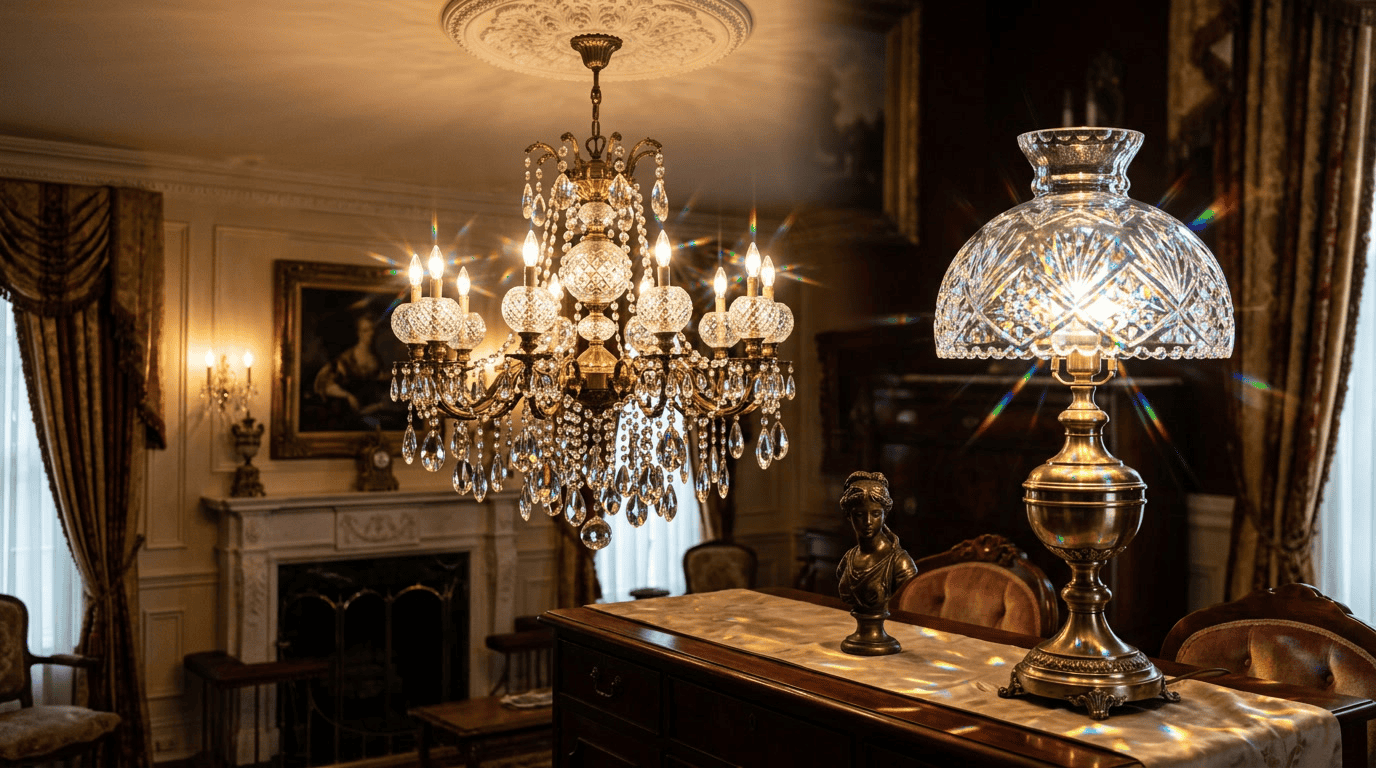
Lead Crystal vs. Soda-Lime “Crystal” Glass: The Real Difference
Lead crystal:
- Contains 24–30%+ lead oxide (European crystal) or 10–23% (American crystal)
- Refractive index 1.56–1.61 (vs. 1.52 for soda-lime glass)
- Higher refractive index = more brilliant light dispersal, more vivid rainbow effects
- Noticeably heavier than same-size soda-lime glass
- Rings with a clear, sustained musical tone when tapped (the “crystal ring”)
- Takes a sharper cut — edges more precisely polished
- Softer than soda-lime (Mohs 5–5.5 vs. 5.5–6) — scratches more easily
- More expensive at every quality level
lead-free crystal (modern):
- Developed as EU and US regulations restricted lead in consumer glass
- Uses barium oxide, zinc oxide, or titanium dioxide to raise refractive index
- Very close visual performance to lead crystal, safer in production
- Increasingly the standard for “crystal” quality glass from European manufacturers
High-quality soda-lime pressed “crystal”:
- Soda-lime glass batch with added clarity agents
- Refractive index 1.52 (lower than crystal)
- Good optical clarity, good facet polish in quality production
- Lighter weight than crystal
- Does not ring with musical tone
- More resistant to scratching than lead crystal
- Most “crystal look” lamp shades in the residential and hospitality market
For practical lamp shade selection: In a normal residential room, the visual difference between true lead crystal and high-quality pressed soda-lime glass is visible in direct comparison but not apparent day-to-day. For flagship statement pieces (the main chandelier in a formal dining room, a pair of prominent table lamps in an entry), true crystal’s superior brilliance is worth the premium. For secondary and supporting pieces, quality pressed soda-lime delivers 80% of the visual result at 30% of the cost.
Classic Crystal-Style Shade Forms
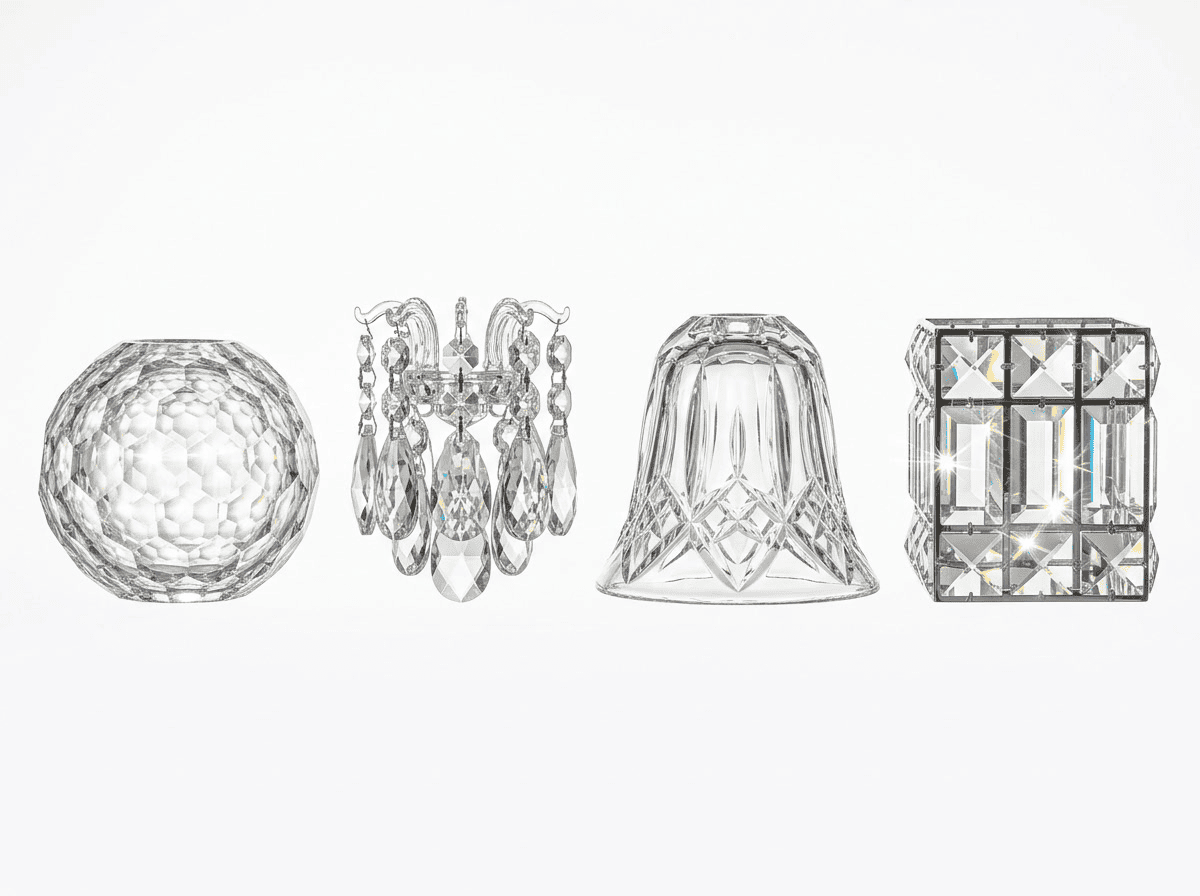
Faceted globe (most common crystal-style): Spherical or near-spherical shade with diamond or hexagonal facets covering the entire exterior. The most recognizable “crystal lamp shade” form. Available in true lead crystal and pressed soda-lime versions.
Chandelier pendant drops: Small crystal shade components used on chandelier arms — typically 50–150mm tall, pear or almond shapes with cut facets. These are often true lead crystal even in mid-range chandeliers because the small size makes the crystal cost per component manageable.
Faceted bell (table lamp): Bell-form shade with diamond facets. The most practical crystal-style shade for a table lamp — the bell silhouette is proportionally flexible and the facets work at table lamp scale.
Square or hexagonal lantern panels: Crystal-style flat panels in a metal frame, creating a geometric lantern form. Common in entry fixtures and formal dining pendants.
Drop/teardrop pendants: Elongated teardrop shapes in faceted crystal, hanging from pendant fixtures. Particularly effective in clusters.
How to Evaluate Crystal Lamp Shade Quality
Before purchasing any “crystal” lamp shade, three tests distinguish quality levels:
The tap test: Gently tap the shade near its base with a fingernail. True lead crystal produces a clear, sustained ringing tone — the “crystal ring.” Lead-free crystal produces a similar but slightly shorter ring. Standard soda-lime glass produces a dull, brief tap sound with no ring. This test requires the shade to be off the lamp.
The weight test: True crystal is measurably heavier than soda-lime of the same dimensions. If you’ve handled crystal glassware (a wine glass, a tumbler), lead crystal lamp glass should feel similarly heavy.
The brilliance test: Hold the shade in direct sunlight or near a point-source bright light. True crystal creates brilliant rainbow dispersal from the facets — distinct, vivid colored bands. High-quality soda-lime pressed glass creates sparkle but with less spectral separation. Low-quality pressed glass creates minimal sparkle.
For detailed guidance on crystal identification, the コーニングガラス美術館 maintains extensive reference materials on glass types and their optical properties.
Sizing Crystal Cut Glass Shades for Table Lamps
Crystal-style shades follow the same proportion rules as all table lamp shades:
| ランプベースの高さ | Crystal shade outer diameter | Best form |
| 8〜10インチ | 8~12インチ | Faceted globe or small faceted bell |
| 10~14インチ | 12〜14インチ | Faceted bell or faceted globe |
| 14〜18インチ | 14〜16インチ | Large faceted bell |
| 18″+ | 16–20″ | Large faceted globe |
Fitter considerations: Many vintage crystal shades have 2¼” gallery fitters from the period when they were produced. Current production crystal shades commonly use uno (7/8″) or spider fitter. Always confirm fitter type before ordering.
For measurement guidance: 交換用ガラスランプシェードの測り方.
Crystal Shades in Chandelier Applications
Crystal glass is most commonly used in chandeliers, where the multiple individual shade and drop components create a cumulative brilliance effect. In chandelier context, the individual component size is small enough that the cost of true crystal is distributed across many units.
For chandelier replacement components, matching the original production closely matters because mismatched refractive indices or facet styles will be obvious when the chandelier is lit. Request a sample component before ordering replacements in quantity.
日本の Wikipedia’s article on crystal glass, EU regulations now define lead crystal as requiring at least 24% lead oxide, while lower lead content (10–23%) is classified as crystallin. Many “crystal” products sold internationally don’t meet either standard — the term is effectively unregulated in most markets.
Using Crystal Cut Glass Shades Effectively
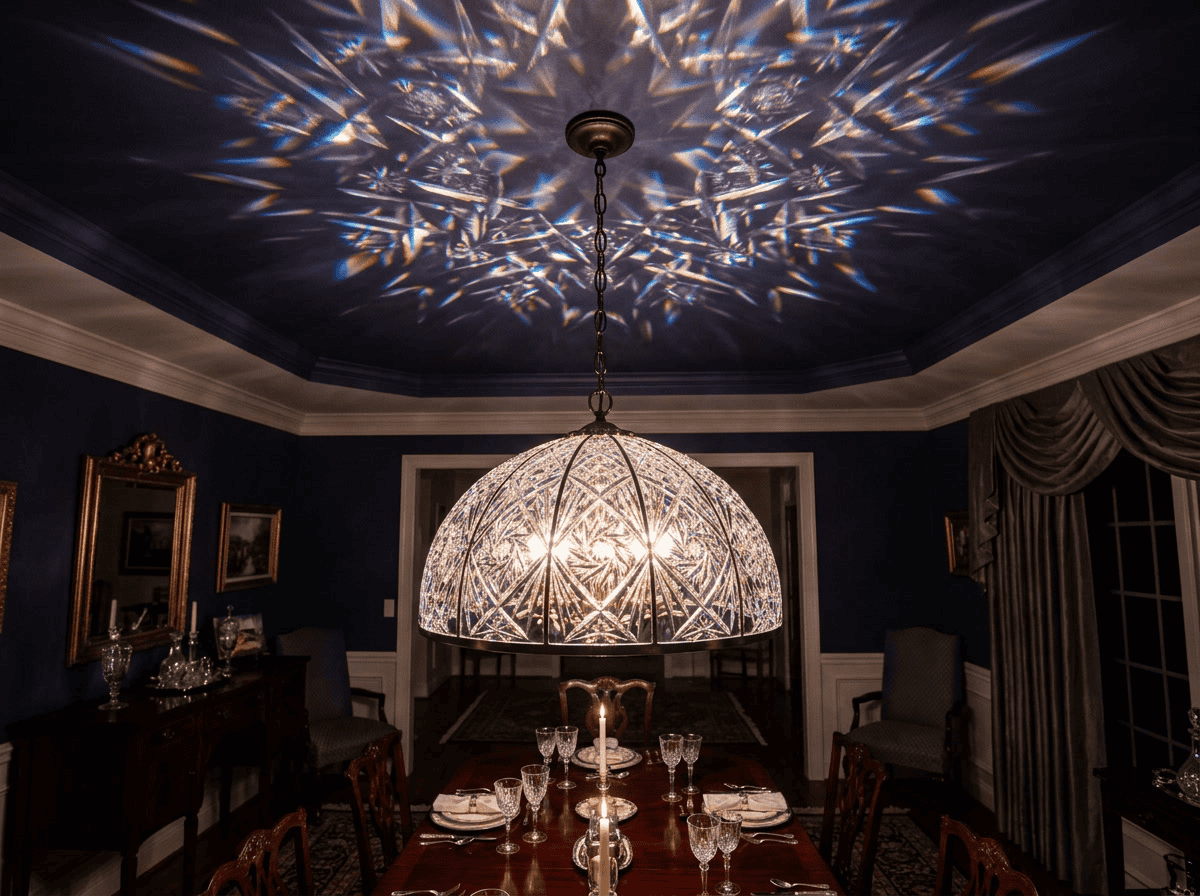
Light source selection: Crystal cut glass performs best with a single-point source — a decorative filament LED or a compact LED — that creates defined refraction from each facet. Omnidirectional LED sources work but reduce the sharpness of the prismatic patterns. Match warm 2700K for the most flattering crystal appearance.
Dimmer use: Crystal shades are the glass type most transformed by dimming. At full brightness, a crystal shade is brilliant; at 30–40% dimmed, the same shade creates a gentle warmth. A dimmer switch is essentially mandatory for any room where crystal lamp shades are used as mood lighting.
Background material: Crystal’s prismatic patterns are most visible against dark or matte surfaces. Against light-colored walls or high-gloss surfaces, the patterns wash out. Dark walnut, deep charcoal wall, or matte plaster backgrounds show crystal patterns most effectively.
Symmetry: Crystal shades have such strong visual presence that asymmetrical placement (one crystal shade, one opal shade) reads as an error. Specify crystal shades in matching pairs or complete sets within the same room zone.
For current production crystal-style pressed glass shades, our cut glass lamp shades collection で選択肢をご覧いただけます。.
よくある質問
How can I tell if my lamp shade is real lead crystal?
Three tests: (1) Tap test — lead crystal rings with a clear musical tone; soda-lime glass gives a dull tap sound. (2) Weight — lead crystal is heavier than same-size soda-lime. (3) Brilliance — hold in direct sunlight; lead crystal produces vivid rainbow dispersal; soda-lime glass produces sparkle but less spectral separation.
Is lead crystal safe for use in lamp shades?
Yes. Lead is present in the glass matrix and does not leach into air or surfaces under normal use. The health concerns around lead crystal relate to prolonged contact with acidic liquids (wine, water stored in crystal decanters) — not relevant for lamp shades. Lead-free crystal alternatives are available and perform nearly as well optically.
What is lead-free crystal, and is it better?
Lead-free crystal uses barium oxide or other compounds instead of lead to raise the refractive index. Performance is very close to lead crystal — essentially equivalent for lamp shade use. Lead-free crystal is safer in production (no lead exposure for workers) and is now standard from most European manufacturers.
Can crystal cut glass shades be used outdoors?
Not for exposed outdoor use. Crystal and cut glass shades require interior installation. For covered outdoor areas (pergolas, covered porches), enclosed pendants with crystal components are possible but require IP-rated fixture bodies.
How do I clean lead crystal lamp shades?
Same process as standard cut glass: soft brush to remove dust from pattern recesses, then damp microfiber cloth with warm water and mild dish soap. Important: use pH-neutral soap only — acidic or highly alkaline cleaners can affect the glass surface of genuine lead crystal over time. Rinse with clean water, air dry fully.
Are crystal lamp shades appropriate for contemporary interiors?
In limited quantities, yes. One crystal globe shade in a contemporary room reads as a deliberate luxury accent. Multiple crystal shades throughout a contemporary room can feel thematically heavy. The key is intentionality — crystal as punctuation works; crystal everywhere works only in traditional formal contexts.
What’s the price range for quality crystal cut glass lamp shades?
True lead crystal shade (10–14″ outer diameter): $80–250 depending on pattern complexity and whether it’s a named manufacturer. Quality lead-free crystal: $50–150. Quality soda-lime pressed “crystal style”: $25–70. Low-quality pressed import: under $20 (avoid — facet quality is usually poor).
結論
Crystal cut glass lamp shades deliver brilliant optical effects that no other glass type matches at the same price point — the prismatic dispersal from faceted crystal is genuinely special. The distinction between true lead crystal and quality pressed soda-lime glass matters for premium applications and collector value; for most residential use, quality pressed soda-lime delivers excellent results at significantly lower cost.
The decision is straightforward: if the lamp is a prominent statement piece in a formal room, invest in true crystal. For secondary lamps and supporting pieces where the crystal effect is desired but the lamp isn’t the focal point, quality pressed glass is the practical choice.