Direct answer: Stained glass floor lamp shades are colored glass covers for floor lamp fixtures in Mission, Arts & Crafts, or Tiffany-style construction. They typically use gallery ring fitters (3¼” to 4″) or large ring supports, and work best on tall floor lamps (55″+ fitter height) where the shade sits above seated eye level to prevent colored glass glare.
Stained glass floor lamp shades occupy a specific niche in period lighting. The large scale of a floor lamp allows for stained glass shades that would be physically overwhelming on a table lamp — 16″, 18″, or even 20″ outer diameter shades in mission or geometric patterns that create substantial colored ambient light in a room.
The height challenge applies to stained glass on floor lamps just as it does to cut glass: colored glass at seated eye height creates direct colored glare rather than the ambient glow that makes stained glass beautiful. But stained glass floor lamps can be magnificent when the shade is elevated correctly.
Floor Lamp Heights and Stained Glass Compatibility
For an overview of how floor lamps compare to other stained glass formats, see our stained glass lamp shades hub.
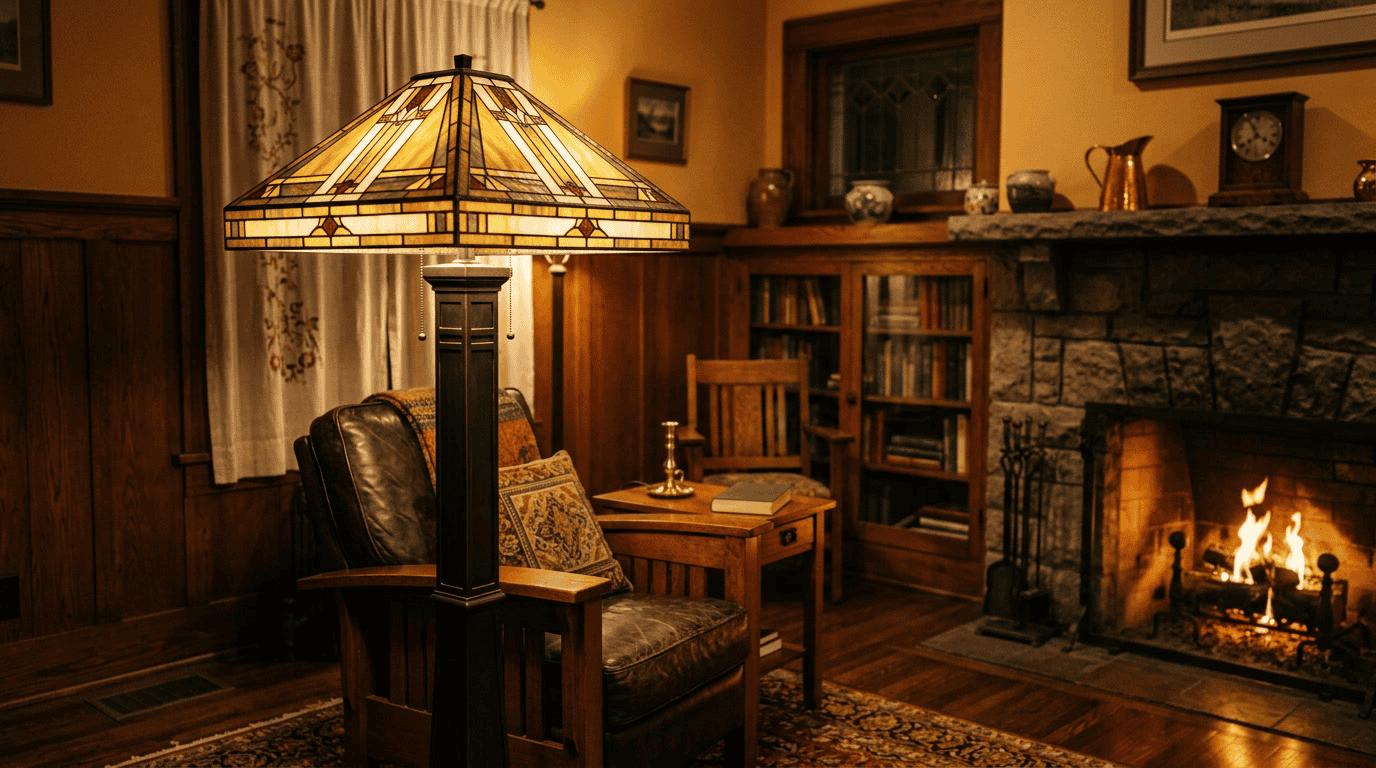
The rule for stained glass floor lamps: the shade’s bottom edge should sit at or above 52–55″ from the floor. This places the shade above normal seated eye height (~42–44″ for sofa-seated, ~48″ for chair-seated), preventing direct glare from the colored glass.
Floor lamp types and their stained glass compatibility:
Tall column floor lamp (60–72″ fitter height): Ideal. The shade at 60″+ sits well above all seated eye heights. Shades up to 20″ outer diameter work at this height. The lamp becomes a room-scale decorative element.
Standard reading floor lamp (48–54″ fitter height): Stained glass works only if the specific room configuration doesn’t place any seating directly facing the shade. Better alternative: use an opaque or semi-opaque opal single-piece colored glass shade at this height.
Swing-arm floor lamp: Generally not appropriate for large stained glass shades — the arm mechanism isn’t designed for the weight of large copper foil shades.
| Floor Lamp Type | Fitter Height | Stained Glass Suitability |
| Tall column floor lamp | 60-72″ | Ideal – shades up to 20″ outer diameter |
| Standard reading floor lamp | 48-54″ | Conditional – depends on seating layout |
| Swing-arm floor lamp | Varies | Not recommended for large stained glass |
Three Classic Stained Glass Floor Lamp Shade Styles
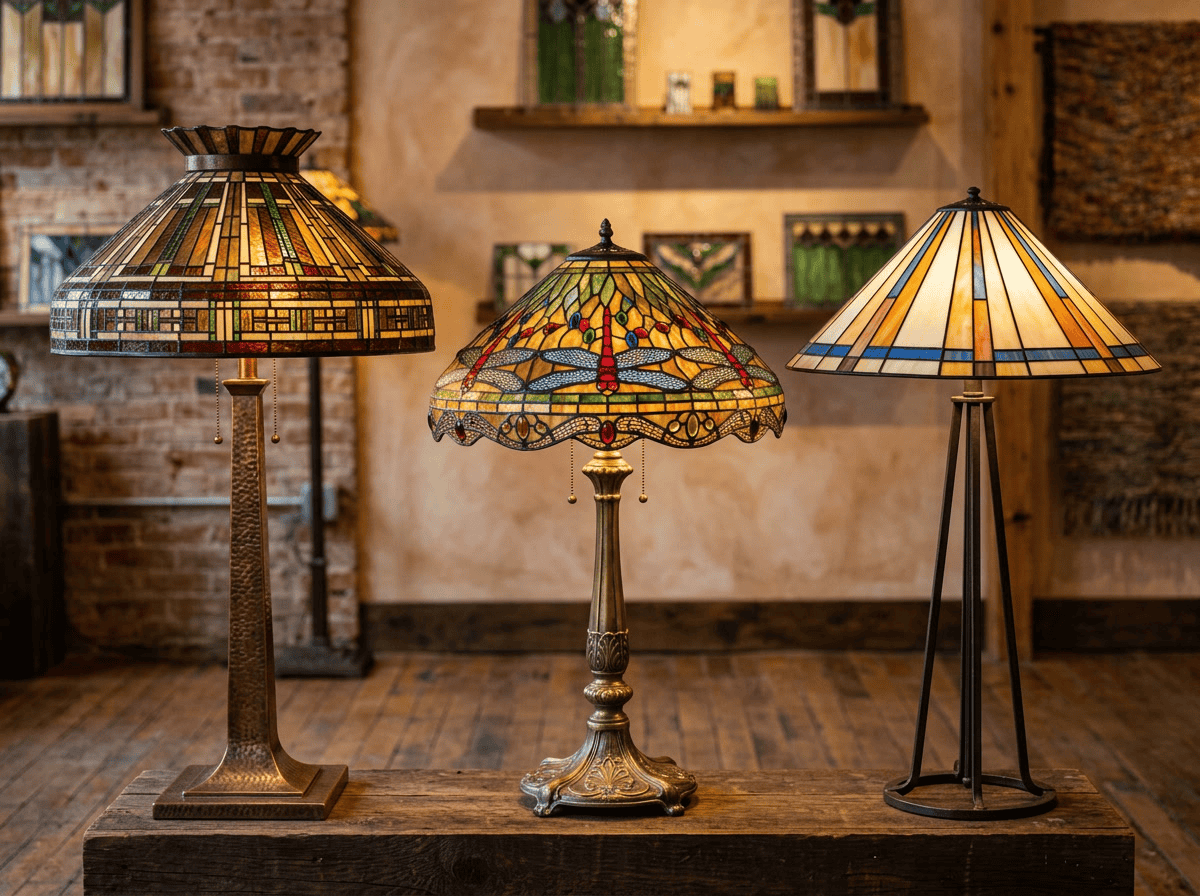
Mission geometric large bell (most common for floor lamps): Angular geometric pattern — Greek key border, diamond or square interior fill — in amber, green, and ruby glass. 14–20″ outer diameter. The Mission style (also called Prairie Style) was designed for Arts & Crafts interiors with horizontal emphasis, dark wood furniture, and warm earth tones.
Arts & Crafts dragonfly or floral bell (16–20″): The larger Tiffany Studios-pattern shades — dragonfly, peony, water lily — that appear on table lamps also appear on floor lamps at larger scale. A full-size dragonfly shade at 20″ outer diameter on a tall column floor lamp is one of the most impressive examples of the style.
Geometric segment (flat-panel construction): Large shades constructed from simple geometric segments — triangles, trapezoids — in a few colors (amber/green/clear, or ruby/amber/green). Simpler construction than floral patterns, more affordable, structurally robust for the weight demands of a large floor lamp shade. The stained glass lampshade construction walkthrough shows how segment panels like these are cut, foiled, and soldered.
| Style | Outer Diameter | Pattern | Relative Price |
| Mission geometric large bell | 14-20″ | Greek key, diamond, square fill | Mid |
| Arts & Crafts dragonfly/floral bell | 16-20″ | Dragonfly, peony, water lily | High |
| Geometric segment (flat-panel) | 14-20″ | Triangles, trapezoids, few colors | Lower |
Fitter Types for Floor Lamp Stained Glass Shades
Most period and reproduction floor lamps for stained glass shades use:
Gallery ring (4″ or 5″ inner diameter): The shade’s upper fitter rim rests in a circular metal ring attached to the lamp post. Large stained glass shades (16–20″) use 4″ or 5″ gallery rings. Measure the ring inner diameter before ordering.
Weighted ring support (antique/vintage): Some antique floor lamp bases use a three-arm or four-arm ring support. Measure the inner support ring diameter rather than assuming standard size.
For measurement guidance: how to measure a replacement glass lamp shade.
Weight Considerations for Large Stained Glass Floor Lamp Shades
Large copper foil and lead came stained glass shades are substantially heavier than single-piece glass shades:
| Outer diameter | Approximate weight (copper foil construction) |
| 14″ | 0.8–1.2 kg |
| 16″ | 1.2–1.8 kg |
| 18″ | 1.8–2.5 kg |
| 20″ | 2.5–3.5 kg |
Floor lamp bases for stained glass use must be specifically designed for this weight. A standard floor lamp with a lightweight base may tip with a 2–3 kg shade. Confirm the base’s weight rating or check that the base’s footprint and weight are adequate. Heavy cast iron or heavy bronze bases are appropriate; lightweight chrome or painted steel bases are not.
Interior Context for Stained Glass Floor Lamps
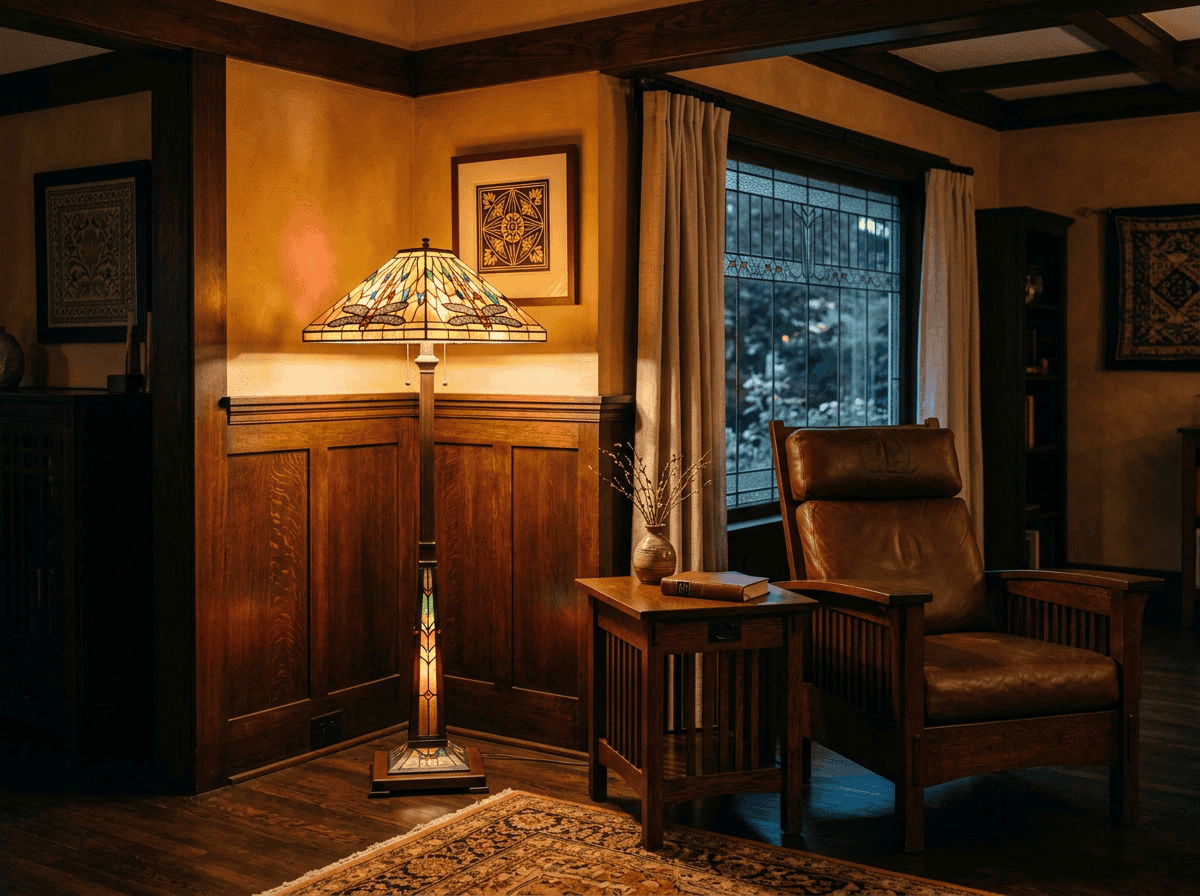
Stained glass floor lamps are almost exclusively appropriate in period-influenced interiors: Arts & Crafts, Craftsman bungalow, Prairie Style, Victorian, or deliberately maximalist rooms. They look dramatically out of place in minimalist, Scandinavian, or industrial interior contexts.
The complete Arts & Crafts room: Dark quartersawn oak furniture, warm earth-toned textiles, hammered copper accessories, Craftsman architectural details (exposed beams, built-in shelving, brick fireplace). In this context, a tall stained glass floor lamp in mission geometric or dragonfly pattern is period-perfect and visually magnificent.
Contemporary contrast: One stained glass floor lamp as a deliberate period accent in an otherwise contemporary room works only if the specific lamp is an acknowledged statement piece — something genuinely exceptional in quality, not a mass-market reproduction. The quality of the glass and craftsmanship must justify the visual disruption of the contemporary context.
According to Wikipedia’s article on the Arts and Crafts movement, the movement’s emphasis on handcraft and natural materials specifically included stained glass as a craft medium — making period stained glass floor lamps authentic artifacts of the movement, not decorative reproductions.
For colored glass options that provide stained glass visual warmth without multi-piece construction, our vintage glass lamp shades includes amber, green, and multi-color options. If a pendant fixture suits the room better than a floor lamp, see our stained glass pendant lamp shades guide, and for table-lamp-scale options see our stained glass table lamp shades guide. Bulk or hospitality orders can be sourced through our custom stained glass OEM production guide.
Frequently Asked Questions
What gallery ring size do floor lamp bases for stained glass shades use?
Typically 4″ inner diameter (for shades 14–18″ outer diameter) or 5″ inner diameter (for shades 18–22″ outer diameter). Always measure your specific base — there is more dimensional variation in floor lamp ring sizes than in table lamp fitters.
How heavy are stained glass floor lamp shades?
A copper foil 16″ shade weighs approximately 1.2–1.8 kg. An 18″ shade weighs 1.8–2.5 kg. Ensure the floor lamp base is adequately heavy and stable for the shade weight — cast iron or heavy bronze bases are appropriate.
Can a standard floor lamp base hold a stained glass shade?
Only if it was specifically designed for one. Most standard floor lamp bases are too light. A base that wobbles when nudged with a light touch will not safely hold a 2 kg stained glass shade. The base weight should be 3–5× the shade weight for stable operation.
Are stained glass floor lamp shades available new?
Yes. Custom copper foil artisans produce floor lamp shades to specification. The price range for a quality 16–18″ shade is $400–1200+ depending on pattern complexity. Simpler geometric patterns are at the lower end; complex floral at the higher end. Mass-market reproductions in resin are available at $100–200.
What is the best room for a stained glass floor lamp?
A large living room or library with period Arts & Crafts or Victorian furniture, high ceilings, and space for the lamp to stand without visual crowding. The lamp needs visual breathing room — at least 90cm clearance on all sides — for the stained glass shade’s colored light to project naturally.
How do I transport a large stained glass floor lamp shade safely?
For copper foil construction: wrap in multiple layers of bubble wrap or foam, then pack in a rigid box with at least 5cm of padding on all sides. Never rest the shade fitter rim on a hard surface — pack it upright or on its side with the rim fully protected. Single-piece glass alternatives are more resilient to transport.
Related Reading
- Stained Glass Lamp Shades: Full Buying Guide
- Stained Glass Pendant Lamp Shades: Styles, Sizing & Installation
- Stained Glass Table Lamp Shades: Tiffany Style, Custom & Decorative Options
- Custom Stained Glass Lamp Shades: OEM Production Guide
Conclusion
Stained glass floor lamp shades are for rooms and lamp configurations that specifically call for them — tall floor lamps in period-appropriate interiors where height clears the seated eye line and the colored light can project freely. When all three conditions are met, a stained glass floor lamp is one of the most visually powerful single objects in residential decorative lighting. When any condition is missing — wrong height, wrong interior, wrong scale — a simpler alternative serves better.