
ガラスランプシェード製造の完全ガイド

手吹きガラスとプレスガラスの製造に関する技術的詳細、カスタム対応力、品質の卓越性

イントロダクション:すべての完璧なライトの背後にある隠れた複雑さ

あなたが〜を持つとき オーダーメイドガラスランプシェード あなたの手の中にあるのは、単なる照明アクセサリーではありません。何世紀にもわたるガラス製造の伝統と、精密な現代工学が融合した結晶なのです。 ガラスランプシェードメーカー 職人技と工業規模の生産の交差点で活動し、私たちは美的な美しさと技術的な性能のバランスを二十年以上かけて磨き上げてきました。.
この記事は、プロフェッショナルの内部で実際に何が起こっているのかを明らかにします。 ランプシェード工場. 照明デザイナーをお探しの場合 カスタムボロシリケートガラス二重壁ランプシェード, 照明器具メーカーとしてサプライヤーを評価する場合や、調達担当者として品質基準を確認する場合、優れたガラスランプシェードと一般的な商品を区別する重要な違いを発見することができます。.
私たちはすべての段階を検証します ガラスランプシェード製造プロセス, 、決定的な技術的比較を提供する 手吹きガラスとプレスガラスのランプシェード, そして、製造手法がプロジェクトの成功に直接影響を与えることを示す実際の顧客事例を共有します。.
 

第1章:基礎—ガラスランプシェード製造における材料科学

なぜホウケイ酸ガラスがプロフェッショナル照明を支配しているのか

ガラスがブローパイプや型に触れる前に、材料の選定が最終製品の性能の70%を決定します。プロフェッショナル ガラスランプシェードの製造業者 材料は、コストだけでなく、熱的、光学的、機械的要件に基づいて選定してください。.
ホウケイ酸ガラス3.3 は、プレミアム照明用途のゴールドスタンダードとなっています。その組成は約81%シリカ、13%ホウ酸、4%ナトリウム/カリウム酸化物、2%アルミニウム酸化物で構成されており、従来のソーダライムガラスとは根本的に異なる三次元ネットワーク構造を形成します。.
 
ケーススタディ:ホテルチェーンの熱的故障
2019年、日本のブティックホテルグループが、ビーチフロントの物件でソーダライムガラスシェードの壊滅的な故障を経験した後、私たちに相談しました。彼らの元の ガラスランプシェードメーカー は、コスト削減のため標準ガラスを指定していました。6ヶ月以内に、23%のシェードが空調のサイクル(室内18°C、室外35°C、さらに60Wハロゲンの熱)によって熱亀裂を発生しました。.
私たちのエンジニアチームは熱シミュレーションを実施し、 カスタムボロシリケートガラス二重壁ランプシェード. を推奨しました。二重壁構造は熱バッファーを作り、外側表面温度を89°Cから41°Cに低減し、ホウケイ酸ガラスの低膨張係数が熱ショックによる故障を排除しました。5年後、交換はゼロで、元の仕様では340回以上の交換が必要でした。.
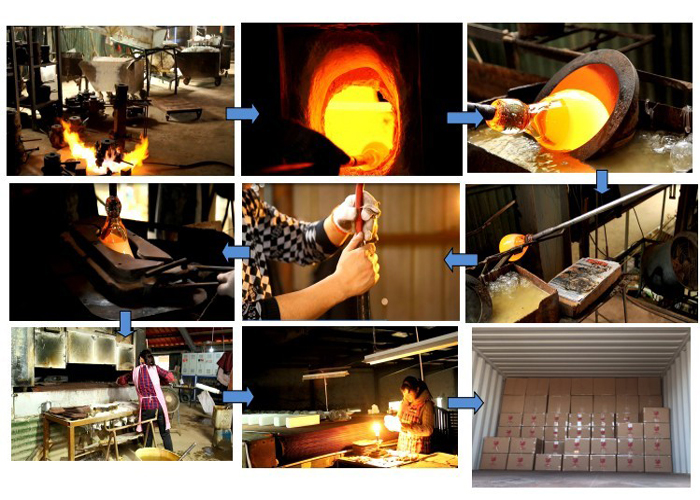
 

第2章:手吹きガラスランプシェード製造—職人の手法

七段階精密工程

手吹きガラスランプシェード製造 はガラス工芸の頂点を示し、習得には8〜15年を要します。即興的な芸術性のイメージとは異なり、プロの製造は厳格な科学的プロトコルに従います。.
 

第1段階:バッチ準備と投入(1バッチあたり00:30〜01:00)

当工場は認定サプライヤー(主にSCHOTTジャパンおよびASTM E438を満たす中国メーカー)からホウケイ酸ガラスチューブを受け取ります。各バッチは入荷検査を受けます:
  • 寸法公差: 外径±0.2mm、壁厚±0.1mm
  • 応力複屈折: <20 nm/cm(偏光器検査)
  • 種子数: <0.5種子/kg(顕微鏡検査)
  • 化学組成: 分析証明書と照合したXRF検証
チューブはCNC位置決め付きのダイヤモンドホイールカッターで計算された長さに切断され、ブロー工程における最適な材料歩留まりと熱質量の一貫性が確保されます。.
 

第2段階:加熱およびガザリング(1本あたり02:00~04:00)

日本の ガラスランプシェードメーカー‘職人はチューブ片を1,150~1,200°Cで稼働するガス酸素炉に投入します。重要なパラメータは以下の通りです:
  • 温度均一性: 加熱ゾーン全体で±5°C(熱電対で監視)
  • 浸漬時間: ガラスの質量と肉厚に基づき正確に計算
  • 回転速度: 均一な加熱分布のため15~30RPM
ガラスは剛性のある固体から粘性のある液体(粘度約10⁴dPa·s)へと移行し、加工が可能になります。この「作業範囲」は約150°Cと狭く、熟練したタイミングが求められます。.
 

Stage 3: Blowing and Forming (03:00-08:00 per piece)

Here’s where hand blown vs pressed glass lampshade differentiation becomes dramatic. The artisan attaches the heated glass to a blowpipe and introduces compressed air (0.2-0.4 MPa) while simultaneously manipulating the form using traditional tools:
  • Block: Wet cherry wood tool for initial shaping
  • Jack: Bladed tool for neck definition and thread preparation
  • Paddle: Flat carbon tool for bottom flattening
  • Tagliol: Shears for trimming excess glass
Technical Precision in Hand Blowing:
For a オーダーメイドガラスランプシェード measuring 180mm diameter × 150mm height, the artisan must achieve:
  • Wall thickness variation: <±0.5mm (measured by ultrasonic gauge)
  • Symmetry deviation: <1.5mm from central axis (laser alignment check)
  • Surface defect rate: <2% (visual inspection under 500 lux)
These tolerances are remarkable given the manual nature of the process, demonstrating why experienced ガラスランプシェードの製造業者 command premium positioning.
 

Stage 4: Thread Formation (01:30-03:00 per piece)

日本の glass G9 screw thread requires specialized technique. While the shade body remains attached to the blowpipe, the neck region is reheated and shaped using precision graphite tools machined to ISO 965-1 Class 6H specifications.
Our master craftspeople achieve thread tolerances of:
  • Major diameter: +0/-0.12mm
  • Pitch diameter: +0/-0.09mm
  • Minor diameter: +0.18/-0mm
This precision ensures seamless integration with metal lamp holders—critical for luminaire manufacturers requiring reliable assembly.
 

Stage 5: Annealing (Critical Quality Determinant)

Immediately after forming, each 手吹きガラスランプシェード enters the annealing lehr—a precisely temperature-controlled kiln where stress elimination occurs over 48-72 hours.
The Science of Annealing:
Glass formed above its strain point (510°C for borosilicate) contains frozen-in stresses from rapid cooling. Without proper annealing, these stresses cause spontaneous cracking during service—particularly dangerous in lighting applications with thermal cycling.
Our annealing curve follows this protocol:
  1. Hold at annealing point (560°C): 30 minutes for stress relaxation
  2. Controlled cooling: 2-5°C/hour through the strain range (560-490°C)
  3. Faster cooling: 20°C/hour to room temperature
This 72-hour investment—versus 4-6 hours for commodity production—explains why professional オーダーメイドガラスランプシェード suppliers achieve <0.1% field failure rates.
 

Stage 6: Cold Working and Finishing (01:00-02:00 per piece)

Post-annealing, shades undergo precision finishing:
  • Fire polishing: Flame-smoothing of cut edges (removes micro-cracks)
  • Grinding: Thread refinement using diamond wheels
  • Washing: Deionized water ultrasonic cleaning (removes particulates)
  • コーティング: Optional vacuum metallization or acid etching

Stage 7: Quality Verification (00:30-01:00 per piece)

すべての 手吹きガラスランプシェード undergoes 100% inspection:
  • Dimensional: CMM (Coordinate Measuring Machine) sampling
  • Optical: Spectrophotometer transmittance verification
  • Mechanical: Torque testing (≥1.5N·m for G9 threads)
  • Thermal: Spot-check thermal shock testing (-20°C to +150°C)

Chapter 3: Pressed Glass Lampshade Manufacturing—Industrial Efficiency

When Mechanization Makes Sense

Pressed glass lampshade manufacturing serves different market needs. Understanding its capabilities and limitations helps lighting professionals make informed sourcing decisions.
 

The Pressing Process

  1. Glass Melting: Batch materials melted in continuous tank furnace (1,400-1,500°C)
  2. Gob Formation: Precise glass portions sheared into molds
  3. Pressing: Mechanical plunger forms shape under 5-20 MPa pressure
  4. Annealing: Conveyored lehr processing (faster than hand-blown due to uniform thickness)
  5. Automation: Robotic handling for high-volume production
Pressed Glass Advantages:
  • Unit cost: 40-60% lower than hand-blown at volume (>5,000pcs)
  • Dimensional consistency: ±0.3mm typical (better than hand-blown for simple shapes)
  • Production speed: 10-30 pieces per minute vs. 4-8 per hour hand-blown
  • Complex internal features: Molded-in details difficult to achieve by hand
Pressed Glass Limitations:
  • Shape constraints: Limited to mold-release geometries (no undercuts, negative drafts)
  • Wall thickness minimum: Typically 2.5-3mm (vs. 1.5mm achievable hand-blown)
  • Optical quality: Mold marks and chill lines visible; inferior clarity
  • Thermal performance: Soda-lime composition common (cost-driven); borosilicate pressing rare due to material cost and shorter mold life
  • Customization: New mold cost $5,000-15,000 vs. $500-2,000 for hand-blown pattern development

Chapter 4: Definitive Comparison—Hand Blown vs Pressed Glass Lampshade

Technical Decision Matrix for Lighting Professionals

Client Case: The West Elm Decision

When West Elm’s lighting team developed their “Artisan Collection” in 2021, they faced the hand blown vs pressed glass lampshade decision for a pendant line targeting $180-240 retail price points.
Initial Approach: Pressed glass in China at $4.50/unit landed cost.
Prototype Evaluation:
  • Optical distortion created “hot spots” inconsistent with brand’s soft lighting aesthetic
  • Mold parting line visible even after fire polishing
  • Minimum 3,000pcs per SKU locked inventory risk
Our Proposed Solution: Hand-blown borosilicate with production efficiencies.
Implementation:
  • Developed 6-core artisan team dedicated to West Elm patterns
  • Standardized 4 base shapes with 12 surface variations (color/finish)
  • Achieved $11.20/unit at 2,000pcs MOQ through process optimization
  • 14-day sampling vs. 45-day pressed alternative
結果: Collection achieved 34% gross margin (vs. 28% pressed projection) due to premium positioning and reduced markdowns. Customer reviews specifically cited “beautiful glass quality” and “artisan character”—differentiators impossible with pressed alternatives.


Chapter 5: Custom Glass Lampshade Capabilities—Beyond Standard Production

The Engineering of Bespoke Lighting Components

True オーダーメイドガラスランプシェード manufacturing requires capabilities extending far beyond catalog selections. Our factory’s engineering team specializes in translating lighting designers’ visions into manufacturable, certified products.

Customization Dimensions

1. Geometric Complexity
 
Case Study: The “Meteor” Pendant
A New York-based lighting designer conceptualized a custom borosilicate glass double wall lampshade resembling a captured meteor—irregular surface texture, asymmetric form, internal amber gradient, and integrated G9 ceramic socket.
Engineering Challenges:
  • Surface texture: Developed custom mold with CNC-machined irregularities for partial pattern transfer during blowing
  • Gradient color: Layered glass technique with internal gold fuming
  • Socket integration: Borosilicate-to-ceramic thermal expansion matching (Al₂O₃ ceramic selected for 7.2×10⁻⁶/K compatibility)
  • Structural integrity: FEA analysis confirmed 3mm minimum wall thickness at stress concentrations
Development Timeline:
  • Week 1: 3D printed full-scale prototype for form validation
  • Week 2-3: Glass blowing trials (12 iterations)
  • Week 4: Electrical safety testing (UL 1598 preliminary)
  • Week 5: Production sample approval
量産: 180 units across 6 unique forms (30 each), delivered in 8 weeks. Retail price $680, achieving 62% gross margin for the brand.

Surface Engineering Options

Chapter 6: Quality Systems in Professional Lamp Shade Manufacturing

From Artisan Bench to Global Certification

A professional ガラスランプシェードメーカー must bridge the gap between craft tradition and industrial quality standards. Our integrated management system demonstrates this balance.

Three-Tier Quality Architecture

Tier 1: Artisan Self-Inspection
  • Real-time dimensional checking using go/no-go gauges
  • Visual defect identification (seeds, stones, checks)
  • Immediate rework or rejection authority
Tier 2: Process Quality Control
  • In-line laser wall thickness measurement (100%)
  • Annealing curve verification (thermocouple data logging)
  • Thread gauge inspection (G9 plug gauge, GO/NO-GO)
Tier 3: Final Quality Assurance
  • CMM dimensional sampling (AQL 1.0)
  • Optical transmittance verification (spectrophotometer)
  • Thermal shock spot testing (10% batch)
  • Torque validation (statistical sampling)
Case Study: Marriott International Compliance
When designated as a オーダーメイドガラスランプシェード supplier for Marriott’s luxury tier renovations (2022-2024), we underwent extensive supply chain auditing:
Audit Findings:
  • Quality: Zero non-conformances
  • Social: Minor documentation gaps (corrected within 48 hours)
  • Environmental: Exemplary glass recycling program (95% reclaim rate)
Ongoing Requirements:
  • Quarterly third-party inspections
  • Batch COA with full traceability
  • 10-year record retention for liability
結果: Approved for global deployment across 340+ properties, with $2.3M annual contract value.
 

Chapter 7: The Future of Glass Lamp Shade Manufacturing

Innovation in Tradition

As a forward-looking ガラスランプシェードメーカー, we’re investing in technologies that enhance—rather than replace—artisanal craftsmanship.
Digital Integration:
  • 3D scanning: Every master sample digitized for global production consistency
  • AR visualization: Clients preview custom designs in their environments pre-production
  • IoT annealing: Real-time kiln monitoring with predictive maintenance
Material Advances:
  • Borosilicate-nano composite: Enhanced impact resistance for transportation-critical applications
  • Selective light filtering: Integrated UV/IR cutoff without coating degradation
Sustainability Leadership:
  • Electric melting trials: Reducing natural gas dependence (60% carbon reduction target by 2030)
  • Closed-loop water: Zero liquid discharge processing
  • Bio-based refractories: Eliminating chromium-bearing materials

Conclusion: Choosing Your Glass Lamp Shade Manufacturing Partner

The difference between commodity glass and exceptional lighting components lies in the details explored throughout this article—from annealing curve precision to artisan training investment, from material specification discipline to customization engineering capability.
When evaluating a ガラスランプシェードメーカー, demand evidence of:
  1. Technical depth: Can they explain borosilicate vs. soda-lime at molecular level?
  2. Quality infrastructure: Three-tier QC with statistical process control?
  3. Customization agility: Rapid prototyping without prohibitive NRE?
  4. Certification currency: Current audits, not expired certificates?
  5. Application expertise: Understanding of thermal, optical, mechanical integration?
Inside our factory, these aren’t marketing claims—they’re daily operational reality. Whether you require hand blown glass lampshades for boutique hospitality projects or engineered カスタムボロシリケートガラス二重壁ランプシェード for technical lighting applications, the manufacturing methodology must serve your design intent and performance requirements.
We invite lighting professionals to experience the difference firsthand. Schedule a virtual factory tour, request technical samples, or initiate a design consultation. The perfect light deserves nothing less than manufacturing excellence.
 

Technical Appendix: Specifications Quick Reference

Standard Borosilicate Glass Properties (SCHOTT DURAN® equivalent)
  • Density: 2.23 g/cm³
  • Young’s modulus: 64 GPa
  • Poisson’s ratio: 0.20
  • Refractive index (nD): 1.474
  • Abbe number: 65
  • Knoop hardness: 480
G9 Thread Specifications (IEC 60061-1)
  • Thread designation: G9
  • Pitch: 1.0 mm
  • Tolerance class: 6H (internal)
  • Minimum torque: 1.5 N·m
  • Maximum torque: 3.0 N·m (over-torque protection)
Typical Custom Glass Lampshade Tolerances
  • Dimensional: ±1.0mm (hand blown), ±0.5mm (pressed)
  • Wall thickness: ±0.5mm (hand blown), ±0.3mm (pressed)
  • Weight: ±5%
  • Color: ΔE<1.5 (vs. master standard)

Ready to specify your next custom glass lampshade project? Contact our engineering team for DFM consultation or request samples to evaluate our manufacturing quality firsthand.
 

Author Jack Wang


よくある質問

塩城晶新ガラス製品株式会社は、専門的なガラスメーカーです 1999年に設立。自社の生産拠点とオフィスエリア(約4,500㎡、48,430平方フィート以上)を運営し、デザイン、製造、品質管理、輸出サービスを一体化しています。.

幅広い種類の製品を製造しています。 オーダーメイドガラスランプシェード  吹きガラスランプシェード、機械プレスガラスランプシェード、ホウケイ酸ガラスランプシェード、遠心ガラスランプシェードなどを含みます。OEMおよびODM生産に対応しており、様々な用途や業界向けに提供しています。.

はい、当社は完全なOEMおよびODMカスタマイズサービスを提供しています 含まれる内容:

  • カスタム製品設計およびエンジニアリング
  • 社内金型開発
  • ロゴ印刷およびブランディング
  • 表面処理および仕上げ
  • カスタマイズされたパッケージングソリューション

はい、当社のデザインチームはお客様のコンセプトからカスタムガラス製品を開発できます。. お客様のアイデア、参考サンプル、または機能要件に基づき、専門的なデザインサービスを提供します。技術図面は不要です。.

当社のプロセスは量産前に品質を確保します。

お客様によるデザイン確認

自社施設での金型開発

承認用サンプルの製作

お客様によるテストとフィードバック

最終サンプル承認後のみ量産を開始します

私たちは提供します 安全な国際配送のための包括的なカスタムパッケージ:

  • 保護用の内側梱包材
  • 輸出用グレードの段ボール箱
  • カスタムカラーボックスと小売用パッケージ
  • ラベル印刷とブランディング
  • 国際配送基準に合わせて設計されたパッケージ
  • 各生産段階での検査
  • 科学的な品質管理手順
  • 各ロットの出荷前検査
  • 国際輸出基準への準拠
  • 認証された品質管理システム

私たちは運営しています 経験豊富な作業員による複数の生産ライン, これにより、あらゆる規模の注文に対して安定した大量生産が可能です。私たちの施設は、小ロットから大量注文まで、一貫した品質と信頼できる納期を保証します。.

リードタイムは複雑さや数量によって異なります:

  • カタログ/ライトカスタマイズ:1,000個までの注文は25~30日
  • 1,000~5,000個のご注文:35~45日
  • 新しい金型による完全カスタムOEM:45~65日;最終納期はプロジェクトにより確定

当社は日本を含む全世界120以上の国と地域に輸出しています, 例として:

  • 日本(日本国内)
  • ヨーロッパ(イギリス、ドイツ、フランスなど)
  • アジア太平洋市場
  • 中東
  • アフリカ
  • オセアニア(オーストラリア、ニュージーランド)

当社は包括的なグローバル流通ネットワークを維持しています。.

見積もり依頼 一緒に働く準備はできていますか?私たちとプロジェクトを作りましょう!

見積もり依頼
トップへスクロール
見積もり依頼